December 23rd, 2025 | 07:00 CET
Nickel sulfides: The formula for profitability – why Power Metallic Mines is hot on the heels of Talon Metals and Magna
The nickel market is currently undergoing a split that offers investors clear guidance: while countless projects are failing due to low ore grades, skyrocketing energy costs, or politically unstable locations, a small group of winners is emerging. The formula for success is high-grade sulfide deposits in North America. Companies such as Talon Metals, which became known through a supply deal with Tesla, and Magna Mining in Canada's historic Sudbury Basin have proven that this geological constellation is the key to profitability. Power Metallic Mines is following in their footsteps. With its NISK project in Quebec, the Company has the geological ingredients of the two companies mentioned above, but is trading at a significant discount on the stock market, reflecting the past rather than the potential confirmed by drilling and the entry of several mining billionaires.
time to read: 3 minutes | Author: Nico Popp
ISIN: POWER METALLIC MINES INC. | CA73929R1055 , TALON METALS CORP. | VGG866591024 , MAGNA MINING INC | CA55925F1027
Table of contents:
Author

Nico Popp
At home in Southern Germany, the passionate stock exchange expert has been accompanying the capital markets for about twenty years. With a soft spot for smaller companies, he is constantly on the lookout for exciting investment stories.
Tag cloud
Shares cloud
Geology determines the margin: Sulfides vs. laterites
To understand Power Metallic Mines' unique position, it is important to understand the difference between the two main types of nickel deposits. The majority of the world's supply today comes from laterite ores, such as those mined in Indonesia. Although these are abundant, they are often of low quality and require energy-intensive high-pressure acid leaching to produce battery-grade material. The situation is quite different for sulfide deposits: these are geologically rare, but can be processed cost-effectively and cleanly into high-purity nickel, which is essential for the battery industry, using proven standard processes such as flotation.
Research on companies in industry clearly shows that the operating margin is higher for high-grade sulfide mines due to low processing costs. This is precisely where North American projects such as Power Metallic Mines come into their own. While laterite projects swallow up billions in investment costs, sulfide projects can often be brought into production for a fraction of these sums. In an environment of stagnating nickel prices, this cost leadership is not only an advantage, but a valuable, unique selling point that offers security. Power Metallic Mines' NISK project delivers precisely this geological quality with mineralization that contains not only nickel but also valuable by-products such as copper, cobalt, and platinum group metals (PGMs), further increasing the economics per ton of rock.
Peer comparison: Talon Metals and Magna as harbingers
The market has already priced in these quality differences among the established players. Talon Metals is highly valued on the stock market because the Company has proven with its Tamarack project in Minnesota that high-grade sulfides exist in North America – a fact that Tesla recognized with a purchase agreement. The situation is similar at Magna Mining, which is leveraging the infrastructure of the Sudbury Basin in the Canadian province of Ontario to monetize its deposits quickly. These companies demonstrate that investors are willing to pay a significant premium for geological quality and security of supply in NATO countries.
Power Metallic Mines is currently in a phase of valuation adjustment. The NISK project is located in Quebec, one of the most mining-friendly regions in the world, and benefits from excellent infrastructure, including access to green hydroelectric power. What makes Power Metallic Mines so exciting for investors is the fact that the drill results in terms of grades are quite comparable to the early stages of Talon or Magna. However, the market capitalization is still that of a pure explorer. Power Metallic scores not only with outstanding geology, but also with state-of-the-art methods: for example, the Company uses ambient noise tomography to precisely identify high-grade ore lenses underground, which massively increases the hit rate of drilling and minimizes the risk of failure. These are also key data that speak in favor of the Company.
Conclusion: A bet on revaluation
The logic behind investing in Power Metallic Mines is based on a simple arbitrage consideration. The market demands clean, North American nickel for the battery supply chain, but has already highly valued the few remaining sulfide projects, such as Talon Metals. Power Metallic Mines could offer the classic "second-mover" opportunity here: the asset has the geological DNA of the industry leaders. However, it is still at the beginning of its valuation curve. If the Company can prove through further drilling in the coming months that NISK has the volume to accommodate a world-class mine, the valuation gap with its peers is likely to close rapidly. For risk-conscious investors, Power Metallic Mines is therefore the logical option for betting on the renaissance of North American nickel mining without having to pay the already inflated valuations of the market leaders.
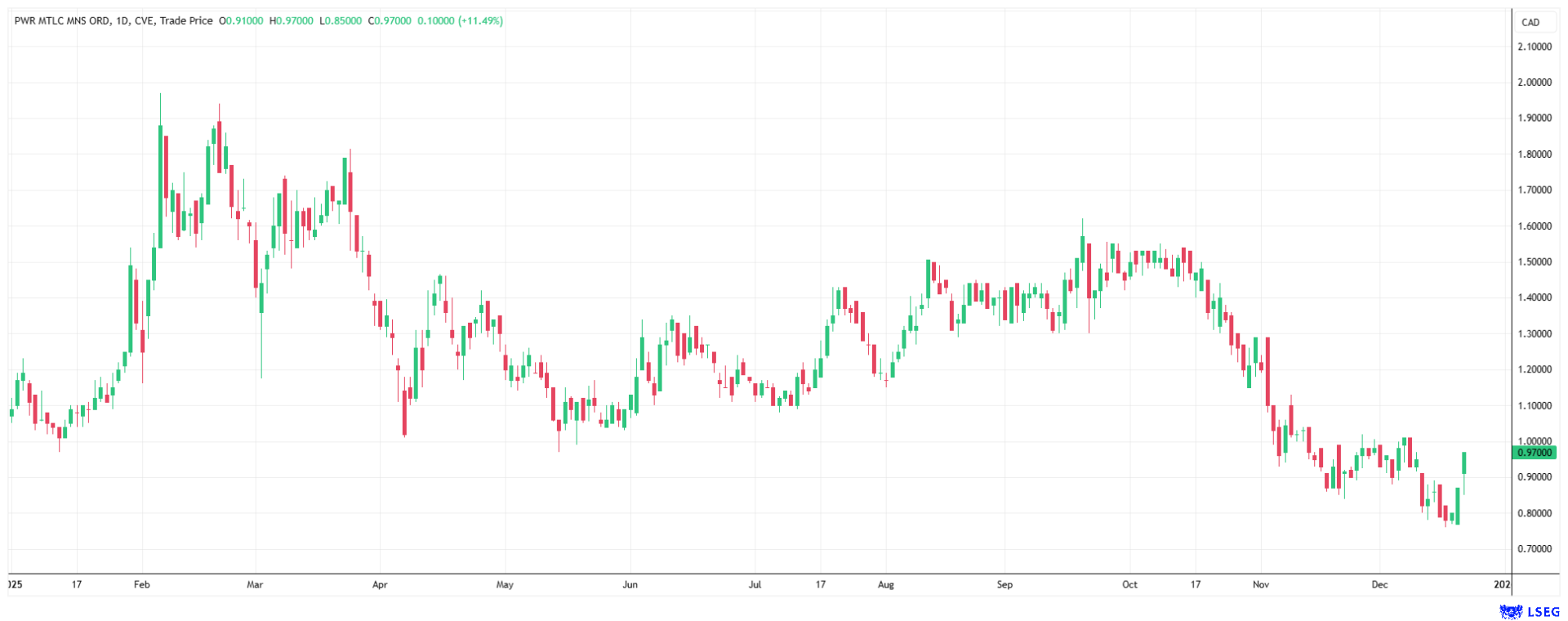
As the stock regains momentum following a mixed 2025, it warrants closer attention from investors. In February, several prominent mining entrepreneurs, including Rob McEwen, Robert Friedland, and Australia's mining icon, Gina Rinehart, invested in the Company. Their involvement underscores growing confidence in the NISK project and supports the view that it has attractive long-term potential.
Watch YouTube videoConflict of interest
Pursuant to §85 of the German Securities Trading Act (WpHG), we point out that Apaton Finance GmbH as well as partners, authors or employees of Apaton Finance GmbH (hereinafter referred to as "Relevant Persons") may hold shares or other financial instruments of the aforementioned companies in the future or may bet on rising or falling prices and thus a conflict of interest may arise in the future. The Relevant Persons reserve the right to buy or sell shares or other financial instruments of the Company at any time (hereinafter each a "Transaction"). Transactions may, under certain circumstances, influence the respective price of the shares or other financial instruments of the Company.
In addition, Apaton Finance GmbH is active in the context of the preparation and publication of the reporting in paid contractual relationships.
For this reason, there is a concrete conflict of interest.
The above information on existing conflicts of interest applies to all types and forms of publication used by Apaton Finance GmbH for publications on companies.
Risk notice
Apaton Finance GmbH offers editors, agencies and companies the opportunity to publish commentaries, interviews, summaries, news and the like on news.financial. These contents are exclusively for the information of the readers and do not represent any call to action or recommendations, neither explicitly nor implicitly they are to be understood as an assurance of possible price developments. The contents do not replace individual expert investment advice and do not constitute an offer to sell the discussed share(s) or other financial instruments, nor an invitation to buy or sell such.
The content is expressly not a financial analysis, but a journalistic or advertising text. Readers or users who make investment decisions or carry out transactions on the basis of the information provided here do so entirely at their own risk. No contractual relationship is established between Apaton Finance GmbH and its readers or the users of its offers, as our information only refers to the company and not to the investment decision of the reader or user.
The acquisition of financial instruments involves high risks, which can lead to the total loss of the invested capital. The information published by Apaton Finance GmbH and its authors is based on careful research. Nevertheless, no liability is assumed for financial losses or a content-related guarantee for the topicality, correctness, appropriateness and completeness of the content provided here. Please also note our Terms of use.