March 17th, 2026 | 07:15 CET
Antimony Resources: Geopolitics Is Driving Antimony Prices
Antimony is increasingly becoming a geopolitically important commodity. China dominates production, and export restrictions have already caused prices to rise sharply. At the same time, demand is growing from the defense, technology, and energy sectors. With the Bald Hill project, Antimony Resources is developing a potentially significant source of antimony for North America. New discoveries and high-grade drill results suggest that the project could have significantly greater potential than previously assumed.
time to read: 3 minutes | Author: Stefan Feulner
ISIN: ANTIMONY RESOURCES CORP | CA0369271014 | CSE: ATMY , OTCQB: ATMYF
Table of contents:
Author

Stefan Feulner
The native Franconian has more than 20 years of stock exchange experience and a broadly diversified network.
He is passionate about analyzing a wide variety of business models and investigating new trends.
Tag cloud
Shares cloud
Chinese dominance and rising demand drive prices
Antimony is one of the strategically essential metals of modern industry, yet it remains largely outside the public spotlight. However, both the US and the European Union list this semi-metal among their critical raw materials. The main reason is the extreme concentration of global production.
According to the US Geological Survey, China controls more than 60 to 70% of global antimony production and also dominates large parts of the processing sector. Russia is also a major producer, though its exports are increasingly affected by Western sanctions. For North America and Europe, this means a massive dependence on just a few supplier countries.
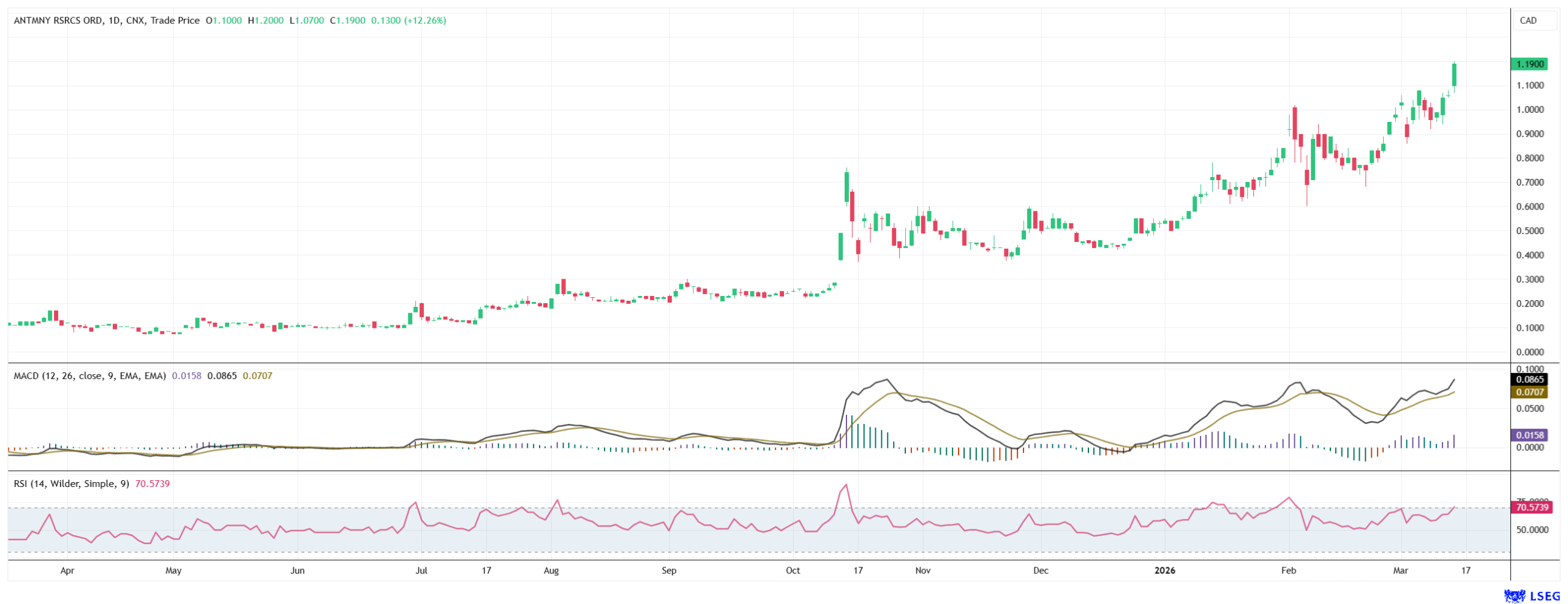
The situation worsened further when China introduced export restrictions on antimony at the end of 2024. In an already tight market, this led to significant price spikes, at times reaching nearly USD 60,000 per metric ton. At the same time, demand is growing in numerous industries.
Industry and Defense Drive Antimony Demand
In the defense sector in particular, antimony is a key component of modern weapon systems. According to studies, military applications account for just under 20% of global demand - a share that is likely to grow further given rising defense spending. For Western industrialized nations, securing independent supply chains is therefore becoming a major strategic challenge.
Parallel to the geopolitical situation, economic demand is also growing. In addition to traditional industry, the main drivers are new applications in the energy, technology, and security markets. In data centers, antimony is needed for flame-retardant cable sheathing, while in the solar industry, sodium antimonate is used as a refining agent in glass production.
At the same time, supply remains limited, as hardly any new projects outside of China have gone into production. There is currently virtually no significant primary production in North America. It is precisely this structural gap that makes new projects in Canada or the US particularly interesting from a strategic perspective.
Bald Hill – Key Source for North America
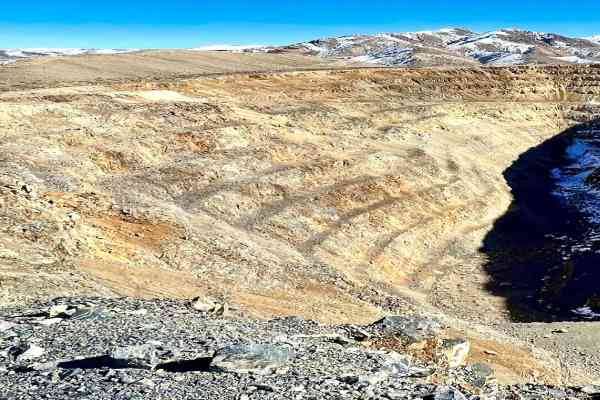
Against this backdrop, Antimony Resources is increasingly coming into the spotlight of the commodities industry. The Canadian explorer is focusing on the Bald Hill project in the province of New Brunswick, which is emerging as one of the most promising antimony deposits in North America. The company holds an option to acquire a 100% interest in the project and has recently expanded the property through additional claims.
The goal is to establish a significant North American source of antimony. Exploration work to date has yielded remarkable results. A technical report in accordance with NI 43-101 currently estimates the exploration potential at approximately 2.7 million tonnes of mineralized rock with high-grade contents of about 3 to 4%. Drilling completed last year returned several strong intercepts, including 9.6 m at 2.38% antimony and 2.3 m at 6.79% antimony.
The main zone has already been traced over a strike length of approximately 700 m and to depths of at least 400 m. A 10,000-meter drilling program is currently underway, intended to lay the groundwork for an initial official resource estimate. Approximately 4,000 m have already been completed.
New Zone Discovered
New discoveries underscore the project's additional potential. While working on an access road, the exploration team discovered a previously unknown mineralization zone. The so-called Marcus Zone, west of the main area, hosts massive stibnite mineralization extending over at least 10 m.
In the southern area as well, a previously known structure has been significantly extended and now reaches a length of approximately 150 m. In the central zone, historical excavations are also yielding promising results. There, 2.9% antimony was identified over 8.18 m, including a high-grade 8.47% over 1.53 m.
According to CEO Atkinson, these results indicate a significantly larger mineralized system. According to the company, antimony-bearing stibnite bodies have now been identified in four different areas of the property, both as massive and brecciated structures. This suggests that the resource potential of the project could extend far beyond the main zone defined to date.
The antimony market is facing a structural realignment. Export restrictions from China, rising demand from defense, energy, and technology markets, as well as the political will of Western nations to establish their own supply chains, are increasingly bringing this raw material into focus. With the Bald Hill project, Antimony Resources has a deposit with high grades and growing exploration potential. Following a CAD 7 million capital raise, the company is fully funded for its current exploration program. If ongoing drilling confirms previous estimates, the company could play a strategic role in establishing an independent antimony supply in North America.
Conflict of interest
Pursuant to §85 of the German Securities Trading Act (WpHG), we point out that Apaton Finance GmbH as well as partners, authors or employees of Apaton Finance GmbH (hereinafter referred to as "Relevant Persons") may hold shares or other financial instruments of the aforementioned companies in the future or may bet on rising or falling prices and thus a conflict of interest may arise in the future. The Relevant Persons reserve the right to buy or sell shares or other financial instruments of the Company at any time (hereinafter each a "Transaction"). Transactions may, under certain circumstances, influence the respective price of the shares or other financial instruments of the Company.
In addition, Apaton Finance GmbH is active in the context of the preparation and publication of the reporting in paid contractual relationships.
For this reason, there is a concrete conflict of interest.
The above information on existing conflicts of interest applies to all types and forms of publication used by Apaton Finance GmbH for publications on companies.
Risk notice
Apaton Finance GmbH offers editors, agencies and companies the opportunity to publish commentaries, interviews, summaries, news and the like on news.financial. These contents are exclusively for the information of the readers and do not represent any call to action or recommendations, neither explicitly nor implicitly they are to be understood as an assurance of possible price developments. The contents do not replace individual expert investment advice and do not constitute an offer to sell the discussed share(s) or other financial instruments, nor an invitation to buy or sell such.
The content is expressly not a financial analysis, but a journalistic or advertising text. Readers or users who make investment decisions or carry out transactions on the basis of the information provided here do so entirely at their own risk. No contractual relationship is established between Apaton Finance GmbH and its readers or the users of its offers, as our information only refers to the company and not to the investment decision of the reader or user.
The acquisition of financial instruments involves high risks, which can lead to the total loss of the invested capital. The information published by Apaton Finance GmbH and its authors is based on careful research. Nevertheless, no liability is assumed for financial losses or a content-related guarantee for the topicality, correctness, appropriateness and completeness of the content provided here. Please also note our Terms of use.