February 23rd, 2026 | 07:20 CET
New valuation level ahead? How Volatus Aerospace is rising to become a system supplier in the shadow of DroneShield and AgEagle Aerial Systems
The threat to critical infrastructure and national borders is completely reshaping the budgets of Western governments: today's wars are no longer fought with tanks, but with unmanned aerial systems and intelligent surveillance technology. Canada has responded to this reality with a new defense industry strategy that aims to end its dependence on foreign military equipment. The Ottawa government's stated goal is to award 70% of future procurement contracts to domestic companies, thereby creating demand for local producers. In this environment, Volatus Aerospace is transforming itself from a service provider to a systemically important technology producer for national security.
time to read: 4 minutes | Author: Nico Popp
ISIN: VOLATUS AEROSPACE INC | CA92865M1023 , DRONESHIELD LTD | AU000000DRO2 , AGEAGLE AERIAL SYS DL-001 | US00848K1016
Table of contents:
Author

Nico Popp
At home in Southern Germany, the passionate stock exchange expert has been accompanying the capital markets for about twenty years. With a soft spot for smaller companies, he is constantly on the lookout for exciting investment stories.
Tag cloud
Shares cloud
DroneShield: Top figures and full order books
Australian market leader DroneShield demonstrates how the valuation lever in defense technology works when companies achieve scale. The company recorded revenue of AUD 216.5 million in the past fiscal year, an increase of 277% over the previous year. These figures demonstrate the high willingness of governments to pay once a technology has proven its operational capability to defend against drones. DroneShield operates with a gross margin of around 65% and is driving its software revenues forward, with revenue in this segment climbing 312% to AUD 11.6 million. The company has cash reserves of AUD 201.1 million and a robust order pipeline of AUD 2.09 billion. While DroneShield occupies the defense market, Volatus Aerospace is securing the foundation for active aerial reconnaissance and the development of sovereign flight systems in North America.
Volatus: In-house manufacturing and regional resilience
Volatus Aerospace is currently undergoing a strategic transformation by building its own manufacturing capabilities to become independent of volatile global supply chains. A key component of this strategy was the acquisition of MALE (Medium Altitude Long Endurance) drone technology from the British company Caliburn Holdings for CAD 2 million. This transaction and the relocation of the engineering team to Canada mean that the country now has the capability to produce its own large military long-range drones for the first time. The acquired portfolio includes scalable platforms with a take-off weight of between 100 and 265 kilograms, including the VANTAGE-V200 for observation missions and the VIGIL-V300, which has a range of up to seven days of continuous flight. With cash reserves of approximately CAD 40 million, management has the financial basis to ramp up these industrial capacities at the Mirabel facility and scale up production of the systems.
Its presence in the key regions of Québec, Ontario, and Alberta guarantees operational resilience and positions Volatus as a reliable partner for global defense companies. In Mirabel, Québec, the company is expanding its manufacturing center at YMX International Aerocity, where investments of over CAD 10 million are planned to scale up drone series production. Ontario is home to the company's headquarters and central operations control center and serves as the location for the Volatus Academy training program, which certifies hundreds of pilots annually. From Alberta, the company manages its activities for the energy and raw materials sector through subsidiaries such as Synergy Aviation, ensuring direct integration into Canada's economic center. International defense companies bidding for government contracts must meet local value-added requirements and find in this infrastructure the docking station within the Canadian procurement program.
Scalable revenues beat pure technology concepts
In direct contrast to Volatus are technology startups such as AgEagle Aerial Systems, which are struggling with economic implementation despite having viable concepts. AgEagle reported a decline in revenue to USD 1.97 million for the third quarter of 2025, down 40% from the same period last year. A positive net result in the first nine months of the year for the US company was primarily due to non-cash accounting gains, which mask the operational reality of an operating loss of USD 3.15 million. Volatus, on the other hand, has scalable, revenue-generating operations, as evidenced by its revenue of CAD 10.6 million in the third quarter of 2025 – an increase of 60%. The share of equipment sales in total revenue rose from 16% to 53% within a year, while adjusted operating loss (EBITDA) improved by 52% to CAD 0.66 million. This operational traction provides a solid foundation for implementing new plans and advancing into new operational spheres.
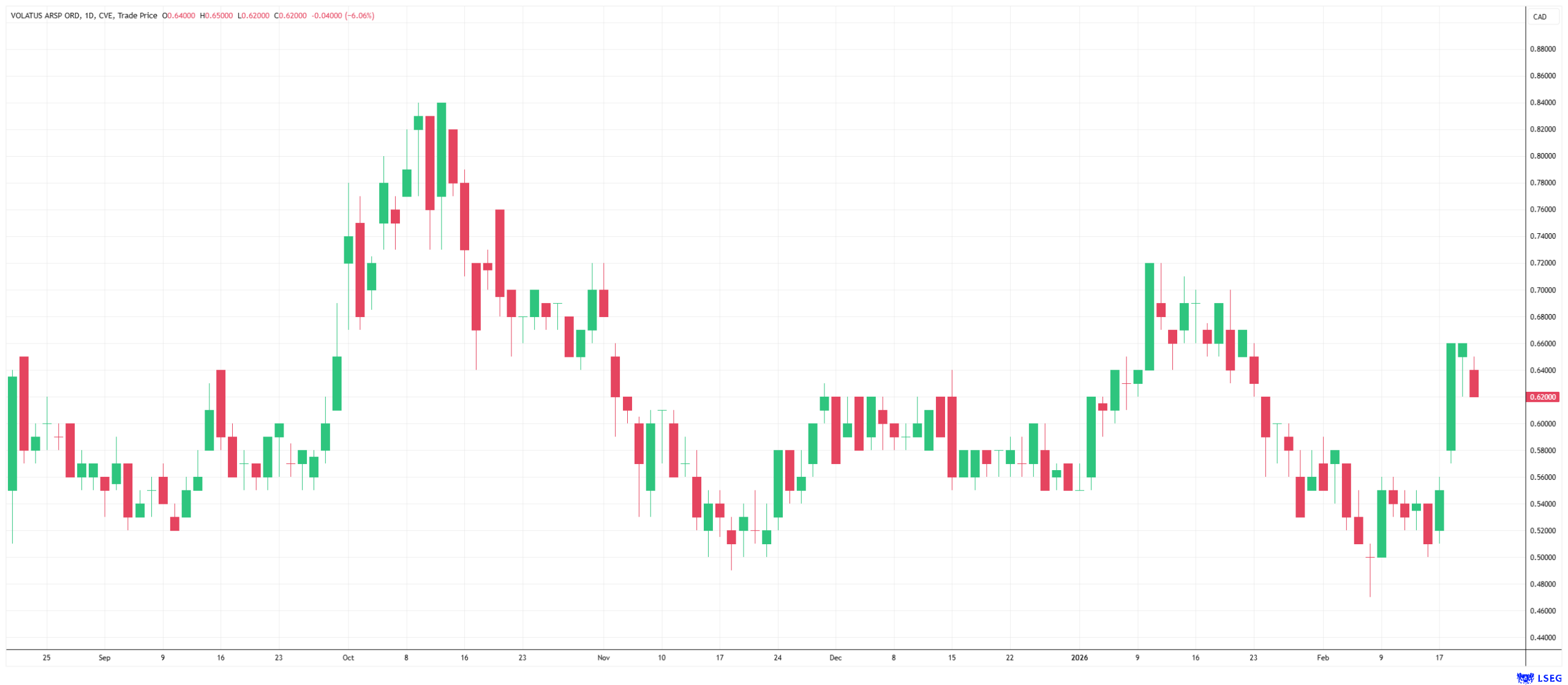
An important pillar of this operational strength is the ability to provide an immediate response to infrastructure monitoring needs in the north of the country. With over 75,000 flight hours completed and a modern control center, the company monitors energy corridors, pipelines, and supply routes over distances of up to 3,300 km. These monitoring capabilities are of fundamental importance to North American energy suppliers, as inspecting networks in the extreme climates of the Arctic with manned aircraft poses a significant financial risk. By integrating autonomous systems, Volatus offers monitoring that combines air and ground sensors. Volatus is thus solving an industry problem, having conducted over 1.7 million km of pipeline inspections in the past, while also refining the technology for military reconnaissance missions.
Reindustrialization of aviation as a return lever
The combination of existing business, high cash reserves, and entry into defense production creates a calculable starting point for investors. The Canadian government will invest billions in securing Arctic sovereignty in the coming years and push ahead with the development of a national drone fleet. To overcome logistical challenges in regions without developed infrastructure, Volatus is collaborating with partners to develop runway-independent cargo drones. For investors, Volatus Aerospace represents an opportunity to participate directly in the structural reindustrialization cycle of Western aviation before the full capacity of the new manufacturing facility is priced into the market. The gap between its valuation as a service provider and its potential as a system supplier for the military offers attractive opportunities. Anyone looking to bet on the return of supply chains and the development of a national security architecture will find Volatus a promising stock.
Watch YouTube videoConflict of interest
Pursuant to §85 of the German Securities Trading Act (WpHG), we point out that Apaton Finance GmbH as well as partners, authors or employees of Apaton Finance GmbH (hereinafter referred to as "Relevant Persons") currently hold or hold shares or other financial instruments of the aforementioned companies and speculate on their price developments. In this respect, they intend to sell or acquire shares or other financial instruments of the companies (hereinafter each referred to as a "Transaction"). Transactions may thereby influence the respective price of the shares or other financial instruments of the Company.
In this respect, there is a concrete conflict of interest in the reporting on the companies.
In addition, Apaton Finance GmbH is active in the context of the preparation and publication of the reporting in paid contractual relationships.
For this reason, there is also a concrete conflict of interest.
The above information on existing conflicts of interest applies to all types and forms of publication used by Apaton Finance GmbH for publications on companies.
Risk notice
Apaton Finance GmbH offers editors, agencies and companies the opportunity to publish commentaries, interviews, summaries, news and the like on news.financial. These contents are exclusively for the information of the readers and do not represent any call to action or recommendations, neither explicitly nor implicitly they are to be understood as an assurance of possible price developments. The contents do not replace individual expert investment advice and do not constitute an offer to sell the discussed share(s) or other financial instruments, nor an invitation to buy or sell such.
The content is expressly not a financial analysis, but a journalistic or advertising text. Readers or users who make investment decisions or carry out transactions on the basis of the information provided here do so entirely at their own risk. No contractual relationship is established between Apaton Finance GmbH and its readers or the users of its offers, as our information only refers to the company and not to the investment decision of the reader or user.
The acquisition of financial instruments involves high risks, which can lead to the total loss of the invested capital. The information published by Apaton Finance GmbH and its authors is based on careful research. Nevertheless, no liability is assumed for financial losses or a content-related guarantee for the topicality, correctness, appropriateness and completeness of the content provided here. Please also note our Terms of use.