June 12th, 2026 | 06:45 CEST
Nel ASA Buys Its Way Out, Vestas Wind Keeps Winning Orders, and RE Royalties Nears a Technical Breakout!
The renewable energy market currently resembles a stormy ocean. Of course, this is partly due to global conflicts that are affecting oil prices. Since the closure of the Strait of Hormuz, oil prices have been on a rollercoaster ride. As a result, renewable energy has returned to the spotlight, and hydrogen stocks, for example, have experienced something of a second wind. However, while disappointment is once again setting in for some major players, activity continues to build beneath the surface among smaller companies. This mixed picture is reflected in the recent developments of the three stocks we are following. We take a look at a Danish wind turbine manufacturer that is practically being showered with new orders, yet continues to be punished by the stock market. We also examine a Norwegian hydrogen pioneer struggling with costly legacy issues and a shrinking project pipeline. Away from the headlines, a Canadian financier of green energy projects presents a particularly interesting case. Here, fundamental shifts and an intriguing chart setup suggest that a breakout could be imminent. Read on to find out what is currently driving these stocks and where investors may find performance opportunities for their portfolios.
time to read: 5 minutes | Author: Matthias Schomber
ISIN: RE ROYALTIES LTD | CA75527Q1081 | TSXV: RE , OTCQX: RROYF , NEL ASA NK-_20 | NO0010081235 , VESTAS WIND SYST. NAM.DK1 | DK0010268606
Table of contents:
Author

Matthias Schomber
Raised in Giessen, Hesse, Matthias Schomber discovered his passion for the financial markets as early as the 1990s—at a time when stock trading was still largely the domain of true, die-hard traders. After completing his banking apprenticeship, he worked for a private bank there and witnessed the rise and fall of the Neuer Markt firsthand on the trading floor of the Frankfurt Stock Exchange, drawing lessons from the experience that continue to shape his thinking as a trader, author, and trading system developer to this day.
Tag cloud
Shares cloud
Vestas Wind: Between a Flood of Orders and Weak Share Price
Danish wind turbine manufacturer Vestas is currently racking up new projects at a rapid pace. The company recently reported new orders from France totalling 112 megawatts, with delivery scheduled primarily for 2027. These French projects are secured by long-term service contracts spanning 20 to 25 years, providing the group with predictable revenue in the medium to long term. Orders totalling 183 megawatts were also added from Germany and the UK. In parallel with this operational momentum, the group is consistently continuing its share buyback program. Between late May and early June 2026, Vestas repurchased over 700,000 of its own shares at an average price of just under DKK 178.40. The program envisages a total volume of up to DKK 747 million by August 2026 at the latest.
Despite this generally positive news, the stock is performing extremely poorly in the market and recently fell to around EUR 22. The magic of strong numbers seems to have faded, as the stock failed to break through the key resistance zone of EUR 26–27. A double top that formed there now looks rather unpromising from a technical perspective and is limiting the upward movement. The loss of key support at EUR 23.5 has further clouded the chart picture. The EUR 22 mark is currently being tested. Analysts, meanwhile, are divided. While Kepler Cheuvreux has raised its rating to "Buy" and set a price target of DKK 200 (approximately EUR 26.75), Barclays remains extremely pessimistic with a target of DKK 80 (~EUR 10.70). RBC lowered its price target to DKK 210 but maintained its "Outperform" rating.
Much like the Danish wind giant, a prominent player in the hydrogen sector must currently prove that it can weather the fierce headwinds, which is why we are now turning our attention to Norway.
Nel ASA Pays a High Price for Legal Peace
For the Norwegian hydrogen specialist Nel ASA, there is a gaping gap between its ambitions and market reality. At least the company was able to settle a protracted legal dispute with the US-based Iwatani Corporation of America through an official settlement. However, the price for this agreement—intended to resolve differences regarding the delivered refuelling station equipment—is quite high. The parent company is paying USD 7.5 million, while the former subsidiary Cavendish Hydrogen is contributing an additional USD 3 million. This cash outflow ties up capital that would normally be needed, but it also removes one source of uncertainty. This frees management from unpredictable and sometimes extremely costly legal proceedings in the US.
The stock is nevertheless under pressure and has lost over 30% of its value in recent weeks. Trading volume has declined, further accelerating price declines and sometimes amplifying them disproportionately.
Operationally, too, there is a lack of fresh momentum, as the order backlog shrank by a substantial 24% year-over-year in the first quarter of 2026. In addition, the closure of hydrogen refuelling stations by a Swiss energy provider by the end of 2026 is dampening sentiment in the passenger vehicle sector. Large-scale offshore projects and a new pressurized alkali electrolyzer platform, which is expected to significantly reduce investment costs for customers, remain sources of hope. From a technical analysis perspective, the outlook is somewhat bleak, as the stock has fallen below key support levels and also below key SMAs.
When big names like Vestas or Nel are struggling with operational hurdles and high cost structures, it is often worth taking a look at smaller, initially unassuming companies. There is, for example, one in the background that is providing the urgently needed capital for the green transition for other projects.
RE Royalties: The Financing Pioneer
As a pioneer in renewable energy financing, the Canadian company RE Royalties is taking a different approach. As it enters its eleventh year of operation, management recently initiated a formal strategic review. This could be good for shareholders. The board, together with financial advisor PwC CF, is evaluating a wide range of options—from strategic partnerships and capital structure optimizations to a potential sale of the company—to maximize long-term value for shareholders. The foundation for such steps is extremely solid. The company is currently reviewing potential investments worth CAD 200 million and has already received non-binding letters of intent totalling approximately CAD 20 million.
The business model is lucrative yet structured to be risk-averse. RE Royalties extends short-term, secured loans at interest rates of 12-13% while securing long-term royalties that generate an average internal rate of return of 18%. With more than USD 83 million invested in over 135 projects and 27 successfully completed transactions, the portfolio is broadly diversified across sectors such as solar, wind, and battery storage.
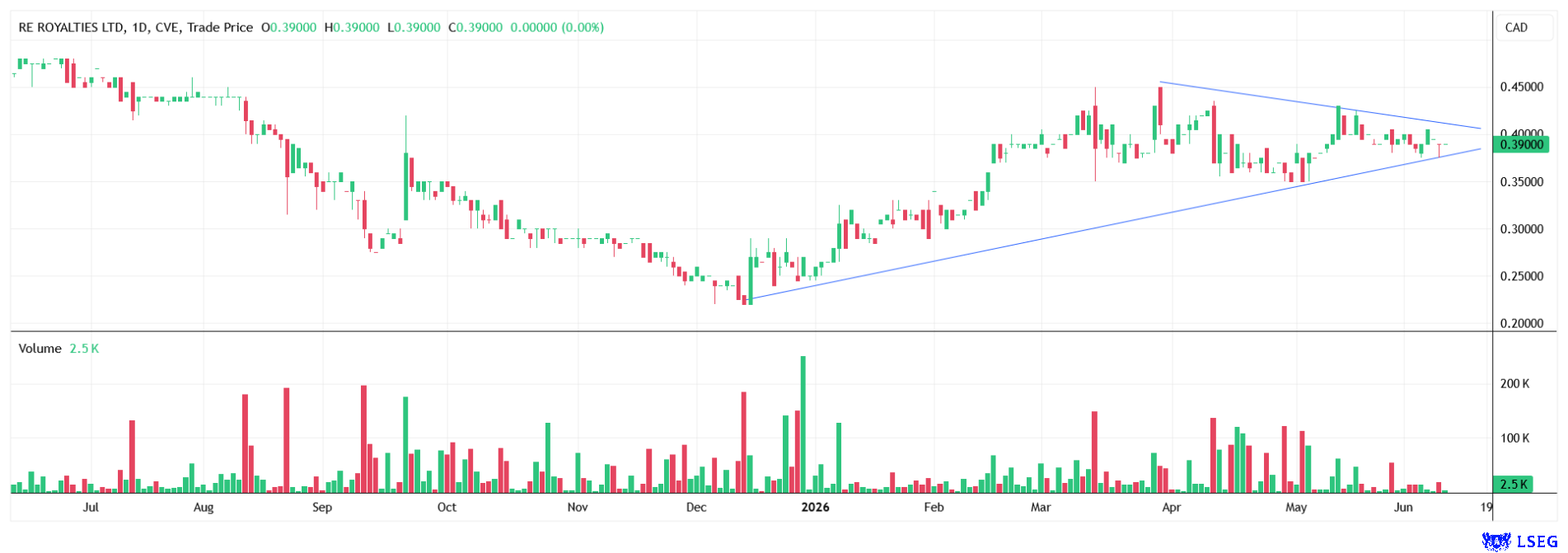
Also noteworthy is the annualized revenue growth of a whopping 63% between 2019 and 2023. With a current market capitalization of just around CAD 17 million and a share price of around CAD 0.39, the stock is an exciting candidate for investors.
Chart patterns, in particular, are currently sparking a lot of excitement. RE Royalties' stock has formed a distinctive pennant pattern, which it could break out of right now at the CAD 0.41-0.42 level. On the downside, there is stable horizontal support in the range of CAD 0.35-0.40, which keeps risk manageable. If the stock now actually rises sustainably above the CAD 0.42 mark, it should pick up considerable momentum again. According to technical analysis, an initial and logical price target would be in the region of CAD 0.50. Should this hurdle also be cleared with sufficient volume, the path to the CAD 0.60 mark will quickly open up. The technical signals, coupled with the fundamental tailwind, make the stock something of an insider tip.
In summary, the renewable energy market currently presents an extremely mixed picture. While Vestas Wind can point to full order books, it urgently needs to regain solid footing both technically and in investor perception. Nel ASA has bought itself legal peace in the US market for a few million, but now faces the challenge of operationally halting the decline in its order book. RE Royalties is positioning itself smartly within a rapidly growing niche of project financing. Supported by its ongoing strategic review and a broadly diversified portfolio, the company appears to be well positioned. The fundamental foundation looks solid. If the anticipated technical breakout materializes, the prospects for a positive share price development appear favourable.
Conflict of interest
Pursuant to §85 of the German Securities Trading Act (WpHG), we point out that Apaton Finance GmbH as well as partners, authors or employees of Apaton Finance GmbH (hereinafter referred to as "Relevant Persons") may hold shares or other financial instruments of the aforementioned companies in the future or may bet on rising or falling prices and thus a conflict of interest may arise in the future. The Relevant Persons reserve the right to buy or sell shares or other financial instruments of the Company at any time (hereinafter each a "Transaction"). Transactions may, under certain circumstances, influence the respective price of the shares or other financial instruments of the Company.
In addition, Apaton Finance GmbH is active in the context of the preparation and publication of the reporting in paid contractual relationships.
For this reason, there is a concrete conflict of interest.
The above information on existing conflicts of interest applies to all types and forms of publication used by Apaton Finance GmbH for publications on companies.
Risk notice
Apaton Finance GmbH offers editors, agencies and companies the opportunity to publish commentaries, interviews, summaries, news and the like on news.financial. These contents are exclusively for the information of the readers and do not represent any call to action or recommendations, neither explicitly nor implicitly they are to be understood as an assurance of possible price developments. The contents do not replace individual expert investment advice and do not constitute an offer to sell the discussed share(s) or other financial instruments, nor an invitation to buy or sell such.
The content is expressly not a financial analysis, but a journalistic or advertising text. Readers or users who make investment decisions or carry out transactions on the basis of the information provided here do so entirely at their own risk. No contractual relationship is established between Apaton Finance GmbH and its readers or the users of its offers, as our information only refers to the company and not to the investment decision of the reader or user.
The acquisition of financial instruments involves high risks, which can lead to the total loss of the invested capital. The information published by Apaton Finance GmbH and its authors is based on careful research. Nevertheless, no liability is assumed for financial losses or a content-related guarantee for the topicality, correctness, appropriateness and completeness of the content provided here. Please also note our Terms of use.