March 25th, 2026 | 07:20 CET
Multi-Billion-Dollar Defense Deal in Canada: Volatus Aerospace Secures Major Contract - Early Investors Take Note
The Canadian government is fundamentally changing its defense procurement strategy. In the future, 70% of defense spending is to remain within the country - a multi-billion-dollar opportunity for domestic technology providers. One company that seems tailor-made for this is Volatus Aerospace. But while many see the defense boom as merely a source of short-term profits, the Ontario-based drone specialist is pursuing a different strategy. It is not about individual weapon systems, but rather an integrated platform that has already been tested in everyday civilian use.
time to read: 4 minutes | Author: Armin Schulz
ISIN: VOLATUS AEROSPACE INC | CA92865M1023 | TSXV: FLT , OTCQB: TAKOF
Table of contents:
Author

Armin Schulz
Born in Mönchengladbach, he studied business administration in the Netherlands. In the course of his studies he came into contact with the stock exchange for the first time. He has more than 25 years of experience in stock market business.
Tag cloud
Shares cloud
Setting a Strategic Course: From Service Provider to Platform
Anyone who has followed the Canadian aviation industry in recent years is familiar with the usual pattern: sluggish procurement cycles, a large portion of contracts flowing to the US, and promising technology startups failing to commercialize their products. Over the past few years, Volatus Aerospace has built a structure that now seems tailor-made for the new geopolitical reality.
The key difference from many competitors lies in the business model. Volatus is not merely a drone manufacturer hoping for a specific defense contract. Instead, management has created an integrated platform encompassing manufacturing, operations, software, and training. "Our focus is on operational implementation and economic viability…", COO Greg Colacitti recently explained in connection with a new offshore wind power deal. It is this DNA from the tough, regulated industrial sector that makes the company so attractive to government clients.
The recent listing on the Toronto Stock Exchange (TSX) is more than just a formality. CEO Glen Lynch commented on this move: "The move to the TSX is a pivotal milestone in our company's history. This step reflects our growth and provides us with a high-profile platform to reach a broader audience of institutional and international investors." The listing on Canada's premier stock exchange opens the door for institutional investors, who have identified a notable gap compared to US competitors in previous analyst reports.
Operational Depth: The Edge of Experience
While other companies are still studying Ottawa's new "Defence Industrial Strategy," Volatus can already point to years of operational experience. The company monitors pipelines, provides logistics for energy companies, and recently signed a two-year contract with a major offshore wind operator, under which heavy-lift drones are controlled centrally from the Operations Control Center in Vaughan, Ontario. It is precisely this ability to remotely manage missions over long distances that the Canadian government is seeking for Arctic surveillance.
Volatus underpins this claim with a clear industrial strategy. At its core is the new production facility in Mirabel, Quebec, located within one of North America's most significant aerospace clusters.
This new factory will provide the manufacturing capacity for the next generation of MALE drones, built to NATO standards, of course. By acquiring British RPAS technologies, the company is not only securing valuable intellectual property, it is fulfilling a key requirement of the new government strategy: "Build in Canada." Support comes, among other sources, from the "National Research Council of Canada Industrial Research Assistance Program" (NRC-IRAP), which is funding the development of the heavy transport drone "Condor XL."
This strategic direction was most recently rounded out by the complete acquisition of Synergy Aviation. Glen Lynch emphasized: "By taking this step, we can operate even more seamlessly within our aerospace platform. The full consolidation of our aircraft operations under the Volatus umbrella strengthens the integration of our manned and unmanned capabilities. It enables us to act even more consistently as we continue to grow in North America and internationally." This consolidation significantly simplifies operational management between manned and unmanned systems.
At the same time, the company is driving forward the commercialization of new technologies. In March, SKYDRA™, the company's first proprietary SaaS platform for defense and mission planning in the unmanned systems sector, was launched. Lynch commented: "The global threat landscape related to unmanned systems is constantly evolving. SKYDRA™ represents an important milestone for Volatus as our first SaaS platform and creates a recurring revenue stream from software sales as part of our defense strategy." With margins exceeding 80%, it marks the shift toward high-margin, recurring revenue.
The Valuation Gap: Opportunity or Risk?
The operational improvement is also reflected in the financial metrics. Analysts at Stifel and Haywood see the company on the path to profitability, driven by a growing pipeline of over CAD 600 million and annual recurring revenue of around CAD 20 million from service contracts. At the same time, Volatus remains more attractively valued by analyst standards than many comparable drone and defense companies in the US.
The strategic moves of recent weeks underscore this momentum. The signing of a NATO training contract for extreme environments demonstrates the company's international reach. On March 24, the company announced the appointment of Major General (Ret.) Gary Deakin, CBE, to its advisory board. He brings several decades of leadership experience in the British Army and NATO and can leverage his network. In addition, Krish Srinivasan was appointed as the new CTO, an experienced expert in autonomous systems. He brings technological leadership to the company.
Added to this is a comfortable cash reserve of approximately CAD 40 million, which can be used for further acquisitions or to expand production capacity. The capital structure is also of interest to risk-aware investors. Over 20% of the shares are held by insiders, demonstrating that management and the broader community believe in the company. Management has also established extensive stock option programs to foster a performance-oriented culture and align employees' interests with those of shareholders.
Analysts See Upside Potential
Five research firms have recently covered Volatus and see upside potential. The price targets range from CAD 0.85 to CAD 1.25. While Stifel remains the most cautious at CAD 0.85, Desjardins expects CAD 1.10 to 1.25, and Haywood and the Maxim Group set the target at CAD 1.00 and CAD 1.25, respectively. Ventum Capital Markets estimates the fair value at CAD 0.95.
The stock is currently trading at CAD 0.835.
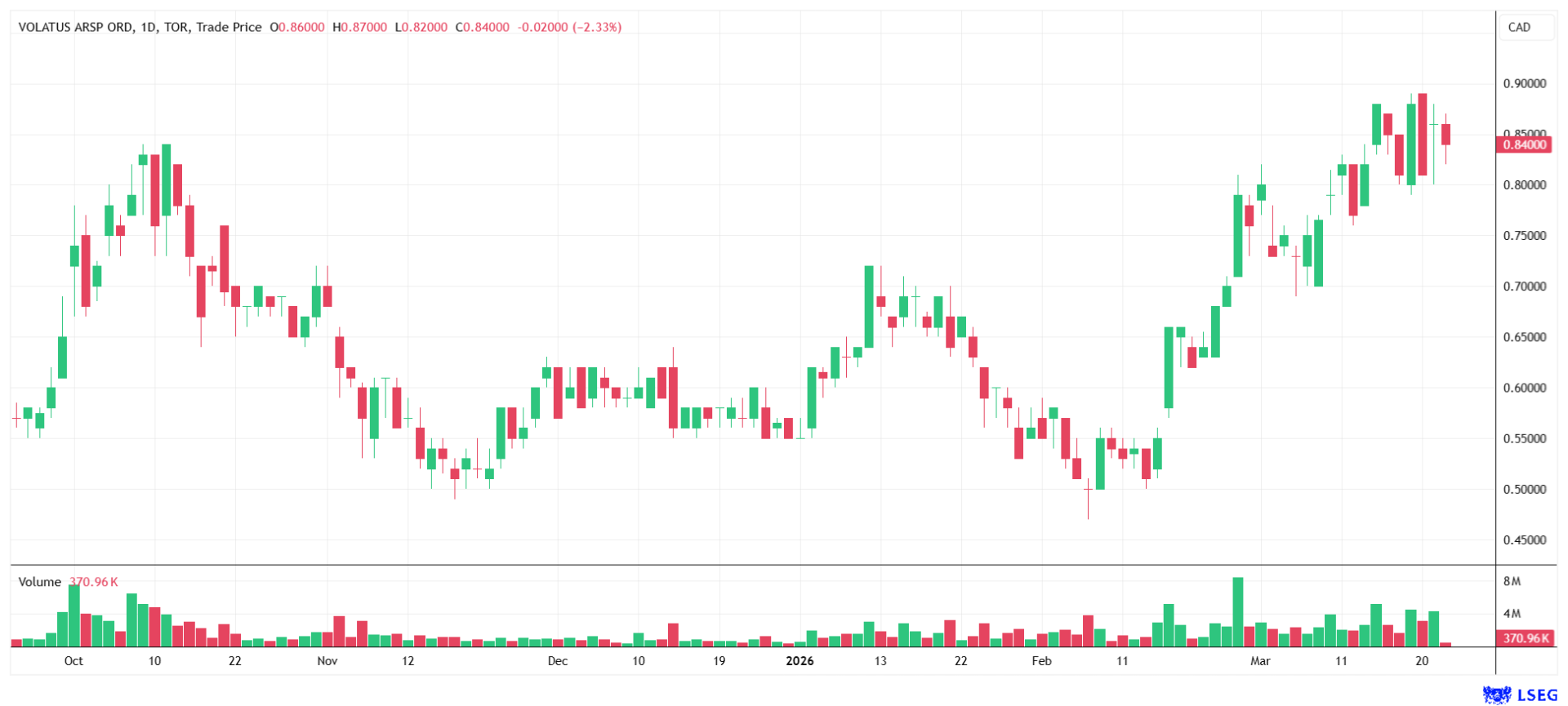
Volatus Aerospace is not a traditional defense contractor. It is a technology-driven service provider benefiting from a political paradigm shift. The combination of operational depth, in-house manufacturing, and a growing software division creates a position from which the company can participate in major procurement programs in Canada and among NATO partners. For investors, this presents an opportunity to bet on a future champion before the market recognizes its full potential.
Conflict of interest
Pursuant to §85 of the German Securities Trading Act (WpHG), we point out that Apaton Finance GmbH as well as partners, authors or employees of Apaton Finance GmbH (hereinafter referred to as "Relevant Persons") currently hold or hold shares or other financial instruments of the aforementioned companies and speculate on their price developments. In this respect, they intend to sell or acquire shares or other financial instruments of the companies (hereinafter each referred to as a "Transaction"). Transactions may thereby influence the respective price of the shares or other financial instruments of the Company.
In this respect, there is a concrete conflict of interest in the reporting on the companies.
In addition, Apaton Finance GmbH is active in the context of the preparation and publication of the reporting in paid contractual relationships.
For this reason, there is also a concrete conflict of interest.
The above information on existing conflicts of interest applies to all types and forms of publication used by Apaton Finance GmbH for publications on companies.
Risk notice
Apaton Finance GmbH offers editors, agencies and companies the opportunity to publish commentaries, interviews, summaries, news and the like on news.financial. These contents are exclusively for the information of the readers and do not represent any call to action or recommendations, neither explicitly nor implicitly they are to be understood as an assurance of possible price developments. The contents do not replace individual expert investment advice and do not constitute an offer to sell the discussed share(s) or other financial instruments, nor an invitation to buy or sell such.
The content is expressly not a financial analysis, but a journalistic or advertising text. Readers or users who make investment decisions or carry out transactions on the basis of the information provided here do so entirely at their own risk. No contractual relationship is established between Apaton Finance GmbH and its readers or the users of its offers, as our information only refers to the company and not to the investment decision of the reader or user.
The acquisition of financial instruments involves high risks, which can lead to the total loss of the invested capital. The information published by Apaton Finance GmbH and its authors is based on careful research. Nevertheless, no liability is assumed for financial losses or a content-related guarantee for the topicality, correctness, appropriateness and completeness of the content provided here. Please also note our Terms of use.