Dwindling mineral reserves in low-risk regions, stagnating discovery rates, and increasingly complex permitting processes—the situation in the gold mining sector is forcing leading producers to act. Since developing new large-scale greenfield projects is associated with sharply rising costs, industry giants are increasingly shifting their focus to acquiring projects already at an advanced stage. According to surveys by the industry portal MiningBeacon, the gold sector accounted for over 40% of the total mining transaction volume in the first five months of 2026 alone, amounting to deals worth USD 41 billion. West African shear trends and established mining regions are therefore becoming target areas for resource-hungry corporations that need to utilize their processing capacities to full capacity.
time to read: 3 minutes | Author: Nico Popp
ISIN: DESERT GOLD VENTURES | CA25039N4084 | TSXV: DAU , OTCQB: DAUGF , B2GOLD CORP. | CA11777Q2099 , OREZONE GOLD CORP. | CA68616T1093
Table of contents:
Author

Nico Popp
At home in Southern Germany, the passionate stock exchange expert has been accompanying the capital markets for about twenty years. With a soft spot for smaller companies, he is constantly on the lookout for exciting investment stories.
Tag cloud
Shares cloud
B2Gold: Structured Generational Transition and the Satellite Strategy in Africa
While industry giant B2Gold is consolidating its market position through the targeted ramp-up of regional satellite projects such as Fekola Regional in Mali in the second half of 2026, it faces operational cost pressures. For the full year 2026, management forecasts all-in sustaining costs at a level of USD 2,400 to USD 2,580 per ounce, driven by high investments in deferred stripping at Fekola as well as logistical hurdles in Arctic Canada. In 2025, the Group generated GAAP net income of USD 402 million (adjusted: USD 612 million) on revenue of USD 3.06 billion. To ensure that the figures remain positive even during the current cost-intensive phase, the Group recently carried out a planned leadership transition. Following the scheduled retirement of founder Clive Johnson, B2Gold appointed former CFO Mike Cinnamond as the new CEO. On the Toronto Stock Exchange, the company's market capitalization currently stands at approximately CAD 7.5 billion.
Orezone Gold Becomes a Diversified Mid-Tier Producer
Orezone Gold demonstrates the strong consolidation momentum in the sector through its aggressive expansion strategy. Through the successful commissioning of the Phase 1 expansion at the Bomboré project in Burkina Faso and the nearly simultaneous acquisition of the Casa Berardi mine in Canada, the company has transformed itself into a geographically diversified mid-tier producer with a long-term annualized production forecast of more than 250,000 ounces of gold. In the first quarter of 2026, Orezone achieved production of 38,789 ounces of gold at consolidated all-in sustaining costs (AISC) of USD 2,245 per ounce. This development is accompanied by an expansion of the management team. The hiring of Marc-André Pelletier as the new COO and Jean-François Ravenelle as Vice President of Exploration, who will drive exploration along the 37-km-long Casa Berardi mineral corridor, also generated positive sentiment in the markets—the stock has recently risen significantly.
Desert Gold: Production Start in Promising Mining Region
In a market environment shaped by mergers and acquisitions, the agile junior explorer Desert Gold stands out with a first-class strategic position. The SMSZ project in Mali has measured and indicated resources of 336,800 ounces of gold, as well as inferred resources of 879,900 ounces of gold. With the commissioning of its turnkey 200 t/d gravity and carbon-in-leach (CIL) plant at Barani East scheduled for July 19, 2026, the company is making the decisive leap toward becoming a profitable producer and generating its first cash flows.

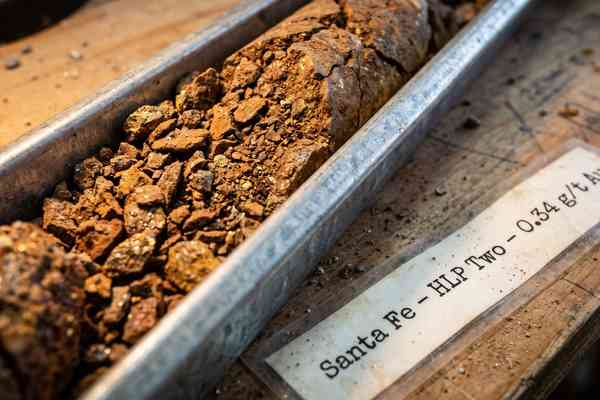
The project is free from administrative development risks thanks to an official small-scale mining permit and targets the highly profitable, near-surface oxide deposits. A metallurgical test hole in the Barani East zone intersected a spectacular 12.41 g/t Au over 45 m (true thickness not specified), demonstrating the quality of the ore body. Initial production reduces financing risks and puts Desert Gold in a promising position.
To ensure sufficient cash on hand, management, led by CEO Jared Scharf, successfully completed an oversubscribed private placement for a gross amount of CAD 7.18 million in February. To save costs ahead of production, the Board also made the unorthodox decision in May to switch to semi-annual financial reporting. Such cost management is likely to be well-received by shareholders—at Desert, a proportionally larger share of funds is now flowing into exploration.
Desert Gold: Valuation Justifies Upside Potential
While premiums for verified ounces in the West African shear zone averaged a low of USD 66 per ounce over the past decade, Desert Gold is currently valued at just around USD 9 per ounce in the markets. The updated feasibility study for the SMSZ main project confirms robust key metrics for the fully permitted oxide gold system, with an after-tax return of exactly 57% at a payback period of just 2.1 years and a calculated gold price of USD 2,850. Since Desert Gold is currently valued at just under CAD 50 million, further opportunities exist. The proximity to companies such as B2Gold and Barrick Mining is another argument in favour of this agile explorer's stock, which is set to begin production soon. Investors should take a closer look at the company and keep an eye on further news. The fact that Desert has explicitly communicated the date of production commencement exudes confidence. Desert is advancing promising projects in Mali in the immediate vicinity of major producers.
Watch YouTube videoConflict of interest
Pursuant to §85 of the German Securities Trading Act (WpHG), we point out that Apaton Finance GmbH as well as partners, authors or employees of Apaton Finance GmbH (hereinafter referred to as "Relevant Persons") currently hold or hold shares or other financial instruments of the aforementioned companies and speculate on their price developments. In this respect, they intend to sell or acquire shares or other financial instruments of the companies (hereinafter each referred to as a "Transaction"). Transactions may thereby influence the respective price of the shares or other financial instruments of the Company.
In this respect, there is a concrete conflict of interest in the reporting on the companies.
In addition, Apaton Finance GmbH is active in the context of the preparation and publication of the reporting in paid contractual relationships.
For this reason, there is also a concrete conflict of interest.
The above information on existing conflicts of interest applies to all types and forms of publication used by Apaton Finance GmbH for publications on companies.
Risk notice
Apaton Finance GmbH offers editors, agencies and companies the opportunity to publish commentaries, interviews, summaries, news and the like on news.financial. These contents are exclusively for the information of the readers and do not represent any call to action or recommendations, neither explicitly nor implicitly they are to be understood as an assurance of possible price developments. The contents do not replace individual expert investment advice and do not constitute an offer to sell the discussed share(s) or other financial instruments, nor an invitation to buy or sell such.
The content is expressly not a financial analysis, but a journalistic or advertising text. Readers or users who make investment decisions or carry out transactions on the basis of the information provided here do so entirely at their own risk. No contractual relationship is established between Apaton Finance GmbH and its readers or the users of its offers, as our information only refers to the company and not to the investment decision of the reader or user.
The acquisition of financial instruments involves high risks, which can lead to the total loss of the invested capital. The information published by Apaton Finance GmbH and its authors is based on careful research. Nevertheless, no liability is assumed for financial losses or a content-related guarantee for the topicality, correctness, appropriateness and completeness of the content provided here. Please also note our Terms of use.