February 2nd, 2026 | 07:25 CET
Energy from waste, as at Verbio: CHAR Technologies as the savior of the steel industry – competition for market leader SunCoke Energy
The steel industry is facing a severe test that is often glossed over in ESG reports. While politicians, the media, and futurologists dream of green hydrogen, this vision collides with harsh reality: steel, the basic material of our modern civilization, cannot be produced in existing plants without solid carbon. It serves not only as an energy source, but also as a chemical reducing agent to extract oxygen from iron ore and as a support structure in the furnace. Against this backdrop, it becomes clear that decarbonization cannot be achieved by completely eliminating carbon, but only by replacing its fossil origin. In this billion-dollar market, the Canadian company CHAR Technologies is positioning itself as a key problem solver. While the established market leader SunCoke Energy still relies on fossil coal and is increasingly under margin pressure, CHAR's biochar is an immediately available, climate-neutral solution. At the same time, Verbio's success in Europe shows that scaling up waste materials to energy works – a logic that CHAR is now applying to the steel sector.
time to read: 3 minutes | Author: Nico Popp
ISIN: VERBIO VER.BIOENERGIE ON | DE000A0JL9W6 , CHAR Technologies Ltd. | CA15957L1040 , SUNCOKE ENERGY INC. DL-01 | US86722A1034
Table of contents:
Author

Nico Popp
At home in Southern Germany, the passionate stock exchange expert has been accompanying the capital markets for about twenty years. With a soft spot for smaller companies, he is constantly on the lookout for exciting investment stories.
Tag cloud
Shares cloud
The SunCoke dilemma and the Verbio proof
To understand CHAR Technologies' role in the market, one must first look at the competition. SunCoke Energy is one of the market leaders: the Company supplies the US steel industry with coke made from coal. However, the latest figures reveal cracks in the business model. In the third quarter of 2025, SunCoke's adjusted EBITDA fell to USD 59.1 million, a decline of over 20% compared to the previous year. Pressure from expiring contracts and the volatility of fossil fuel markets is growing. Although SunCoke is confidently managing the status quo, it offers few answers to the impending CO2 taxes that are weighing on its customers.
On the other side is Verbio. The German bioenergy specialist has proven that it is possible to produce green gas from straw and residues on an industrial scale and earn money from it. Despite political headwinds, Verbio has recently increased its production volumes, thereby fundamentally validating the "waste-to-value economy" model. CHAR Technologies now combines these two worlds: it is attacking SunCoke's market, but using Verbio's technological sophistication and circular logic.
CHAR Technologies: The "green knight" for the blast furnace
CHAR Technologies has developed something that steel bosses are desperately seeking: biochar. This material is obtained from sustainable biomass such as wood waste using a proprietary high-temperature pyrolysis (HTP) process and has metallurgical properties similar to those of fossil coke.
The decisive advantage for the steel industry is its "drop-in capability." Steel companies such as ArcelorMittal do not need to build new billion-dollar plants to use CHAR's biochar; they can simply use it in their existing blast furnaces. This is a tremendous economic lever. Since biogenic carbon is considered climate-neutral in European emissions trading, steel manufacturers can save a ton on CO2 taxes by using CHAR's product, which could rise from the current level of EUR 80 per ton to over EUR 100 per ton by 2030. So CHAR is not just selling fuel, but also compliance and future security.
Validation by market leaders
CHAR Technologies' collaboration with industry proves that the story surrounding CHAR Technologies is not just a theory from the laboratory. CHAR Technologies has been working with ArcelorMittal Dofasco for several years to test the use of biochar on a large scale. This partnership is the ultimate accolade. When one of the world's largest steel producers validates the technology, it sends a clear signal to the entire sector: the solution works.
At the same time, development of the Company's own flagship plant in Thorold, Canada, is progressing – last week, the Company announced the start of commissioning. This plant will not only produce biochar, but also deliver around 500,000 gigajoules of green natural gas (RNG) per year as a by-product once Phase 2 is complete. This demonstrates the model's dual revenue stream. CHAR collects revenue on the one hand for the carbon replacement in the steel mill and on the other for feeding green energy into the grid.
Conclusion: Exciting opportunity for speculative investors
The investment thesis for CHAR Technologies is clear. The Company addresses a market that is not "nice to have" but rather a regulatory and ecological necessity. The steel industry cannot exist without solid carbon, but it is no longer allowed to use fossil fuels. CHAR Technologies fills precisely this gap.
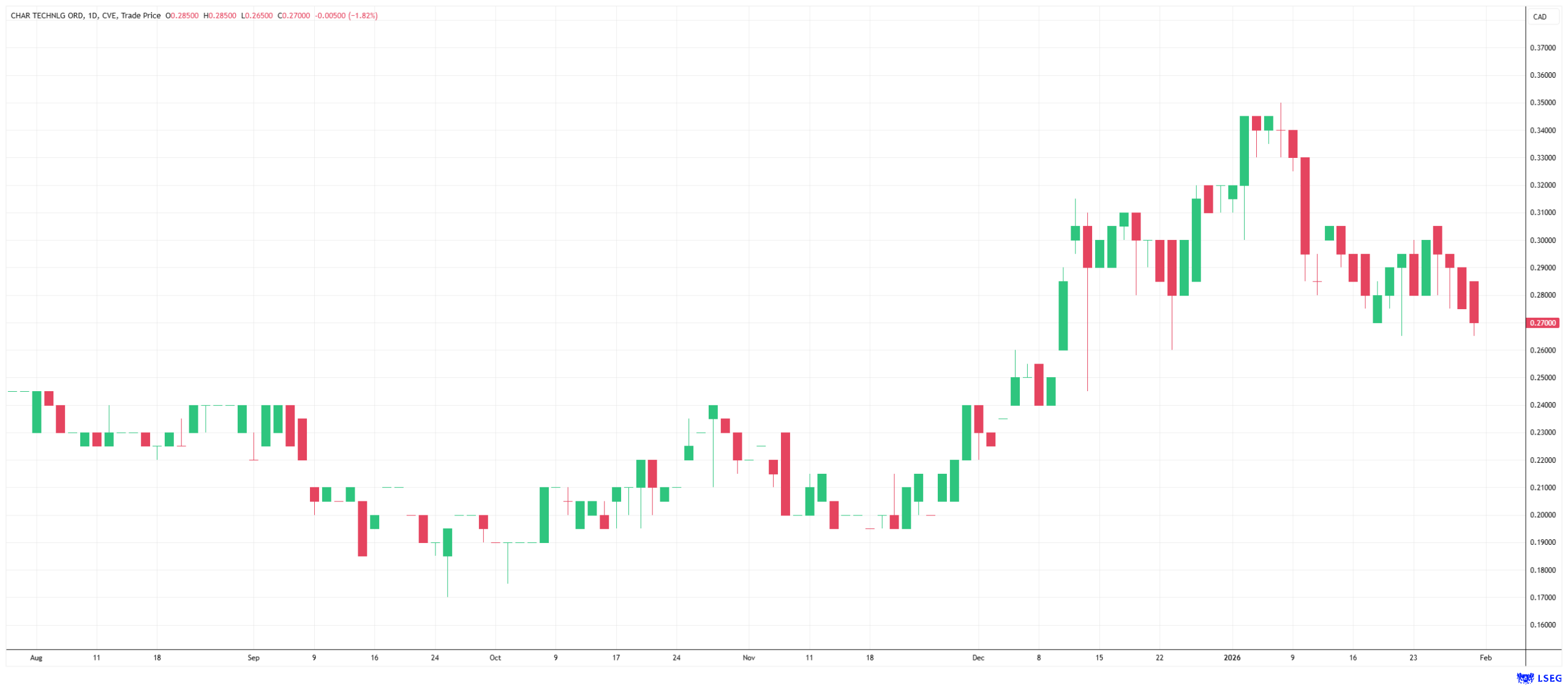
While SunCoke Energy is on the defensive and trying to save its cash flows, and Verbio remains primarily focused on the transportation sector, CHAR is one of the few pure plays for the decarbonization of heavy industry using solid biomass. With its recent listing on the Frankfurt Stock Exchange and commercial scaling in Thorold, the Company is now entering a new phase. For venture capitalists, the stock offers a rare combination: a validated technology that solves a complex industrial problem, valued at a fraction of the fossil fuel dinosaurs it will replace. Those who believe that green steel is more than just a buzzword can hardly ignore CHAR Technologies.
Watch YouTube videoConflict of interest
Pursuant to §85 of the German Securities Trading Act (WpHG), we point out that Apaton Finance GmbH as well as partners, authors or employees of Apaton Finance GmbH (hereinafter referred to as "Relevant Persons") currently hold or hold shares or other financial instruments of the aforementioned companies and speculate on their price developments. In this respect, they intend to sell or acquire shares or other financial instruments of the companies (hereinafter each referred to as a "Transaction"). Transactions may thereby influence the respective price of the shares or other financial instruments of the Company.
In this respect, there is a concrete conflict of interest in the reporting on the companies.
In addition, Apaton Finance GmbH is active in the context of the preparation and publication of the reporting in paid contractual relationships.
For this reason, there is also a concrete conflict of interest.
The above information on existing conflicts of interest applies to all types and forms of publication used by Apaton Finance GmbH for publications on companies.
Risk notice
Apaton Finance GmbH offers editors, agencies and companies the opportunity to publish commentaries, interviews, summaries, news and the like on news.financial. These contents are exclusively for the information of the readers and do not represent any call to action or recommendations, neither explicitly nor implicitly they are to be understood as an assurance of possible price developments. The contents do not replace individual expert investment advice and do not constitute an offer to sell the discussed share(s) or other financial instruments, nor an invitation to buy or sell such.
The content is expressly not a financial analysis, but a journalistic or advertising text. Readers or users who make investment decisions or carry out transactions on the basis of the information provided here do so entirely at their own risk. No contractual relationship is established between Apaton Finance GmbH and its readers or the users of its offers, as our information only refers to the company and not to the investment decision of the reader or user.
The acquisition of financial instruments involves high risks, which can lead to the total loss of the invested capital. The information published by Apaton Finance GmbH and its authors is based on careful research. Nevertheless, no liability is assumed for financial losses or a content-related guarantee for the topicality, correctness, appropriateness and completeness of the content provided here. Please also note our Terms of use.