March 24th, 2026 | 07:15 CET
Energy Crisis Escalates: A.H.T. Syngas Comes to the Rescue of Small and Medium-Sized Businesses – Haffner and Vow Position Themselves
The escalation of the war in the Middle East and the de facto blockade of the Strait of Hormuz are putting energy supply chains and the raw materials they depend on to the test. Since approximately 20% of global LNG trade flows through the strait, European natural gas prices have skyrocketed to record levels. The Dutch TTF benchmark reached a level of over EUR 90 per MWh in early March - a threefold increase within a few days that threatens the upturn in the manufacturing sector. In this market environment, the spotlight is turning to companies that offer immediately available, decentralized solutions for energy self-sufficiency. While many corporations are still stuck in long-term planning for a comprehensive hydrogen infrastructure, players like Haffner Energy and Vow are driving niche solutions for heavy industry and logistics. For medium-sized industrial companies, however, A.H.T. Syngas Technology offers a promising solution. Investors should recognize the dependence on global supply chains and bet on companies that are smartly tackling high energy costs.
time to read: 3 minutes | Author: Nico Popp
ISIN: A.H.T. SYNGAS TECH. EO 1 | NL0010872388 , HAFFNER ENERGY SA | FR0014007ND6 , VOW ASA NK -_10 | NO0010708068
Table of contents:
Author

Nico Popp
At home in Southern Germany, the passionate stock exchange expert has been accompanying the capital markets for about twenty years. With a soft spot for smaller companies, he is constantly on the lookout for exciting investment stories.
Tag cloud
Shares cloud
Haffner Energy Focuses on Green Hydrogen
Haffner Energy's solutions are primarily aimed at decarbonizing mobility and heavy industry. The French company uses thermochemical biomass gasification to produce green hydrogen and sustainable aviation fuels (SAF). Its flagship product is the Hynoca system, which, unlike electrolysis, operates largely independently of electricity prices. With the market launch of the new generation of plants, Haffner was able to reduce production costs for green hydrogen to EUR 2.34/kg, which is considered a breakthrough in the industry. To scale the business globally, the company has expanded its portfolio into complementary markets such as renewable methanol and entered into a major joint venture in Canada in December. An initial pilot project in Québec is expected to generate revenue of EUR 4.2 million in the near term and serve as a blueprint for expansion in North America. For the current fiscal year, management is targeting operational breakeven on an EBITDA basis, which should ensure financial stability following a phase of heavy investment.
Vow ASA Supplies Biochar to Heavy Industry
While Haffner Energy focuses on gaseous energy sources, the Norwegian company Vow addresses the industrial demand for solid carbon carriers. Through its subsidiary Arbion Industries, the group produces high-quality biochar, which is needed in the metallurgical industry as an environmentally friendly substitute for fossil coal and coke. Since heavy industry, particularly established steel and silicon production, has a critical need for carbon as a chemical reducing agent, Arbion has already secured long-term supply contracts with industry giants such as Elkem and Outokumpu. The first large-scale plant in Follum, Norway, is nearing commissioning and is expected to deliver high output thanks to a new pyrolysis reactor. By the end of the decade, Arbion plans to reach a total capacity of 200,000 tons of biochar per year. Vow benefits directly from the continuously rising prices of EU emission allowances, as these make biochar competitive against fossil alternatives and pave the way for the group to achieve positive cash flow.
A.H.T. Syngas Technology Eases the Burden on Small and Medium-Sized Enterprises
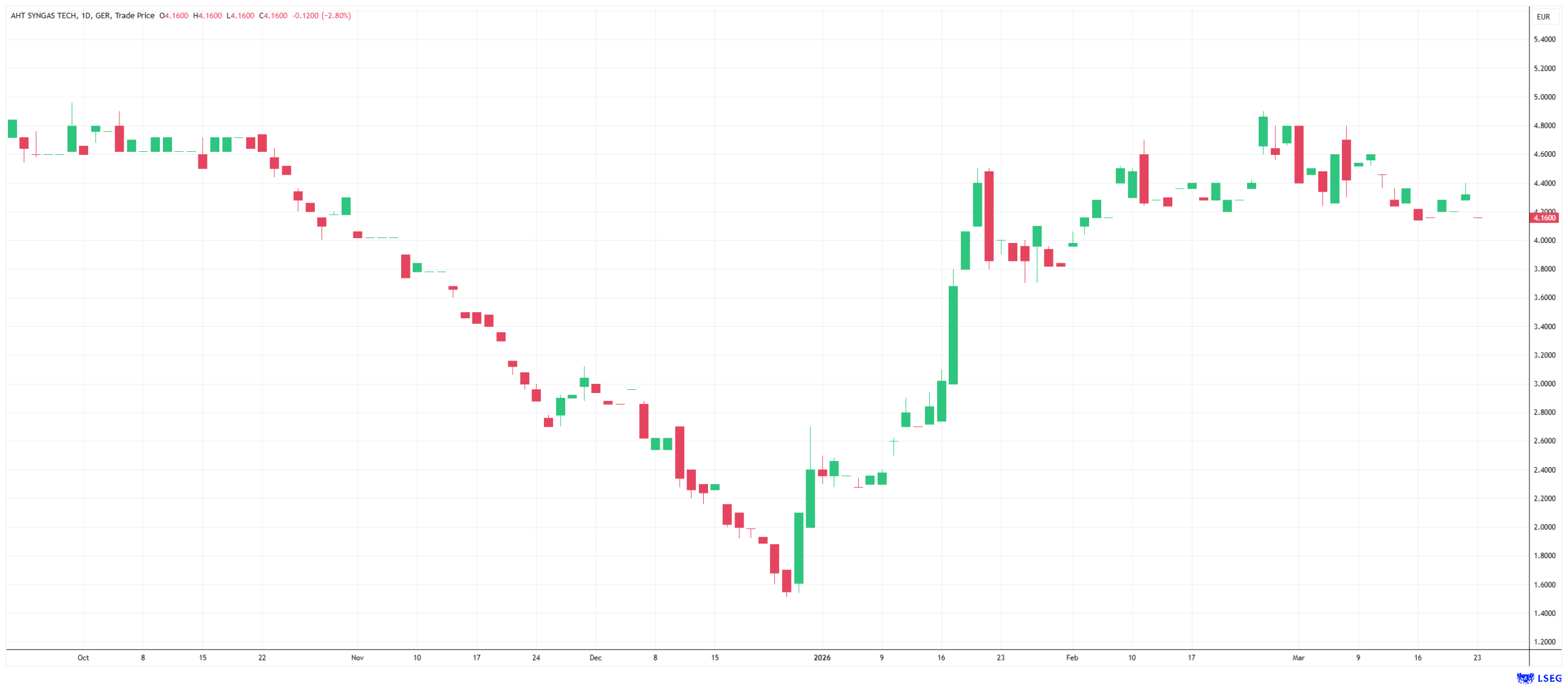
For traditional small and medium-sized enterprises, ranging from domestic paper manufacturing to metal finishing, gas prices exceeding EUR 80 per MWh simply mean a loss of competitiveness. This is precisely the gap that A.H.T. Syngas Technology is filling. The North Rhine-Westphalia-based company has positioned itself as a specialist in decentralized, biomass-based energy systems. It addresses the need for process heat, electricity, and synthesis gas directly at the point of consumption. At the heart of A.H.T.'s solution is a patented dual-fire gasification process that highly efficiently converts local waste materials such as wood waste or agricultural residues into extremely clean synthesis gas. Unlike conventional gasifiers, the gas produced by A.H.T. Syngas has low tar content, which is why it can be used in industrial burner systems as a direct substitute for natural gas. These modular plug-and-play systems enable medium-sized companies to transform their existing waste into a lucrative energy source, thereby increasingly decoupling themselves from volatile global market prices.
A.H.T. Syngas: Strategic Transformation Drives Margins
From an investor's perspective, A.H.T. Syngas's far-reaching transformation is highly interesting. The company no longer operates solely as a plant builder but now acts as an integrated energy service provider in the market. Through its new contracting model, A.H.T. operates its own plants at industrial customers' sites and sells the energy produced directly, generating recurring and profitable revenue streams with expected margins in this segment of up to 19%. Since the marginal costs of energy production are minimal due to the use of waste materials, this model proves to be extremely lucrative in the current high-price environment for natural gas. The financial basis for this expansion was secured through a successful capital increase and the placement of a convertible bond earlier this year. A key growth driver with significant implications for the European business is a framework agreement with a Japanese customer covering 20 plants with a total value of EUR 160 million. Analysts at GBC estimate the price target for A.H.T. shares at EUR 8.50, underscoring the strategic importance of this decentralized technology. The survival of small and medium-sized industrial companies depends more than ever on self-sufficient cycles - A.H.T. Syngas provides the solution.
Watch YouTube videoConflict of interest
Pursuant to §85 of the German Securities Trading Act (WpHG), we point out that Apaton Finance GmbH as well as partners, authors or employees of Apaton Finance GmbH (hereinafter referred to as "Relevant Persons") may hold shares or other financial instruments of the aforementioned companies in the future or may bet on rising or falling prices and thus a conflict of interest may arise in the future. The Relevant Persons reserve the right to buy or sell shares or other financial instruments of the Company at any time (hereinafter each a "Transaction"). Transactions may, under certain circumstances, influence the respective price of the shares or other financial instruments of the Company.
In addition, Apaton Finance GmbH is active in the context of the preparation and publication of the reporting in paid contractual relationships.
For this reason, there is a concrete conflict of interest.
The above information on existing conflicts of interest applies to all types and forms of publication used by Apaton Finance GmbH for publications on companies.
Risk notice
Apaton Finance GmbH offers editors, agencies and companies the opportunity to publish commentaries, interviews, summaries, news and the like on news.financial. These contents are exclusively for the information of the readers and do not represent any call to action or recommendations, neither explicitly nor implicitly they are to be understood as an assurance of possible price developments. The contents do not replace individual expert investment advice and do not constitute an offer to sell the discussed share(s) or other financial instruments, nor an invitation to buy or sell such.
The content is expressly not a financial analysis, but a journalistic or advertising text. Readers or users who make investment decisions or carry out transactions on the basis of the information provided here do so entirely at their own risk. No contractual relationship is established between Apaton Finance GmbH and its readers or the users of its offers, as our information only refers to the company and not to the investment decision of the reader or user.
The acquisition of financial instruments involves high risks, which can lead to the total loss of the invested capital. The information published by Apaton Finance GmbH and its authors is based on careful research. Nevertheless, no liability is assumed for financial losses or a content-related guarantee for the topicality, correctness, appropriateness and completeness of the content provided here. Please also note our Terms of use.