March 30th, 2026 | 08:00 CEST
Drone Warfare Redefines Security: Challenges for Rheinmetall and AeroVironment – Laggard Volatus Aerospace
The global security architecture has collapsed—where there was once stability, there is now chaos. Or do we seriously believe the US would still support NATO in the event of a defense crisis? At the same time, technological innovation is accelerating: what once began as experimental reconnaissance technology has evolved into a decisive factor in modern warfare - drones. A look at Eastern Europe illustrates the magnitude of this turning point. According to calculations by Reuters, Ukraine recently succeeded in putting up to 40% of Russia's oil export capacity out of commission through the use of drones. This military success is costing the Russian state budget billions. At the same time, Ukraine is emerging as a global exporter of drone technology and expertise. President Volodymyr Zelenskyy recently confirmed the deployment of military experts to the Middle East to assist countries such as the United Arab Emirates and Qatar in defending against drone attacks. Germany is also upgrading its capabilities, as conventional air defense systems are reaching their limits. Major corporations such as Rheinmetall and AeroVironment are positioning themselves in this market, which, according to forecasts by Global Industry Analysts, is expected to reach a volume of over USD 58 billion by the end of 2026. However, the most compelling leverage for investors is offered by the up-and-coming Canadian company Volatus Aerospace.
time to read: 3 minutes | Author: Nico Popp
ISIN: RHEINMETALL AG | DE0007030009 , AEROVIRONMENT DL -_0001 | US0080731088 , VOLATUS AEROSPACE INC | CA92865M1023 | TSXV: FLT , OTCQB: TAKOF
Table of contents:
Author

Nico Popp
At home in Southern Germany, the passionate stock exchange expert has been accompanying the capital markets for about twenty years. With a soft spot for smaller companies, he is constantly on the lookout for exciting investment stories.
Tag cloud
Shares cloud
Rheinmetall Delivers Cost-Effective Drone Defense
The asymmetric threat posed by drones is forcing Western armies to radically rethink their strategies. Rheinmetall CEO Armin Papperger recently issued a stark warning that stockpiles of interceptor missiles in Europe and the US are nearly depleted. The economic imbalance is obvious: deploying a Patriot missile costing around USD 2 million to combat a simple drone costing USD 20,000 is neither militarily nor financially sustainable. To close this gap in air defense, Rheinmetall presented the new RCWS 320C-UAS system at the Enforce Tac 2026 industry trade show. This remote-controlled weapon station uses a minigun with a rate of fire of 3,000 rounds per minute. It neutralizes micro-drones at distances of up to 600 m using radar-based sensors. A salvo from this system costs just USD 4,000. Financially, the defense conglomerate stands on solid ground. In the past fiscal year, Rheinmetall reported revenue of EUR 9.9 billion, representing a 29% increase. The order backlog is expected to grow to a record EUR 135 billion by the end of 2026, driven by major NATO projects.
AeroVironment Grapples With the Downsides of Growth
In the field of offensive drone systems and so-called loitering munitions, AeroVironment remains the dominant technology leader. With its Switchblade system, the company sets global standards for precision strikes. In the third quarter of fiscal year 2026, the US company recorded a significant 143% jump in revenue to USD 408 million, driven primarily by the acquisition of the specialist firm BlueHalo. Despite this enormous growth in revenue, the current figures also reveal operational risks. During the same period, AeroVironment posted a net loss of USD 156.6 million. This was caused by an impairment charge in the aerospace segment, triggered by the US Space Force's cancellation of an antenna program. This highlights the risks associated with shifts in political priorities. To meet the enormous demand for tactical drones, CEO Wahid Nawabi is currently building a new factory in Salt Lake City, which is expected to manufacture hardware worth over USD 2 billion annually in the future.
Volatus Aerospace Comes into Focus as a Pure Play
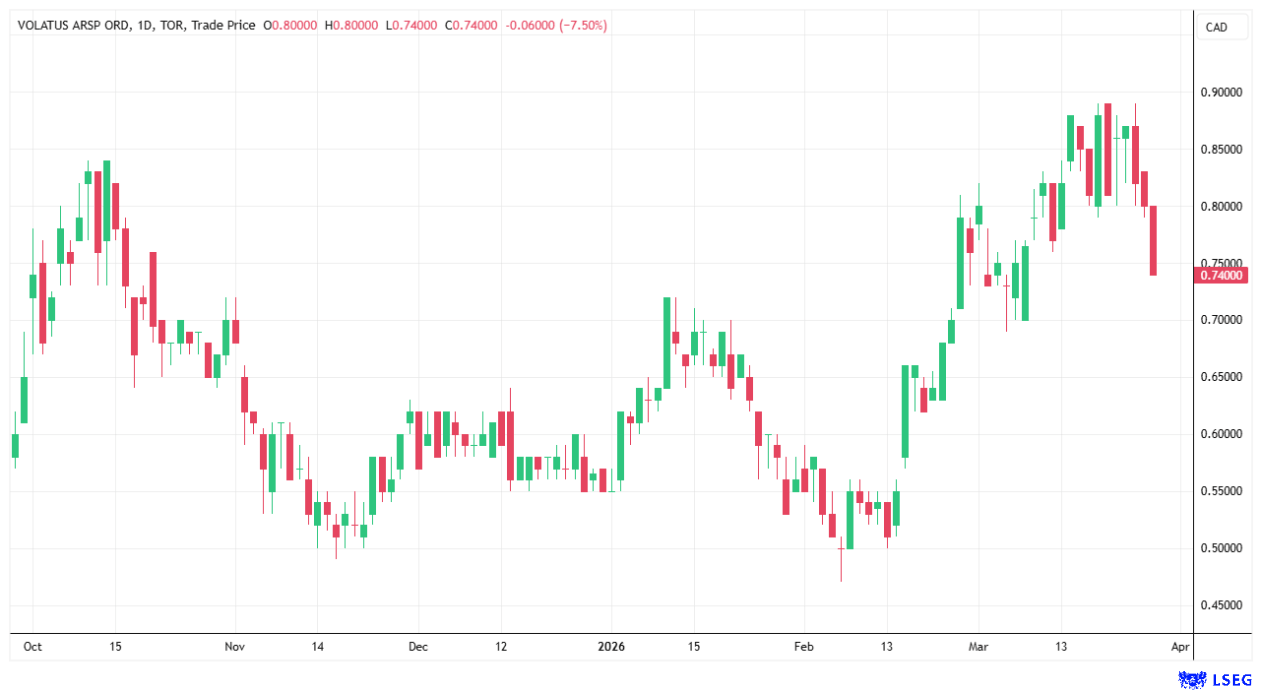
While large corporations primarily impress with their scale and capacity, the Canadian company Volatus Aerospace offers investors the opportunity to invest in an agile, vertically integrated drone ecosystem. With its successful listing on the Toronto Stock Exchange (TSX) in mid-March, the company has reached a decisive level of maturity and is now opening up to institutional capital. The model ranges from in-house drone design and software solutions to training pilots for public safety. This independence makes Volatus a Western alternative to Chinese manufacturers. The figures demonstrate the scaling: in the third quarter of 2025, Volatus recorded revenue growth of 60% to approximately USD 7.8 million. Particularly lucrative is the shift in the revenue mix, where the share of higher-margin hardware sales climbed from 16% to 53%.
Technological Sovereignty and Operational Turnaround
Another key competitive advantage of Volatus Aerospace lies in its four-pillar model, which guarantees Western customers complete technological sovereignty independent of Asian supply chains. In addition to developing its own NDAA-compliant hardware, such as the Condor XL heavy-lift drone, the group also provides operational services and certified training for over 4,000 public safety specialists worldwide. To meet the challenges of modern electronic warfare, the company is also driving the development of edge AI with its V-Cortex platform, enabling drones to navigate autonomously even without a GPS signal or direct radio connection. This advantage simultaneously paves the way for commercial logistics, where Volatus has already obtained key national approvals for long-range flights beyond visual line of sight. This broad positioning is clearly reflected in the balance sheet. Thanks to the strong growth in recurring revenue by the end of 2025, the company was able to reduce its EBITDA loss by 85%, showing that Volatus is on the path to profitability.
Volatus: Software and Geopolitical Tailwinds Drive Returns
However, the real strategic lever for Volatus Aerospace lies in the software sector and geopolitical shifts. With its SaaS platform SKYDRA, the company is advancing a solution for the simulation and mission planning of drone defense systems that promises high margins. At the same time, Volatus benefits from Canada's new defense strategy, which calls for investments in the billions and strictly mandates that 70% of contracts must be awarded to domestic suppliers. Studies by McKinsey emphasize that the future focus will be on systems that seamlessly integrate hardware and software. With an active sales pipeline of over USD 440 million, which far exceeds the company's current market capitalization, Volatus stock offers significant upside potential. Investors will find here a value proposition that represents the realignment of the global security architecture toward small, networked, and autonomous systems—a potential that has not yet been fully recognized by the market.
Watch YouTube videoConflict of interest
Pursuant to §85 of the German Securities Trading Act (WpHG), we point out that Apaton Finance GmbH as well as partners, authors or employees of Apaton Finance GmbH (hereinafter referred to as "Relevant Persons") may hold shares or other financial instruments of the aforementioned companies in the future or may bet on rising or falling prices and thus a conflict of interest may arise in the future. The Relevant Persons reserve the right to buy or sell shares or other financial instruments of the Company at any time (hereinafter each a "Transaction"). Transactions may, under certain circumstances, influence the respective price of the shares or other financial instruments of the Company.
In addition, Apaton Finance GmbH is active in the context of the preparation and publication of the reporting in paid contractual relationships.
For this reason, there is a concrete conflict of interest.
The above information on existing conflicts of interest applies to all types and forms of publication used by Apaton Finance GmbH for publications on companies.
Risk notice
Apaton Finance GmbH offers editors, agencies and companies the opportunity to publish commentaries, interviews, summaries, news and the like on news.financial. These contents are exclusively for the information of the readers and do not represent any call to action or recommendations, neither explicitly nor implicitly they are to be understood as an assurance of possible price developments. The contents do not replace individual expert investment advice and do not constitute an offer to sell the discussed share(s) or other financial instruments, nor an invitation to buy or sell such.
The content is expressly not a financial analysis, but a journalistic or advertising text. Readers or users who make investment decisions or carry out transactions on the basis of the information provided here do so entirely at their own risk. No contractual relationship is established between Apaton Finance GmbH and its readers or the users of its offers, as our information only refers to the company and not to the investment decision of the reader or user.
The acquisition of financial instruments involves high risks, which can lead to the total loss of the invested capital. The information published by Apaton Finance GmbH and its authors is based on careful research. Nevertheless, no liability is assumed for financial losses or a content-related guarantee for the topicality, correctness, appropriateness and completeness of the content provided here. Please also note our Terms of use.