January 15th, 2026 | 07:25 CET
Double returns: How CHAR Technologies is closing the gap between ArcelorMittal's coal hunger and Montauk's gas profits
We are witnessing a historic turning point for global heavy industry. We are currently seeing not only a technological evolution, but also a fundamental revaluation of industrial assets, driven by two parallel megatrends: the decarbonization of primary steel production and the monetary revaluation of waste streams for energy security. While regulatory constraints are forcing steel giants such as ArcelorMittal to reinvent their blast furnaces, and specialists such as Montauk Renewables are demonstrating the enormous valuations possible in the renewable natural gas (RNG) market, CHAR Technologies is positioning itself at the intersection of these two worlds. With its proprietary high-temperature pyrolysis technology, the Canadian company provides the answer to both questions at once: it produces biochar for the steel industry and RNG for the energy grid – from a single waste source.
time to read: 3 minutes | Author: Nico Popp
ISIN: CHAR Technologies Ltd. | CA15957L1040 , ARCELORMITTAL S.A. NOUV. | LU1598757687 , MONTAUK RENEWABLES INC | US61218C1036
Table of contents:
Author

Nico Popp
At home in Southern Germany, the passionate stock exchange expert has been accompanying the capital markets for about twenty years. With a soft spot for smaller companies, he is constantly on the lookout for exciting investment stories.
Tag cloud
Shares cloud
ArcelorMittal and the push for "green coal"
For ArcelorMittal, the world's second-largest steel producer, climate protection is no longer a PR issue, but a matter of business survival. Pressure from the European Emissions Trading System (EU ETS) and the Carbon Border Adjustment Mechanism (CBAM) has created a new reality in which every ton of CO2 emitted directly impacts margins. The challenge is tangible: blast furnaces need carbon not only as an energy source, but also as a chemical reducing agent to convert iron ore into steel. Hydrogen can play this role in the long term, but in the short and medium term, biochar is the only viable substitute for fossil coking coal.
However, as industry analyses show, the market for high-quality biochar is virtually non-existent. ArcelorMittal must secure enormous quantities of this material to avoid billions in penalties and achieve its own targets. This is creating a massive demand vacuum. The steel industry is desperately seeking partners who can supply biochar not only on a laboratory scale, but also industrially and with a consistent carbon content, in order to replace fossil coal without compromising the quality of the end product.
Montauk Renewables: Proof of the value of gas
While steelmakers are looking for carbon, a look at Montauk Renewables shows how lucrative the other side of the equation is: energy production from waste. Montauk specializes in processing landfill gas and biogas into pipeline-ready renewable natural gas. The capital market values this business model highly, as RNG provides stable, recurring cash flows and can be fed directly into the existing gas infrastructure.
Investors appreciate the independence of companies like Montauk from volatile commodity prices, as the "commodity" waste is often sourced free of charge or even accompanied by a tipping fee. However, Montauk focuses primarily on the gas side and often leaves the material potential of the residues untapped. This is precisely where the niche opens up for the next generation of technology providers – companies such as CHAR Technologies.
CHAR Technologies: One process, two sources of income
CHAR Technologies has identified this gap and closed it with its technology. The Company uses a high-temperature pyrolysis (HTP) process that heats wood waste and organic residues to over 800° Celsius in the absence of oxygen. The key difference to conventional processes is the result: CHAR Technologies not only produces RNG that flows directly into the gas networks, but also high-quality biochar that meets the exact specifications of the steel industry.
This "double return" is revolutionizing economic efficiency. From a single ton of waste, CHAR generates two high-quality products for two independent billion-dollar markets. Recent operational progress proves that this approach works. The Company announced that the installation of the kiln at the flagship Thorold Renewable Energy Facility is proceeding according to plan. This facility serves as a blueprint for global scaling.
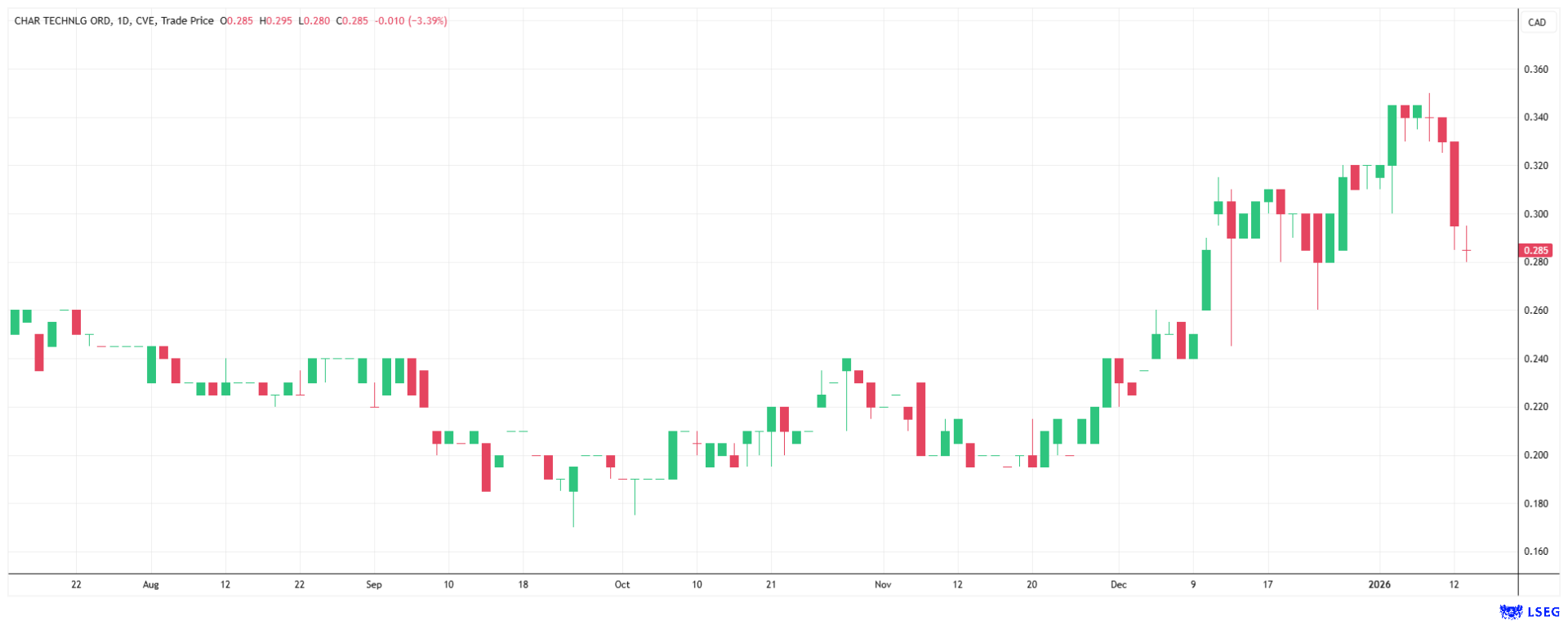
Business model validated: Investors give green light for new plant
Wednesday's announcement confirms that scaling at CHAR Technologies is moving from concept to reality. The BMI Group has reaffirmed its commitment, pledging CAD 10 million for the biochar project in Espanola, Ontario. The plan is to build a plant capable of producing up to 50,000 tons of biochar annually – five times the capacity of the reference plant in Thorold. On the site of a former paper mill, CHAR Technologies will use local wood waste to produce biochar and synthesis gas. The BMI Group's commitment to the previously announced plans reduces the risk on CHAR Technologies' side and enables rapid scaling.
This validates the confidence of the market and the public sector in CHAR Technologies' business model. In addition to BMI Group funding, the Ontario government has contributed CAD 2.25 million to accelerate the commercialization of biochar pellets. CHAR is thus positioning itself in a unique niche that combines the best of both worlds: the RNG cash flows of a utility such as Montauk and strategic indispensability for industrial giants such as ArcelorMittal. For investors, CHAR Technologies thus offers rare access to the intersection of energy transition and industrial decarbonization without the risk of unilateral market dependence.
Watch YouTube videoConflict of interest
Pursuant to §85 of the German Securities Trading Act (WpHG), we point out that Apaton Finance GmbH as well as partners, authors or employees of Apaton Finance GmbH (hereinafter referred to as "Relevant Persons") may hold shares or other financial instruments of the aforementioned companies in the future or may bet on rising or falling prices and thus a conflict of interest may arise in the future. The Relevant Persons reserve the right to buy or sell shares or other financial instruments of the Company at any time (hereinafter each a "Transaction"). Transactions may, under certain circumstances, influence the respective price of the shares or other financial instruments of the Company.
In addition, Apaton Finance GmbH is active in the context of the preparation and publication of the reporting in paid contractual relationships.
For this reason, there is a concrete conflict of interest.
The above information on existing conflicts of interest applies to all types and forms of publication used by Apaton Finance GmbH for publications on companies.
Risk notice
Apaton Finance GmbH offers editors, agencies and companies the opportunity to publish commentaries, interviews, summaries, news and the like on news.financial. These contents are exclusively for the information of the readers and do not represent any call to action or recommendations, neither explicitly nor implicitly they are to be understood as an assurance of possible price developments. The contents do not replace individual expert investment advice and do not constitute an offer to sell the discussed share(s) or other financial instruments, nor an invitation to buy or sell such.
The content is expressly not a financial analysis, but a journalistic or advertising text. Readers or users who make investment decisions or carry out transactions on the basis of the information provided here do so entirely at their own risk. No contractual relationship is established between Apaton Finance GmbH and its readers or the users of its offers, as our information only refers to the company and not to the investment decision of the reader or user.
The acquisition of financial instruments involves high risks, which can lead to the total loss of the invested capital. The information published by Apaton Finance GmbH and its authors is based on careful research. Nevertheless, no liability is assumed for financial losses or a content-related guarantee for the topicality, correctness, appropriateness and completeness of the content provided here. Please also note our Terms of use.