September 15th, 2026 | 07:55 CEST
Dividends: Headwinds for Allianz and TotalEnergies – RE Royalties in an Interesting Position
Making your money work for you – that is probably every investor's dream. Dividends can be the key to achieving that. But a generous cash flow today is worthless if the underlying business models are already obsolete tomorrow. Taking a sober look at the balance sheet is no longer enough to reliably assess which dividend stock is truly sustainable—both in terms of consistent payouts and ESG criteria. We take a closer look at three dividend stocks with a promising future and show what role these shares could play in a portfolio.
time to read: 3 minutes | Author: Nico Popp
ISIN: RE ROYALTIES LTD | CA75527Q1081 | TSXV: RE , OTCQX: RROYF , ALLIANZ SE NA O.N. | DE0008404005 , TOTALENERGIES SE | FR0000120271
Table of contents:
Author

Nico Popp
At home in Southern Germany, the passionate stock exchange expert has been accompanying the capital markets for about twenty years. With a soft spot for smaller companies, he is constantly on the lookout for exciting investment stories.
Tag cloud
Shares cloud
Allianz: Security and Sustainability
Allianz, Europe's largest insurer, is feeling the effects of global warming: when storms cause damage well over USD 100 billion, or droughts dry up rivers, claims often follow. To mitigate such threats, Allianz is implementing a decarbonization plan: by 2030, the group aims to reduce greenhouse gas intensity among large commercial customers by 45%. This is intended to secure its long-term profitability, which led to a record operating profit of EUR 9.4 billion in the first half of 2026. For the past year, investors received EUR 17.10 per share, corresponding to a dividend yield of approximately 3.8%. A share buyback program totalling EUR 2.5 billion further reduces the supply of shares. Allianz is a solid conglomerate that has recognized the signs of the times.
TotalEnergies Falls Into a Reputational Trap in Africa
At first glance, TotalEnergies resembles a money-printing machine. In the second quarter of 2026, the core fossil fuel business generated operating cash flow of over USD 9.8 billion for the French conglomerate. Thanks to a moderate payout ratio of less than 50%, investors can look forward to dividends of EUR 3.60, which corresponds to a yield of nearly 5%. But there is a downside to this otherwise solid dividend: TotalEnergies is grappling with legal challenges, including a conviction for misleading climate advertising by a Paris court. The controversial EACOP project in Uganda is turning into a reputational fiasco. Specific allegations of human rights violations are already forcing players like Union Investment to rigorously remove the company from sustainability portfolios. This shows that ESG risks can lead to tangible disadvantages.
RE Royalties and the License for Clean Electricity
Those who want to reflect the energy transition in their portfolio while avoiding unnecessary risks will find an exciting candidate in Canada: RE Royalties. The company applies the lucrative mining royalty model to solar farms. Young developers of renewable energy projects often lack start-up capital. This is exactly where RE Royalties steps in as a financing partner. The company grants asset-backed loans with short terms and collects interest, often in the double digits, in return. In exchange, it secures a share of royalties on the power plants' future gross revenue for the next 15 to 25 years.
Because these payments are based solely on revenue, many operator-borne costs do not affect RE Royalties. Remaining risks, however, include payment defaults and insolvencies. RE Royalties' portfolio comprises more than 130 facilities. In 2024, RE Royalties allocated CAD 3.0 million to a battery storage project by SolarBank Corporation, which guarantees the financier a fixed royalty for two decades at an 11% interest rate. A generous credit facility of CAD 10 million for Abraxas Power is intended to eliminate the need for diesel generators in the Maldives. It offers RE Royalties 13% interest plus 2.0% of gross revenue over 15 years**. The company also supports indigenous solar projects in Alberta. According to the company, this business model has already generated internal rates of return of up to 34% in the past.
Further Opportunities for RE Royalties
Despite its operational successes, RE Royalties is relatively unknown on the stock market. With a market capitalization of only about CAD 16 million, this small-cap stock trades "under the radar" for many professional investors. Nevertheless, cash has flowed steadily into RE Royalties shareholders' accounts for many years. Most recently, the dividend yield was even over 10%. Going forward, the company plans to make annual rather than quarterly distributions and will also draw on capital from green bonds, which the company also issues. Management, which itself controls about a quarter of the company's shares, has been fighting against this undervaluation for some time. To boost the valuation, the company commissioned PricewaterhouseCoopers to explore strategic options.
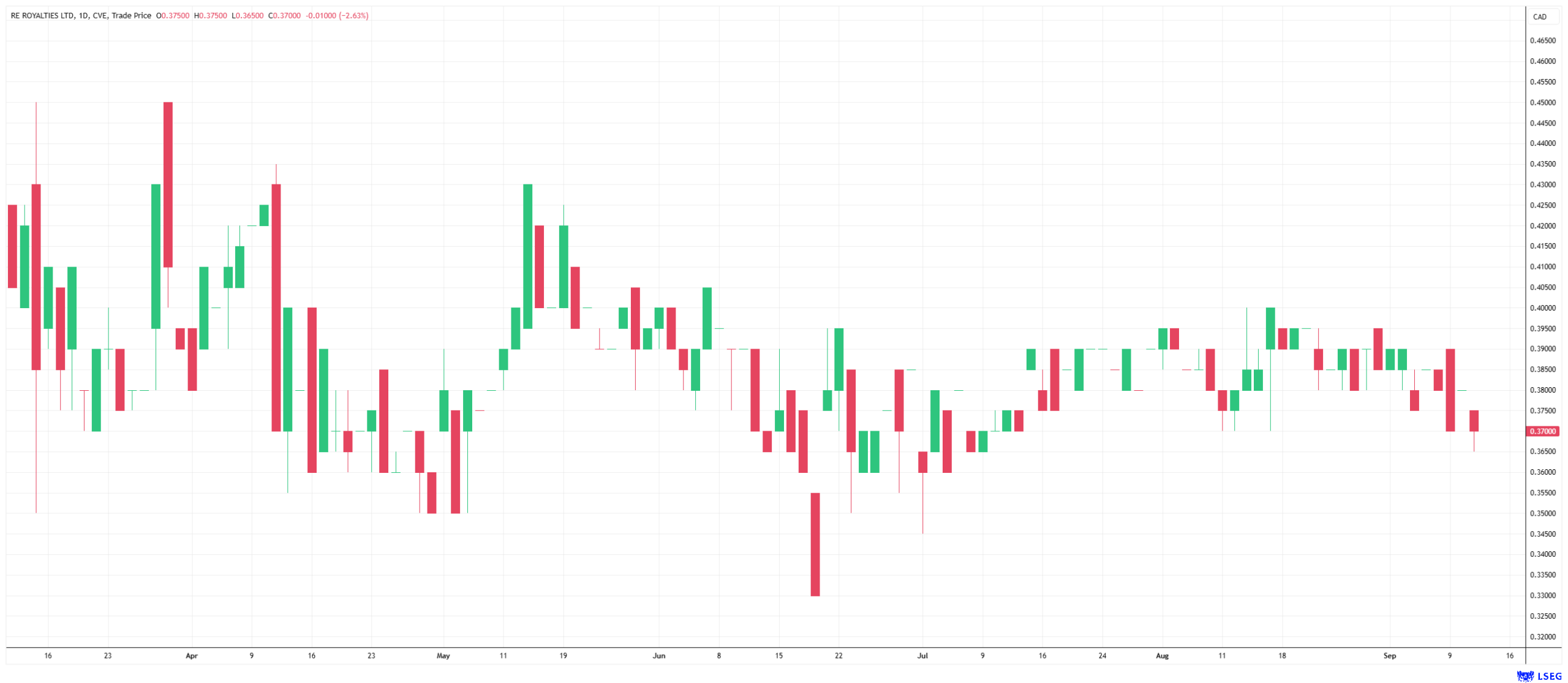
RE Royalties' stock has recently shown positive momentum. Compared to companies like Allianz or TotalEnergies, RE Royalties is a speculative small-cap stock, which entails both opportunities and risks. While large corporations are better able to weather headwinds, as demonstrated, for example, by TotalEnergies with its legal disputes, a company like RE Royalties is more vulnerable. This applies, for instance, to payment defaults. With a portfolio of around 130 projects, RE Royalties is broadly diversified but remains more speculative than the aforementioned corporations. Conversely, the stock's current valuation and niche positioning also present an opportunity—if it can find strong partners to contribute projects or capital, RE Royalties could quickly scale up its operations significantly. Investors should watch the future developments of this specialist in sustainable financing solutions. The company is in an interesting position.
Conflict of interest
Pursuant to §85 of the German Securities Trading Act (WpHG), we point out that Apaton Finance GmbH as well as partners, authors or employees of Apaton Finance GmbH (hereinafter referred to as "Relevant Persons") may hold shares or other financial instruments of the aforementioned companies in the future or may bet on rising or falling prices and thus a conflict of interest may arise in the future. The Relevant Persons reserve the right to buy or sell shares or other financial instruments of the Company at any time (hereinafter each a "Transaction"). Transactions may, under certain circumstances, influence the respective price of the shares or other financial instruments of the Company.
In addition, Apaton Finance GmbH is active in the context of the preparation and publication of the reporting in paid contractual relationships.
For this reason, there is a concrete conflict of interest.
The above information on existing conflicts of interest applies to all types and forms of publication used by Apaton Finance GmbH for publications on companies.
Risk notice
Apaton Finance GmbH offers editors, agencies and companies the opportunity to publish commentaries, interviews, summaries, news and the like on news.financial. These contents are exclusively for the information of the readers and do not represent any call to action or recommendations, neither explicitly nor implicitly they are to be understood as an assurance of possible price developments. The contents do not replace individual expert investment advice and do not constitute an offer to sell the discussed share(s) or other financial instruments, nor an invitation to buy or sell such.
The content is expressly not a financial analysis, but a journalistic or advertising text. Readers or users who make investment decisions or carry out transactions on the basis of the information provided here do so entirely at their own risk. No contractual relationship is established between Apaton Finance GmbH and its readers or the users of its offers, as our information only refers to the company and not to the investment decision of the reader or user.
The acquisition of financial instruments involves high risks, which can lead to the total loss of the invested capital. The information published by Apaton Finance GmbH and its authors is based on careful research. Nevertheless, no liability is assumed for financial losses or a content-related guarantee for the topicality, correctness, appropriateness and completeness of the content provided here. Please also note our Terms of use.