October 15th, 2026 | 05:43 CEST
Disruption in Orbit! Elon Musk’s SpaceX Takes on Deutsche Telekom and Vodafone, While Desert Gold Holds a Strong Hand
Whether in Mali, Japan or Chile, Elon Musk is transforming global communications. Through his space company SpaceX and its Starlink satellite network, the tech billionaire is seeking to establish a leading position in global data transmission. This aggressive expansion in orbit is putting established industry giants such as Deutsche Telekom and Vodafone under increasing pressure. Traditional network operators face significant technological and financial challenges in providing seamless mobile coverage in remote parts of the world. This is where Musk’s satellite constellation comes in, extending internet and telephone connectivity from low Earth orbit. The ambitious goal is to provide high-speed data services to even the most isolated corners of the planet. For traditional mobile operators, satellite-based connectivity presents a new competitive challenge. A blessing for people and businesses in structurally weak regions, as they benefit enormously from this straightforward network infrastructure from space. Canadian mining company Desert Gold, which is advancing several gold projects in West Africa, operates in a region where reliable connectivity can be important for remote operations. A closer look at the company and the changing communications landscape is worthwhile.
time to read: 4 minutes | Author: André Will-Laudien
ISIN: Desert Gold Ventures Inc | CA25039N4084 , DT.TELEKOM AG NA | DE0005557508 , GB00BH4HKS39 , SPACE EXPLORATION TECHNOLOGIES CORP | US84615Q1031
Author

André Will-Laudien
Born in Munich, he first studied economics and graduated in business administration at the Ludwig-Maximilians-University in 1995. As he was involved with the stock market at a very early stage, he now has more than 30 years of experience in the capital markets.
Tag cloud
Shares cloud
Deutsche Telekom and Vodafone: The Losers in Space-Based Mobile Communications
As if a 30% share price loss in just 6 months were not enough, Bonn-based industry leader Deutsche Telekom is falling massively behind due to SpaceX's aggressive expansion. With Elon Musk's latest spectrum purchases in the US, the DAX-listed group and, above all, its US subsidiary T-Mobile face a painful economic loss. Although Deutsche Telekom originally relied on a partnership with Starlink, the satellite service is now becoming an unpredictable mobile rival with its new frequency bands. The immense pressure from orbit has already been reflected recently in a sharp slump in the share price. To defend its market position, management now faces costly strategic course corrections. Ultimately, Deutsche Telekom's conventional mobile masts in rural areas face technological irrelevance because satellites almost always deliver. However, analysts on the LSEG platform apparently see the losing streak as over and set a blended price target of EUR 36.45 over a 12-month horizon. That would mean a return to previous highs, plus a 5% annual payout! Exciting!
The situation is no less dramatic for British competitor Vodafone. The company is miles behind its rival SpaceX in building its own orbital infrastructure. The established partnership with Amazon's "Project Kuiper" is proving a risky bet, as the US online retailer is struggling with significant delays in satellite launches. While Musk's armada is already testing global Direct-to-Cell connections, Vodafone is left empty-handed for now when it comes to comprehensive space connectivity. To counter the looming monopoly from across the Atlantic, the group is now panicking and taking refuge in political alliances. Together with other European providers, it is making desperate attempts to erect regulatory defences in Brussels against the overpowering attacker. After a share price gain of over 40% this year, the rally seems overdue for a correction.
SpaceX: The Quest to Disrupt the Telecommunications Market
With the aggressive expansion of its satellite fleet, SpaceX is preparing to bring conventional telecommunications networks to their knees. The driving force behind this revolution is the innovative “Direct-to-Cell” technology, which connects conventional smartphones directly to space without expensive additional hardware. Tech pioneer Elon Musk is thereby dismantling decades-old monopolies held by terrestrial network providers, which have invested billions in mobile masts worldwide. Where mobile giants previously failed because of geographical obstacles, the Starlink network now provides a seamless global data network. This orbital infrastructure instantly makes SpaceX the planet's most powerful network provider independent of any state. Even in the Earth's most remote deserts and crisis zones, the system guarantees stable, comprehensive broadband coverage. For traditional groups on the ground, pressure is mounting as Musk's space empire single-handedly dictates the rules of global connectivity. Analysts are correspondingly positive about the NASDAQ newcomer, with plenty of AI- and rocket-related speculative potential on top. After a 30% correction in August, SpaceX's share price is now taking off again, above USD 150. However, experts on the LSEG platform say this may not be the end of the road. Share prices of around USD 230 are expected in 2027, which would put Elon Musk’s company on a par with Nvidia and Apple in terms of market value. Anyone who went short at a USD 2 trillion valuation may now be in for a rough ride.
Desert Gold: Taking Great Leaps Forward
Anyone living or working in Mali not only enjoys good orbital internet, but can also dive into existing gold mineralisation with Desert Gold CEO Jared Scharf. It took a few months for the first processing plant to reach its destination, Barani-East. Now things are getting underway, and observers expect the first mining results before the end of this year. The PEA from the spring is now underpinned by a gold price of well above USD 4,000, which also pushes the project value effortlessly above the USD 120 million mark. This is where it gets fun, as total on-site investment is around USD 20 million. To raise the valuation of Desert shares, all that is needed is to wait until the first ounce hits the market.
CEO Jared Scharf recently outlined the upcoming milestones in West Africa at the 20th International Investment Forum.
Following commissioning, the plant will initially process 10 tonnes of raw ore per hour, with a step-by-step increase to 50 tonnes already planned. Based on the PEA data, all-in sustaining costs are expected to be just USD 1,137 per troy ounce, offering an excellent gross margin of almost USD 3,000 per ounce. Energy prices have surged, so costs are likely to rise by around 10 to 20%, but this would have only a marginal impact on the overall result. Over the planned ten-year mine life, total gold production is targeted at 113,100 ounces. Desert Gold's share price has been in the CAD 0.12 to 0.14 range for weeks. That gives a market capitalisation of a solid CAD 40 million for an extremely positive setup, with expansion into Côte d'Ivoire not even factored in yet. Highly exciting!
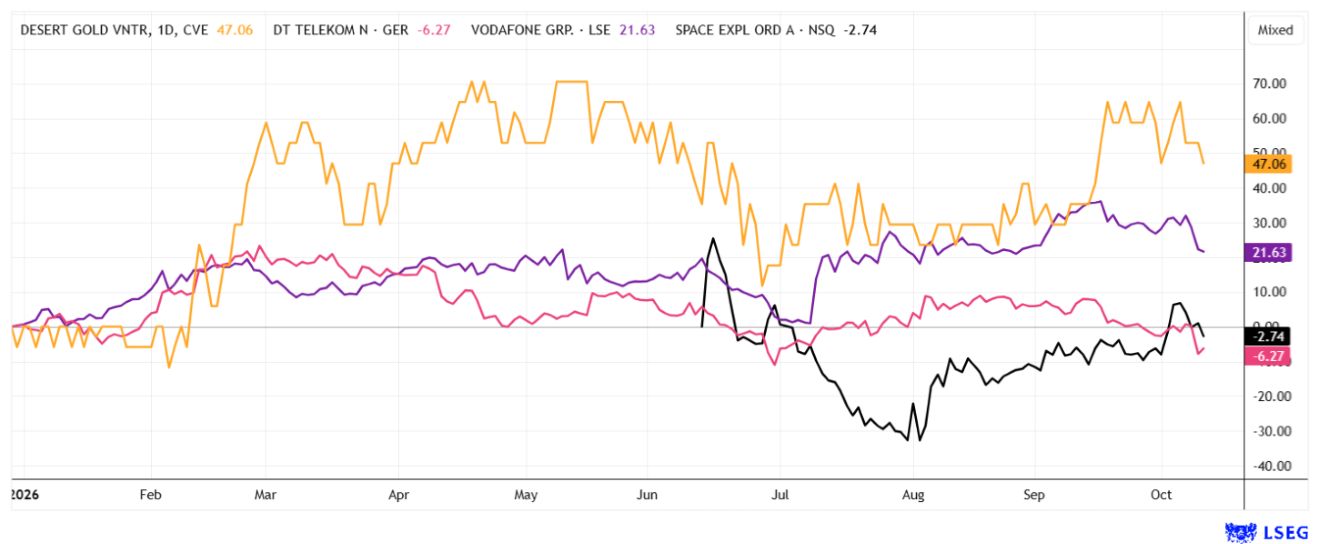
In the 12-month chart, Desert Gold stands out with a gain of more than 40%, while Vodafone is also performing well. Following a sharp sell-off, Deutsche Telekom is now in negative territory, whereas SpaceX is once again approaching positive territory.
Conclusion
Periods of heightened volatility can also create opportunities to identify significantly undervalued stocks. In the telecommunications sector, the major players could continue to generate solid earnings for several more years before Elon Musk builds a customer base large enough to pose a serious competitive threat. At present, only around 12 million customers use satellite-based mobile services. A strong consolidation is underway in the precious metals sector, making many stocks attractive again. Desert Gold is a good example of how companies on the cusp of production can be acquired at low prices.
Conflict of interest
Pursuant to §85 of the German Securities Trading Act (WpHG), we point out that Apaton Finance GmbH as well as partners, authors or employees of Apaton Finance GmbH (hereinafter referred to as "Relevant Persons") currently hold or hold shares or other financial instruments of the aforementioned companies and speculate on their price developments. In this respect, they intend to sell or acquire shares or other financial instruments of the companies (hereinafter each referred to as a "Transaction"). Transactions may thereby influence the respective price of the shares or other financial instruments of the Company.
In this respect, there is a concrete conflict of interest in the reporting on the companies.
In addition, Apaton Finance GmbH is active in the context of the preparation and publication of the reporting in paid contractual relationships.
For this reason, there is also a concrete conflict of interest.
The above information on existing conflicts of interest applies to all types and forms of publication used by Apaton Finance GmbH for publications on companies.
Risk notice
Apaton Finance GmbH offers editors, agencies and companies the opportunity to publish commentaries, interviews, summaries, news and the like on news.financial. These contents are exclusively for the information of the readers and do not represent any call to action or recommendations, neither explicitly nor implicitly they are to be understood as an assurance of possible price developments. The contents do not replace individual expert investment advice and do not constitute an offer to sell the discussed share(s) or other financial instruments, nor an invitation to buy or sell such.
The content is expressly not a financial analysis, but a journalistic or advertising text. Readers or users who make investment decisions or carry out transactions on the basis of the information provided here do so entirely at their own risk. No contractual relationship is established between Apaton Finance GmbH and its readers or the users of its offers, as our information only refers to the company and not to the investment decision of the reader or user.
The acquisition of financial instruments involves high risks, which can lead to the total loss of the invested capital. The information published by Apaton Finance GmbH and its authors is based on careful research. Nevertheless, no liability is assumed for financial losses or a content-related guarantee for the topicality, correctness, appropriateness and completeness of the content provided here. Please also note our Terms of use.