August 25th, 2026 | 06:50 CEST
DIRTY GAS, CLEAN RETURNS, MORE THAN 200% PRICE POTENTIAL: WM, VEOLIA AND ZEFIRO METHANE
Created and Published on Behalf of Zefiro Methane.
WM and Veolia Environnement generate billions in revenue from waste collection and water services. But both companies can do much more: energy generation from landfill gas, CO₂ storage, and the removal of "forever chemicals". According to analysts, however, the greatest upside potential among these environmental remediation companies lies with a Canadian hidden gem whose name alone reveals what it is all about — Zefiro Methane. Three stocks, one common theme: Who cleans up what others have left behind?
time to read: 7 minutes | Author: Jens Castner
ISIN: WASTE MANAGEMENT (DEL.) | US94106L1098 , ZEFIRO METHANE CORP | CA98926D1069 | NEO: ZEFI , VEOLIA ENVIRONNE. EO 5 | FR0000124141
Table of contents:
Author
Jens Castner
The Nuremberg native brings over three decades of capital markets experience, backed by a career shaped by deep market insight and a genuine passion for investing. His journey began in 1994 through an investment club among colleagues – a formative experience that sparked a lifelong dedication to identifying compelling investment opportunities.
Following senior editorial roles at Nürnberger Nachrichten, €uro am Sonntag, and €uro, he went on to serve as Editor-in-Chief of the renowned investor magazine Börse Online from 2014, where he played a key role in shaping high-quality financial journalism for a broad investor audience.
Tag cloud
Shares cloud
Waste Management: The Quiet Methane Giant
When people think of Waste Management, they usually picture trash cans. With a market capitalization of around USD 90 billion, WM, as the company is now officially known, is one of the largest players in the US waste management industry—but it is also North America's leading operator of facilities that convert the landfill gas mixture of methane and CO₂ produced when trash decomposes into usable energy. At over 250 landfills, the company systematically captures methane and processes it into purified biogas of a quality that can be used just like fossil natural gas—for example, to generate electricity or as fuel for its own truck fleet. In Denver, for example, a new facility is expected to capture about 98% of the landfill methane.
The emissions avoided through this process can also be certified as carbon credits under recognized standards, such as the American Carbon Registry's landfill gas method. These are tradable emission credits that other companies can purchase to offset their own CO₂ emissions on a net basis. For WM, this represents an additional revenue stream alongside traditional waste disposal. In the first half of the year, revenue for the Houston, Texas-based company rose 4% to USD 12.9 billion, with the recycling and renewable energy segment—which grew 32.5% in the second quarter alone—clearly serving as the growth driver. With earnings of USD 3.74 per share, WM once again exceeded expectations in the first six months of the current fiscal year and launched a new USD 3 billion share buyback program.
It is no wonder that the waste management and environmental services provider is among the Gates Foundation's preferred stocks. With a stake of about 6.8% of outstanding shares and a market value most recently of just under USD 6 billion, WM is one of the largest single positions in the foundation's portfolio after Berkshire Hathaway, while the former core holding Microsoft was sold in its entirety at the beginning of the year. With 23 consecutive years of dividend increases and a portfolio of long-term landfill permits, WM is the epitome of a defensive moat investment.
Veolia: On the Trail of Persistent Chemicals
In Europe, Veolia Environnement has played a similarly significant role since the French conglomerate acquired large portions of Suez in 2022. With a market capitalization of approximately EUR 25 billion and expected 2026 annual revenue of EUR 46 billion, the company is considered the world's largest provider of water supply and treatment, but it is also a leader in waste management, complemented by a strong energy business across Europe. The core of its operations therefore remains drinking water, wastewater, and waste disposal for municipalities and industry. Through the integration of Suez, Veolia now also controls significant capacity in industrial soil and water remediation as well as hazardous materials management.
Veolia is currently expanding this remediation division. With the acquisition of Clean Earth in June of this year, its US hazardous materials business doubled, and with Enviropacific in Australia, the group strengthened its PFAS remediation expertise. PFAS refers to a group of persistent industrial chemicals, such as Teflon, also known as "forever chemicals" because they hardly break down in nature and accumulate in soil and groundwater. The goal is to generate approximately EUR 1 billion in revenue from the treatment of PFAS and similar micropollutants by 2030. Veolia is also active in the area of climate protection, albeit at an earlier stage of development than WM. The group is testing technologies for CO₂ capture from flue gas at several waste-to-energy plants, such as in Sheffield, United Kingdom, and Le Mans, France. If the biogenic portion of this carbon dioxide is subsequently stored permanently underground, it can be used to generate CDR certificates (Carbon Dioxide Removal)—credits for CO₂ actually removed from the atmosphere, which can also be sold on the market. At the same time, the Paris-based company has set a goal of capturing approximately 80% of the methane generated at its own landfills by 2032. Revenue rose by 1.5% to EUR 22.2 billion in the first half of the year, while net income increased by 10.4% to EUR 837 million. The full-year outlook was raised slightly.
While Veolia does not have a prominent billionaire of the calibre of Bill Gates on board, it does have significant major shareholders. The French state-owned bank Caisse des Dépôts et Consignations, together with its subsidiary CNP Assurances, holds 4.7% of the shares, and the Norwegian sovereign wealth fund holds a smaller but notable stake. Both underscore Veolia's character as a strategic, ESG-compliant investment for long-term-oriented, public investors. This is also reflected in the management team led by CEO Estelle Brachlianoff, who has been at the helm of the company since 2022. Since 2024, she has been supported by Emmanuelle Menning, an equally highly competent executive serving as Deputy Chief Financial Officer (CFO).
Zefiro: The Small Challenger with a Big Mission
Two women at the helm of an environmental company — a pattern that can also be seen at Zefiro Methane. CEO Catherine Flax, who previously worked in the commodities and foreign exchange divisions of BNP Paribas and JPMorgan Chase, is leading the company. Since June 2026, Correne Loeffler has been overseeing the company's finances, having previously held similar roles at several publicly traded energy companies. With a market capitalization equivalent to EUR 34.3 million and a share price of USD 0.44 (EUR 0.38 on German exchanges), the Canadian company is a dwarf compared to the two industry giants — but one that packs a punch.
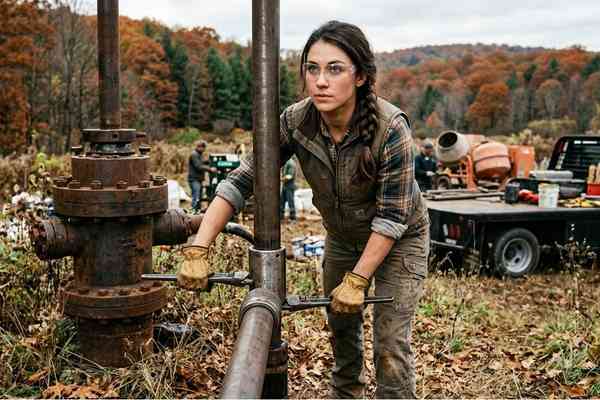
Zefiro's niche is plugging orphaned oil and gas wells that leak methane uncontrollably. Through its US operating subsidiary Plants & Goodwin, Zefiro is working its way through wells in Ohio, Pennsylvania, West Virginia, and most recently Oklahoma and Louisiana, financed in part by federal funds from the Infrastructure Investment and Jobs Act, which provides a total of USD 4.7 billion for the remediation of such contaminated sites. While WM and Veolia have world-renowned major shareholders backing them, Zefiro needs one thing above all else: attention. That is why management recently commissioned the documentary "The Hazard Below". The film, featuring experts from the Environmental Defense Fund and the Ohio River Valley Institute, aims to raise awareness among the US public about the problem of abandoned and orphaned wells—and, incidentally, increase the visibility of Zefiro and Plants & Goodwin. The 25-minute documentary is available here as a YouTube video:
Although a foundation is not a major shareholder in Zefiro, it is a client: since mid-July, the company has been collaborating with the Well Done Foundation, led by former oil executive Curtis Shuck, which has made it its mission to safely plug methane leaks. This opens up further growth potential for Zefiro and Plants & Goodwin, although that potential would be nearly unlimited even without foundation contracts. There are millions of unplugged orphan wells, yet only a handful of specialized companies capable of stopping the escape of this climate-damaging gas.
Like WM and Veolia, Zefiro is also establishing an increasingly important second revenue stream through the sale of carbon credits. Zefiro was the first company ever to successfully market emission credits based on the American Carbon Registry's specially developed "Orphan Well" methodology—that is, certified credits derived from the verifiably avoided methane emissions of a plugged well, which can be sold to companies seeking to improve their own carbon footprint. In the first half of the past fiscal year alone, Zefiro sold approximately 93,000 metric tons of CO₂ equivalent to four different buyers. Looking ahead, the high-margin certificate trading business is expected to become an independent revenue driver alongside the core remediation business.
Three Answers to the Same Question
Whether it is landfill methane in Colorado, CO₂ capture in Europe, or wells in Oklahoma—the task is the same everywhere: to remediate environmental damage caused by others and, increasingly, to build a second business around emissions credits. Only the scale differs by a factor of 1,000, which could present an opportunity for investors. While WM and Veolia have exuded financial strength for decades and, above all, excel as reliable dividend payers, Zefiro is still in the very early stages of a growth story that is increasingly coming to the public's attention. Analysts' price targets for WM average around USD 260, which, at a current price of USD 224, represents upside potential of 16%. For Veolia, experts estimate the fair value of the stock at an average of just over EUR 40, suggesting upside potential of around 20%. The stock is also attractive due to its dividend yield, which, at an estimated 4.8% for this year, is nearly three times WM's.
Zefiro Methane is still a long way from paying a dividend. The company is in a phase where growth investments are more important than returning capital to shareholders. Nevertheless, the Canadian firm is on the verge of turning a profit. Analysts at GBC Research expect a positive net income of USD 0.04 per share for the 2026/27 fiscal year, which began on June 30, resulting in a moderate price-to-earnings (P/E) ratio of 11. This is not only extremely attractive in and of itself for an emerging key player in the environmental sector, but also when compared to Veolia (P/E ratio of 14) or even WM (27). GBC analysts therefore set a price target of USD 1.50, which represents more than 200% profit potential.
Conflict of interest
Pursuant to §85 of the German Securities Trading Act (WpHG), we point out that Apaton Finance GmbH as well as partners, authors or employees of Apaton Finance GmbH (hereinafter referred to as "Relevant Persons") may in the future hold shares or other financial instruments of the mentioned companies or will bet on rising or falling on rising or falling prices and therefore a conflict of interest may arise in the future. conflict of interest may arise in the future. The Relevant Persons reserve the shares or other financial instruments of the company at any time (hereinafter referred to as the company at any time (hereinafter referred to as a "Transaction"). "Transaction"). Transactions may under certain circumstances influence the respective price of the shares or other financial instruments of the of the Company.
Furthermore, Apaton Finance GmbH reserves the right to enter into future relationships with the company or with third parties in relation to reports on the company. with regard to reports on the company, which are published within the scope of the Apaton Finance GmbH as well as in the social media, on partner sites or in e-mails, on partner sites or in e-mails. The above references to existing conflicts of interest apply apply to all types and forms of publication used by Apaton Finance GmbH uses for publications on companies.
Risk notice
Apaton Finance GmbH offers editors, agencies and companies the opportunity to publish commentaries, interviews, summaries, news and etc. on news.financial. These contents serve information for readers and does not constitute a call to action or recommendations, neither explicitly nor implicitly. implicitly, they are to be understood as an assurance of possible price be understood. The contents do not replace individual professional investment advice and do not constitute an offer to sell the share(s) offer to sell the share(s) or other financial instrument(s) in question, nor is it an nor an invitation to buy or sell such.
The content is expressly not a financial analysis, but rather financial analysis, but rather journalistic or advertising texts. Readers or users who make investment decisions or carry out transactions on the basis decisions or transactions on the basis of the information provided here act completely at their own risk. There is no contractual relationship between between Apaton Finance GmbH and its readers or the users of its offers. users of its offers, as our information only refers to the company and not to the company, but not to the investment decision of the reader or user. or user.
The acquisition of financial instruments entails high risks that can lead to the total loss of the capital invested. The information published by Apaton Finance GmbH and its authors are based on careful research on careful research, nevertheless no liability for financial losses financial losses or a content guarantee for topicality, correctness, adequacy and completeness of the contents offered here. contents offered here. Please also note our Terms of use.