November 4th, 2026 | 05:42 CET
Dermatology with Tailwinds: How Galderma Is Deploying Billions, Vidac Pharma Awaits Crucial Clinical Data and Biofrontera Expands
Dermatological research is undergoing a phase of rapid growth. While established corporations generate enormous revenues in systemic therapies, new, targeted approaches to treating precancerous skin lesions are on the verge of clinical validation. High growth rates at Galderma, new approval decisions by the US Food and Drug Administration (FDA) for Biofrontera, and upcoming trial data at Vidac Pharma show how significantly skin disease treatment is changing. We show what opportunities this could create for investors.
time to read: 3 minutes | Author: Nico Popp
ISIN: Vidac Pharma Holding PLC | GB00BM9XQ619 , GALDERMA GROUP AG | CH1335392721 , BIOFRONTERA AG NA | DE0006046113
Table of contents:
Author

Nico Popp
At home in Southern Germany, the passionate stock exchange expert has been accompanying the capital markets for about twenty years. With a soft spot for smaller companies, he is constantly on the lookout for exciting investment stories.
Tag cloud
Shares cloud
Galderma: Expansion and record revenue
Galderma currently provides a clear example of the scalability of modern therapeutic dermatology. The group reports predominantly volume-driven revenue growth, prompting management to raise its full-year forecast to 22.5 to 23.5%. The main driver of this momentum is the biologic Nemluvio, approved in 2024, which generated USD 735 million in revenue in the first nine months. This antibody specifically suppresses chronic itching and illustrates the enormous willingness to pay for systemic therapies in the healthcare sector. Galderma is also consistently diversifying its revenue. The company has announced plans to acquire the premium skincare brand ZO Skin Health for USD 1.5 billion to expand its physician-led aesthetics business in a targeted manner. The transaction is expected to close in the fourth quarter of 2026 or early 2027.
Biofrontera: Challenges in whole-body therapy
Despite significant regulatory progress, Biofrontera's situation reveals the limits of device-based medicine. In mid-September, the FDA granted specialist approval for its Ameluz gel to treat superficial basal cell carcinoma. On October 8, the company also applied to extend approval for this photodynamic therapy to the entire body, enabling treatment of large areas of sun-damaged skin. The business is growing strongly, but cash is tight. At the end of June, Biofrontera had USD 4.7 million in cash and cash equivalents, while the second quarter still posted a small loss of USD 0.6 million despite 33% revenue growth. Placing irradiation lamps in medical practices and distribution remain resource-intensive, and the company itself points to further funding needs. Clinical progress alone therefore does not yet guarantee a profit in the US healthcare market.
Vidac Pharma: Metabolic approach to precancerous skin lesions
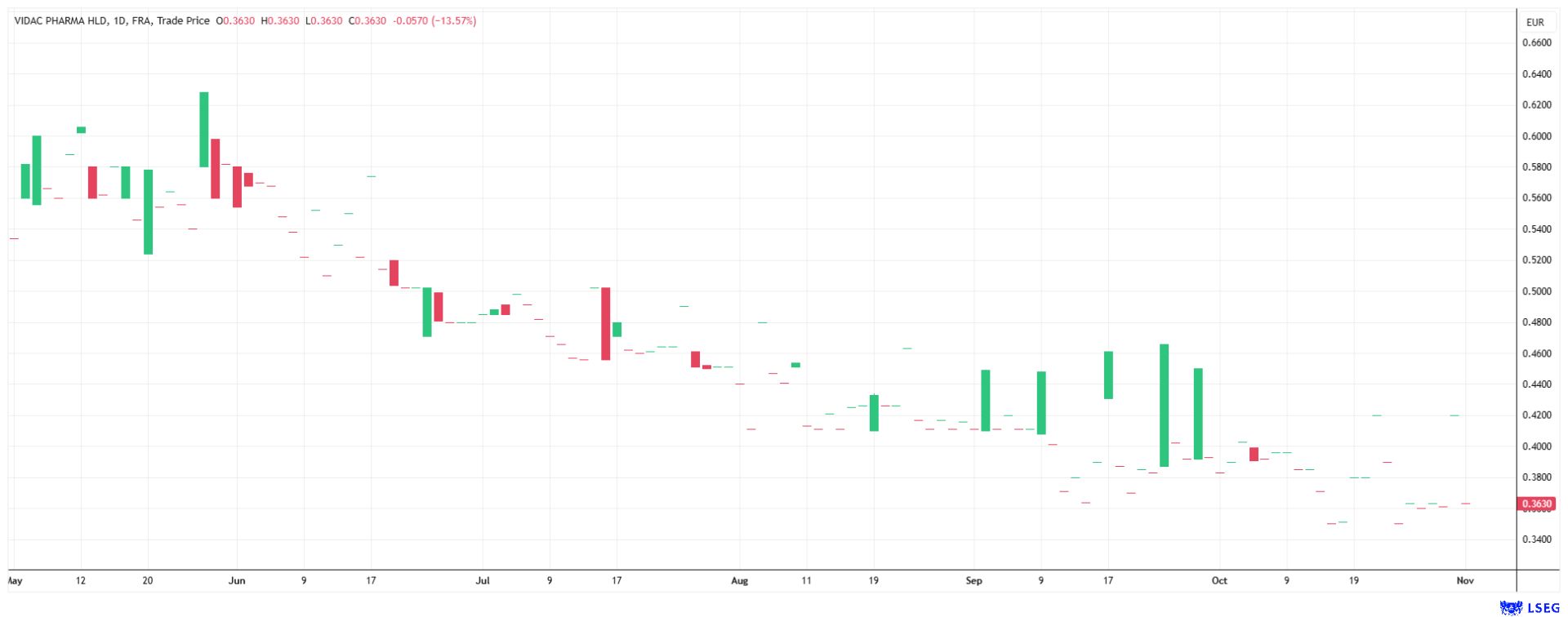
Vidac Pharma is pursuing a fundamentally different approach and is awaiting results from a pivotal trial of its lead candidate, VDA-1102; the company aims to specifically reverse the pathological glucose metabolism of abnormal cells in actinic keratosis. According to the company, healthy skin tissue is to be spared in the process. The active substance prevents the pathological binding of the enzyme hexokinase-2 to mitochondria, thereby reinitiating natural cell death in the affected cells. In a randomised, double-blind and placebo-controlled Phase 2b trial involving 39 patients, the final patient visit took place at CentroDerm in Wuppertal on September 9. Vidac had announced in mid-September that it would present the results "in the coming weeks"; they were not yet available at the editorial deadline. The trial focuses on highly proliferative lesions that carry a particularly high risk of progressing to invasive squamous cell carcinoma. If the data confirm efficacy in severe lesions without significant skin irritation, this would be a strong argument for a Phase 3 trial. As conventional topical chemotherapeutic agents regularly cause severe side effects such as ulceration and pain, many patients discontinue treatment prematurely. Vidac Pharma's onco-metabolic approach is intended to circumvent this problem because, according to the company, it leaves healthy tissue unaffected.
Vidac Pharma: Synergies and strategic expansion
In addition to the direct local treatment of precancerous lesions (precursors to cancer), Vidac Pharma's metabolic approach also opens up broader technological synergies. As part of its clinical evaluation, the company uses so-called line-field confocal OCT. This precision optical diagnostic technique allows researchers to monitor the reduction in cellular atypia in three dimensions in real time, thus sparing patients frequent surgical biopsies. In parallel, Vidac is developing the preclinical candidate VDA-1275, which is intended to extend the concept to solid tumours. Such extensions illustrate the platform's potential to progress from dermatology into broader systemic oncology.
Conclusion: Innovation meets risk
Dermatology is developing into a precise field that is attractive to investors. While Galderma already generates billions from high-priced systemic therapeutics, targeted treatments for precancerous skin lesions offer enormous growth potential. If Vidac Pharma's metabolic approach proves convincing in clinical trials, it could significantly change field therapy for actinic keratosis. Nevertheless, investors should remember that clinical-stage biotech companies are still finding their feet and depend heavily on external capital inflows. As the example of Biofrontera shows, such business models can sometimes entail significant operational hurdles. Shares in research and device companies such as Vidac Pharma and Biofrontera are speculative due to their ongoing capital requirements.
Conflict of interest
Pursuant to §85 of the German Securities Trading Act (WpHG), we point out that Apaton Finance GmbH as well as partners, authors or employees of Apaton Finance GmbH (hereinafter referred to as "Relevant Persons") may hold shares or other financial instruments of the aforementioned companies in the future or may bet on rising or falling prices and thus a conflict of interest may arise in the future. The Relevant Persons reserve the right to buy or sell shares or other financial instruments of the Company at any time (hereinafter each a "Transaction"). Transactions may, under certain circumstances, influence the respective price of the shares or other financial instruments of the Company.
In addition, Apaton Finance GmbH is active in the context of the preparation and publication of the reporting in paid contractual relationships.
For this reason, there is a concrete conflict of interest.
The above information on existing conflicts of interest applies to all types and forms of publication used by Apaton Finance GmbH for publications on companies.
Risk notice
Apaton Finance GmbH offers editors, agencies and companies the opportunity to publish commentaries, interviews, summaries, news and the like on news.financial. These contents are exclusively for the information of the readers and do not represent any call to action or recommendations, neither explicitly nor implicitly they are to be understood as an assurance of possible price developments. The contents do not replace individual expert investment advice and do not constitute an offer to sell the discussed share(s) or other financial instruments, nor an invitation to buy or sell such.
The content is expressly not a financial analysis, but a journalistic or advertising text. Readers or users who make investment decisions or carry out transactions on the basis of the information provided here do so entirely at their own risk. No contractual relationship is established between Apaton Finance GmbH and its readers or the users of its offers, as our information only refers to the company and not to the investment decision of the reader or user.
The acquisition of financial instruments involves high risks, which can lead to the total loss of the invested capital. The information published by Apaton Finance GmbH and its authors is based on careful research. Nevertheless, no liability is assumed for financial losses or a content-related guarantee for the topicality, correctness, appropriateness and completeness of the content provided here. Please also note our Terms of use.