September 15th, 2026 | 10:25 CEST
Defence Stocks Ride the NATO Wave: Boeing, Volatus, Dassault, RTX and DroneShield in Focus
Since Russia's initial actions in Central Europe, the European Union has faced a massive wave of rearmament driven by new NATO requirements, giving the defence industry a significant boost. EU Defence Commissioner Andrius Kubilius called for an unprecedented expansion of European capabilities in Brussels to match Russia's enormous production capacity. To achieve this goal, the EU is aiming to produce up to 10 million state-of-the-art FPV drones and 130,000 jet-powered drones annually. In addition, the defence industry is expected to roll out about 1,700 ballistic missiles per year. Industry giants such as Boeing and Dassault are likely to benefit significantly from this massive technological rearmament initiative. At the same time, specialized drone pioneers like Volatus and DroneShield are stepping into the spotlight as demand for unmanned systems and their countermeasures rises dramatically. A newly formed drone alliance between the EU and Ukraine is now set to accelerate the development of these next-generation systems massively. Which stocks could see the biggest gains?
time to read: 5 minutes | Author: André Will-Laudien
ISIN: DRONESHIELD LTD | AU000000DRO2 , BOEING CO. DL 5 | US0970231058 , RTX CORPORATION | US75513E1010 , VOLATUS AEROSPACE INC | CA92865M1023 | TSXV: FLT , OTCQB: TAKOF , DASSAULT AVIATION INH.EO8 | FR0000121725
Table of contents:
Author

André Will-Laudien
Born in Munich, he first studied economics and graduated in business administration at the Ludwig-Maximilians-University in 1995. As he was involved with the stock market at a very early stage, he now has more than 30 years of experience in the capital markets.
Tag cloud
Shares cloud
Boeing and RTX Corp: At the Centre of the New EU Military Offensive
The arms race continues and is accelerating. The EU's new ambitious plans are accompanied by official approval of an additional EUR 6.1 billion in EU military aid for Kyiv. These funds will go directly toward purchasing ammunition, drones, electronic warfare equipment, and modern air defence systems. Thanks to a special provision by the member states, Ukraine may now even use the money to acquire US Patriot PAC-3 air defence missiles. Commission President Ursula von der Leyen emphasized that this would protect Ukrainian airspace while simultaneously strengthening Europe's own defence. In total, EUR 28.3 billion has already been allocated for military support through the current EU support loan.
Boeing and RTX (formerly Raytheon Technologies) are key players in Ukraine's announced purchase of US Patriot air defence missiles. As the lead defence contractor, RTX manufactures the entire Patriot air defence system as well as the tactical guided missiles. At the same time, Boeing supplies the highly complex seeker heads, which are indispensable as the technological core for the precise target acquisition of the PAC-3 interceptor missiles. With demand in Europe surging, Boeing has agreed with the Pentagon to triple production of these seeker heads. At the same time, RTX is significantly expanding its collaborations with European partners to ramp up production capacity for missile and air defence components across the entire continent. Both US giants are benefiting directly from the European multi-billion-euro funding package, as they supply the urgently needed high-tech systems for Ukrainian airspace. Exciting!
Dassault Aviation: France's Trump Card in European Airspace
Dassault Aviation is also contributing its in-depth expertise in networked air combat systems and state-of-the-art fighter jets to European defence plans. Following the end of the trilateral FCAS jet project, the French defence contractor is now intensively pushing forward with the development of the new Rafale F5 standard, which is considered the technological centrepiece of future air combat. This modernized platform is specifically designed to operate in "collaborative combat" alongside advanced combat drones and unmanned escort systems (Loyal Wingman). In addition, Dassault benefits directly from European financial aid, as Ukraine recently placed a historic order for 16 Rafale fighter jets, which are being co-financed through the EU support loan. With its advanced electronic warfare and digital networking systems, the company supplies key high-tech components that the EU requires to maintain its sovereignty in the air. The stock has recently consolidated significantly and, at EUR 282, is back at last fall's level.
Volatus Aerospace: The First Major Government Contract Is Here
Almost unnoticed, the Canadian company Volatus Aerospace is undergoing a remarkable transformation from a specialized drone service provider to an integrated Canadian aerospace and defence platform. The key driver is the government's Defence Drone Initiative (DDI) Marketplace, through which Volatus is now qualified in all five service areas. The offering ranges from unmanned systems and counter-UAS to communications and data, as well as engineering, training, and innovation. This gives the company access to a significantly broader spectrum of future Canadian defence contracts.
The crucial step from potential to revenue has now also been taken, as Canada has awarded Volatus a 5-year contract to supply tactical ISR drone systems to the Canadian Armed Forces. Initially, 100 systems are to be delivered, with an option for an additional 4,900 units. Theoretically, the procurement volume could thus rise to as many as 5,000 drones. However, the optional systems do not yet constitute an order backlog and therefore do not represent guaranteed revenue. The contract's strategic value extends far beyond the initial tranche, as Volatus is supplying not only the aircraft but a complete ISR solution, including sensors, ground stations, data links, training, spare parts, software, and ongoing support. This unique, integrated model could prove to be a decisive competitive advantage in future government contracts.
In addition, Volatus is consistently expanding its industrial base in Canada. The innovation and manufacturing centre in Mirabel, as well as the Operations Control Centre in Vaughan, provide the infrastructure to cover development, production, integration, and operations all under one roof. As a result, what was previously a drone business is increasingly evolving into a scalable defence platform with recurring service, maintenance, and training components. The decisive factor is the rapidly growing demand among Western nations for cost-effective, rapidly deployable, domestically produced unmanned systems. The latest government contract demonstrates for the first time that Volatus can translate its technological position into a commercial defence contract. Delivery of the first 100 systems is scheduled to begin as early as the fourth quarter of 2026. At the same time, the existing growth potential remains substantial, as qualification for all five DDI divisions opens the door to further tenders.
From an investor's perspective, the narrative is thus shifting from a speculative bet on the drone market to an increasingly robust story of orders and scaling within the Canadian defence sector. Risk-tolerant investors are now hopeful and watching closely to see how quickly Volatus can win additional DDI tenders and fully utilize its existing manufacturing and integration capacity in Mirabel. If this scaling up is successful, the first CAF contract could serve as a door-opener for a significantly larger role within the Canadian and allied defence industries.
CEO Glen Lynch in conversation with IIF host Lyndsay Malchuk about the company's medium-term strategy.
https://youtu.be/ 9Jnd8XALNZ4
DroneShield: Back in Sell Mode Again
Despite strong operating revenue and a high volume of contracted orders, DroneShield shares are plummeting to new yearly lows near EUR 1.00, after trading at EUR 3.80 in the fall of 2025. The main reason for the significant price decline is severe margin compression, which has pushed the company into the red despite its growth. A sharp rise in operating costs led to an unexpectedly high net loss of AUD 32.2 million. With a market capitalization of over AUD 1.5 billion, the EU orders now secured were likely already priced into the stock, which is why investors are now liquidating their speculative positions. From a technical analysis perspective, testing psychological levels threatens to bring additional trouble. The stock thus remains a classic case where the order book appears unable to offset selling pressure. Be careful at the edge of the platform, because fundamentally, with a 2026 P/E ratio of 7, the stock is still not cheap!
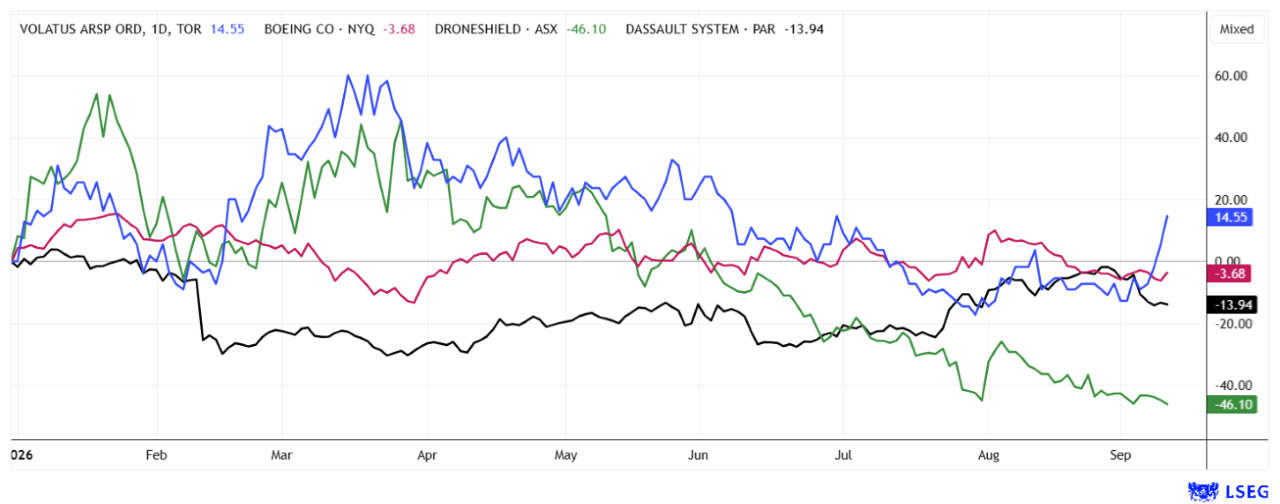
The stock market is suffering from high oil prices. Other factors include rising interest rates, ongoing geopolitical turmoil, and an urgent need for a correction in the completely overvalued high-tech sector. Defence also seems to be becoming a never-ending theme, boosting OEMs as well as the specialty stock Volatus Aerospace. With its first government contract, the stock is now rising rapidly. A well-balanced portfolio protects against major fluctuations in your portfolio.
Conflict of interest
Pursuant to §85 of the German Securities Trading Act (WpHG), we point out that Apaton Finance GmbH as well as partners, authors or employees of Apaton Finance GmbH (hereinafter referred to as "Relevant Persons") currently hold or hold shares or other financial instruments of the aforementioned companies and speculate on their price developments. In this respect, they intend to sell or acquire shares or other financial instruments of the companies (hereinafter each referred to as a "Transaction"). Transactions may thereby influence the respective price of the shares or other financial instruments of the Company.
In this respect, there is a concrete conflict of interest in the reporting on the companies.
In addition, Apaton Finance GmbH is active in the context of the preparation and publication of the reporting in paid contractual relationships.
For this reason, there is also a concrete conflict of interest.
The above information on existing conflicts of interest applies to all types and forms of publication used by Apaton Finance GmbH for publications on companies.
Risk notice
Apaton Finance GmbH offers editors, agencies and companies the opportunity to publish commentaries, interviews, summaries, news and the like on news.financial. These contents are exclusively for the information of the readers and do not represent any call to action or recommendations, neither explicitly nor implicitly they are to be understood as an assurance of possible price developments. The contents do not replace individual expert investment advice and do not constitute an offer to sell the discussed share(s) or other financial instruments, nor an invitation to buy or sell such.
The content is expressly not a financial analysis, but a journalistic or advertising text. Readers or users who make investment decisions or carry out transactions on the basis of the information provided here do so entirely at their own risk. No contractual relationship is established between Apaton Finance GmbH and its readers or the users of its offers, as our information only refers to the company and not to the investment decision of the reader or user.
The acquisition of financial instruments involves high risks, which can lead to the total loss of the invested capital. The information published by Apaton Finance GmbH and its authors is based on careful research. Nevertheless, no liability is assumed for financial losses or a content-related guarantee for the topicality, correctness, appropriateness and completeness of the content provided here. Please also note our Terms of use.