October 1st, 2026 | 07:45 CEST
Decentralized Instead of Power Shortages: A Comparison of Siemens Energy, 2G Energy and A.H.T. Syngas
When the power grid reaches its limits and power shortages loom, even wind turbines and solar farms are of no help. What is needed then is controllable generation, and combined heat and power (CHP) is considered a key bridging technology. Growing energy demand from industry and AI infrastructure calls for systems that can balance fluctuating feed-in from renewable energy sources. Solutions range from gigawatt-scale power plants to decentralized compact systems. We introduce three companies and shed light on this trend.
time to read: 4 minutes | Author: Nico Popp
ISIN: SIEMENS ENERGY AG NA O.N. | DE000ENER6Y0 , 2G ENERGY AG | DE000A0HL8N9 , A.H.T. SYNGAS TECH. EO 1 | NL0010872388
Table of contents:
Author

Nico Popp
At home in Southern Germany, the passionate stock exchange expert has been accompanying the capital markets for about twenty years. With a soft spot for smaller companies, he is constantly on the lookout for exciting investment stories.
Tag cloud
Shares cloud
Siemens Energy: Gigawatt Projects in Asia
Siemens Energy is known for large-scale power plant architectures that offer significant economies of scale. Such solutions are in demand worldwide. In mid-September, the Malaysian energy utilities YTL Power and Ganda Power signed reservation agreements with Siemens Energy for four additional large SGT-9000HL-class gas turbines. Together with three units already secured, the two utilities now have a total of seven turbines with a combined capacity of over 5,250 MW, intended for projects in Malaysia and the region. Large combined-cycle power plants of this type form the backbone of stable grids, particularly in rapidly growing emerging markets. However, they require significant capital, lengthy permitting cycles, and well-developed transmission grids. In densely populated Western European energy markets, such gigawatt-scale facilities are increasingly reaching the limits of public acceptance and feasibility.
2G Energy: Container-Based Power Plants for AI Data Centres
2G Energy is pursuing an agile, decentralized approach. The power plant builder, based in Heek in the Münsterland region, is demonstrating how quickly it can secure orders with modular solutions. Data centres' electricity demand is overwhelming grid infrastructure in many places, leading operators to increasingly rely on on-site generation. On September 23, 2G Energy received an order from the US-based company Energy Vault for containerized power plant modules with a total capacity of 275 MW. The systems are intended for AI and data centre customers in the US and are scheduled for delivery between late 2027 and fall 2028. There, they will work in conjunction with battery storage and control technology from Energy Vault. Rather than waiting for the slow expansion of power transmission lines, clients are opting for pre-assembled modules. This plug-and-play design shortens installation times and keeps pace with the tech industry's product cycles. The shift from custom plant construction to modular series production is noticeably transforming the industry.
A.H.T. Syngas: Wood Gasification Meets KWKG Tailwind
A.H.T. Syngas Technology is also focusing on decentralized solutions. Thermochemical wood gasification was long considered a challenging technology because aggressive tars form during the gasification process. A.H.T. addresses this problem with the Twin-Fire process. The reactor combines co-current and counter-current gasification in two separate zones and breaks down long-chain hydrocarbons in situ. A downstream, multi-stage gas cleaning system reduces the tar content to such an extent that the synthesis gas can be used in gas engines without damaging them. This allows inexpensive residual materials such as roadside vegetation or waste wood to be used instead of expensive wood pellets, reducing fuel costs.
Support is coming from Berlin. The Federal Ministry for Economic Affairs has presented key points for an amendment to the Combined Heat and Power Act (KWKG); it is aiming for a cabinet decision in the fall. The plan is to extend the subsidy program through 2035, increase the annual budget for heating networks and storage from EUR 150 to 400 million, and double the subsidy cap per heating network project to EUR 100 million. At the same time, the European RED III Directive is tightening the sustainability requirements for wood energy. In the future, the certification requirement will apply starting at 7.5 MW of thermal output, rather than 20 MW as was previously the case. Smaller plants can remain below this threshold. With compact plants starting at 200 kW of electrical output, A.H.T. covers precisely this segment, thereby offering municipalities an option for the local heat transition.
A.H.T. Syngas: New Management Team and Poland as a Growth Driver
In September, Dr. Diego Freydl, who has been supporting A.H.T. as an investor and advisor for more than eight years, took over as CEO. He aims to broaden the product portfolio, reduce dependence on the capital-intensive project business, and strengthen recurring revenue. A.H.T. had already begun transitioning to operating its own plants at the start of the year and, to that end, issued a convertible bond worth EUR 2.0 million in January (5% coupon, conversion price of EUR 1.25). Former CEO Gero Ferges will now focus on plant development as Chief Technology Officer. Peter Biewald has joined the Executive Board as Chief Financial Officer. Management sees Poland as the greatest driver of growth. Together with its partner and shareholder INNOTEC ENERGY, A.H.T. is working on 17 plant projects, and management anticipates an order volume of at least EUR 10 million from ongoing activities by 2026.
A.H.T. Syngas: Weak First Half, GBC Sees Potential
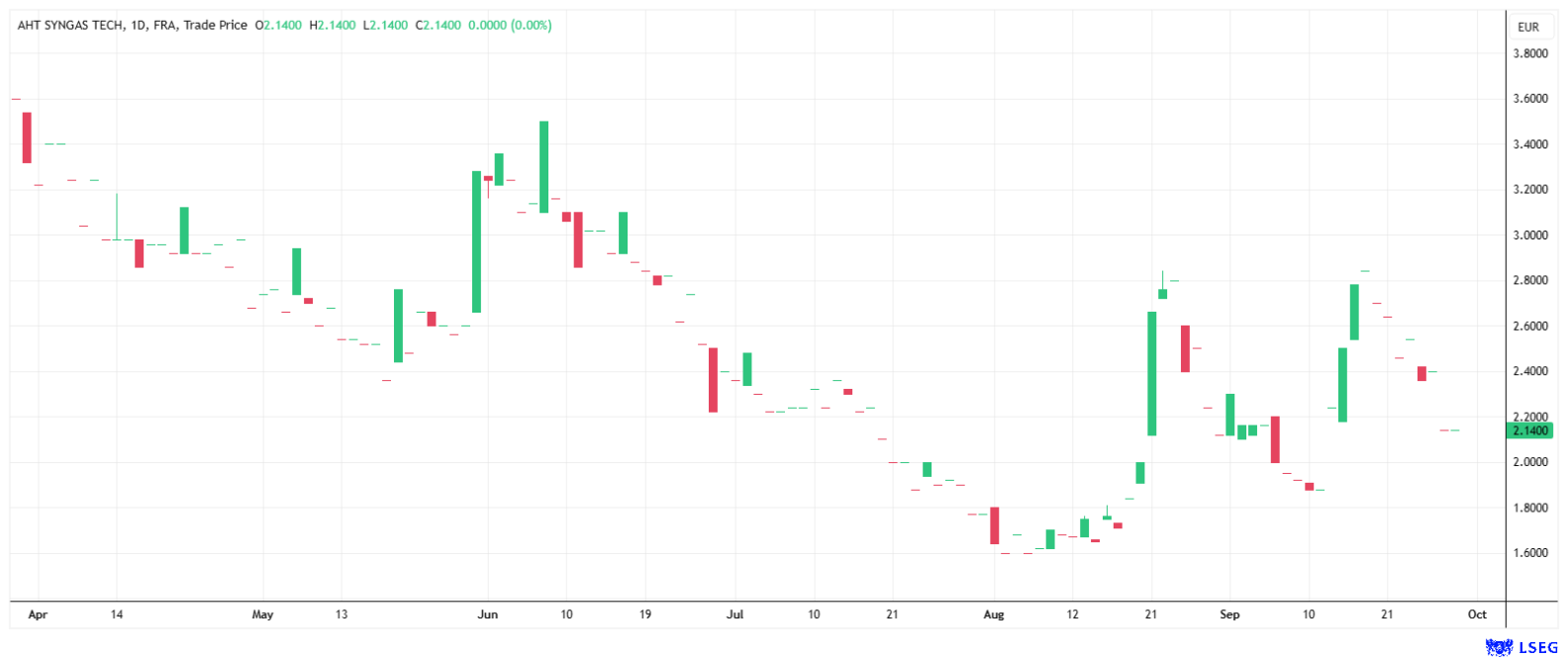
The half-year results presented at the end of September highlight the urgency of the situation. Revenue fell to less than EUR 0.1 million in the first half of 2026 (previous year: EUR 1.9 million), resulting in a net loss of EUR 1.3 million. Shareholders' equity shrank to EUR 0.53 million. Management attributes this development to delays in finalizing projects and remains confident that it will be able to quickly convert several projects into contracts. The stock is trading at around EUR 2.10, bringing the market capitalization to just around EUR 5 million. Analysts at GBC AG lowered their December 2025 price target from EUR 20.20 to EUR 8.50 and maintained their "Buy" rating. However, their forecasts were based on significantly higher revenue for 2026; an update following the half-year results is still pending. If the new management team succeeds in converting the projected order volumes into binding contracts, this will open up opportunities. If the orders fail to materialize, the stock is likely to come under further pressure. The stock is therefore a play for experienced, risk-aware turnaround speculators.
Conflict of interest
Pursuant to §85 of the German Securities Trading Act (WpHG), we point out that Apaton Finance GmbH as well as partners, authors or employees of Apaton Finance GmbH (hereinafter referred to as "Relevant Persons") may hold shares or other financial instruments of the aforementioned companies in the future or may bet on rising or falling prices and thus a conflict of interest may arise in the future. The Relevant Persons reserve the right to buy or sell shares or other financial instruments of the Company at any time (hereinafter each a "Transaction"). Transactions may, under certain circumstances, influence the respective price of the shares or other financial instruments of the Company.
In addition, Apaton Finance GmbH is active in the context of the preparation and publication of the reporting in paid contractual relationships.
For this reason, there is a concrete conflict of interest.
The above information on existing conflicts of interest applies to all types and forms of publication used by Apaton Finance GmbH for publications on companies.
Risk notice
Apaton Finance GmbH offers editors, agencies and companies the opportunity to publish commentaries, interviews, summaries, news and the like on news.financial. These contents are exclusively for the information of the readers and do not represent any call to action or recommendations, neither explicitly nor implicitly they are to be understood as an assurance of possible price developments. The contents do not replace individual expert investment advice and do not constitute an offer to sell the discussed share(s) or other financial instruments, nor an invitation to buy or sell such.
The content is expressly not a financial analysis, but a journalistic or advertising text. Readers or users who make investment decisions or carry out transactions on the basis of the information provided here do so entirely at their own risk. No contractual relationship is established between Apaton Finance GmbH and its readers or the users of its offers, as our information only refers to the company and not to the investment decision of the reader or user.
The acquisition of financial instruments involves high risks, which can lead to the total loss of the invested capital. The information published by Apaton Finance GmbH and its authors is based on careful research. Nevertheless, no liability is assumed for financial losses or a content-related guarantee for the topicality, correctness, appropriateness and completeness of the content provided here. Please also note our Terms of use.