October 1st, 2026 | 07:30 CEST
Trends Put to the Test: Where Fundamentals Meet a Share Price Rally—2G Energy, Hapag-Lloyd and Lahontan Gold
Geopolitical upheavals, the enormous energy demands of digital infrastructure, and the global search for real tangible assets are shaping the 2026 stock market year. Remarkable dynamics are emerging on international trading platforms. Cyclical market leaders are reporting repeated upward revisions to their forecasts, innovative power plant builders are recording historic record orders, and promising mineral resource developers are on the verge of transitioning to industrial-scale production. But which price drivers have real sustainability, and where might operational risks lurk?
time to read: 7 minutes | Author: Stefan Bode
ISIN: 2G ENERGY AG | DE000A0HL8N9 , LAHONTAN GOLD CORP | CA50732M1014 | TSXV: LG , OTCQB: LGCXF , HAPAG-LLOYD AG NA O.N. | DE000HLAG475
Table of contents:
Author

Stefan Bode
A native of the Eichsfeld region in the heart of Germany, he has more than 30 years of experience in the capital markets, with broad expertise spanning financial markets, history, and geopolitics. He founded his own business more than 20 years ago while still a student and today advises clients, foundations, and asset managers across four continents.
Tag cloud
Shares cloud
Hapag-Lloyd Jumps 9.7%: Are High Freight Rates Enough for Billion-Euro Profits?
A 9.7% gain in a single day: Hapag-Lloyd was responsible for one of the most striking movements on the German stock market this Tuesday. At EUR 144.3, the stock reached its highest level in months. The catalyst was an upward revision to its forecast published on Monday evening. The Hamburg-based shipping company is apparently earning significantly more from container transport than previously expected. But how robust is the new profit forecast?
For 2026, Hapag-Lloyd now anticipates an operating profit before interest and taxes (EBIT) of EUR 1.1 to 1.5 billion. The previous range was only EUR 0.1 to 1.0 billion. The Executive Board has also raised its EBITDA forecast from between EUR 2.3 and 3.2 billion to EUR 3.4 to 3.8 billion. This is already the second upward revision since July. The drivers are persistently strong demand and higher prices for container shipments booked on short notice.
A look back at the first half of the year illustrates just how strong the turnaround would need to be in the second half. In the first six months, Hapag-Lloyd generated just EUR 16 million in EBIT on revenue of EUR 9.2 billion. The bottom line was a loss of EUR 148 million. Although the second quarter already yielded an operating profit of EUR 150 million, the shipping company must generate approximately EUR 1.1 to 1.5 billion in EBIT in the second half of the year to meet the new annual forecast. Shareholders are counting on precisely this jump in earnings.
The market has good reasons for this. In the second quarter, Hapag-Lloyd transported more containers than in the same period last year, while the average freight rate rose by 9%. Strong exports from Asia and improved demand from the US boosted business. At the same time, conflicts and reroutings can tie up ships for longer periods, making available transport capacity scarcer. For the shipping company, however, this is a double-edged sword: longer routes also drive up fuel, insurance and logistics costs.
The burden has been significant recently. In the second quarter alone, Hapag-Lloyd estimated the additional costs resulting from the Middle East conflict at the equivalent of approximately EUR 0.5 billion. While the growing terminal business creates a second source of revenue, it is still too small to offset fluctuations in container shipping. Spot freight rates react quickly to bottlenecks. They can fall just as quickly when routes shorten again, or additional ships enter the market. The key factor, therefore, is how much of the higher shipping prices translates into profit.
Since the beginning of the year, the stock has gained about 22.9%. At the current price, it is still EUR 15.0 away from its 52-week high of EUR 159.3. The new forecast provides a strong argument for the rally but also raises expectations. Hapag-Lloyd itself warns of volatile freight rates and geopolitical uncertainty. The next set of financial results must show whether the company can turn high demand into the announced billions in profit.
Lahontan Gold: A Fundamental Milestone in Nevada
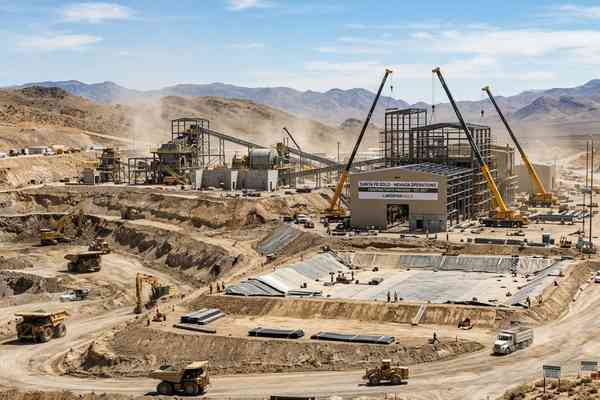
The 2026 macroeconomic environment is presenting mining developers with conflicting stock-market trends. While a restrictive interest rate regime traditionally weighs on non-interest-bearing investments, persistent inflation risks and geopolitical tensions are supporting gold's robust price above USD 4,000. In this market environment, Lahontan Gold is accelerating its fundamental transformation from a pure exploration company to a prospective producer in Nevada. The core Santa Fe project is rapidly evolving from a geological prospect into a planable business complex where deposit quality, local logistics, and capital discipline must all align.
The confirmed resource base provides the quantitative foundation for the targeted start of production by the end of 2027. With 1.195 million ounces of gold equivalent in the indicated resource category and 1.19 million ounces in the inferred resource category, the property possesses substantial potential. Because the deposit has historically been developed via open-pit mining with heap leaching, the project benefits from existing infrastructure and historical drilling data. However, the pending Preliminary Economic Assessment (PEA) must still demonstrate the potential returns on equity at various precious metal prices. The methodological inclusion of sulfide ore alongside oxidized material increases the production volume but also imposes higher technical requirements on the metallurgical processing.
The recent merger with Emergent Metals marked a strategic turning point, leading to full consolidation of the gold-bearing project area. Through this step, the Group secures unrestricted ownership of the West Santa Fe project and expands its property in the high-grade Walker Lane Formation to over 93 km². In addition to acquiring the adjacent New York Canyon area, this consolidation eliminates future liabilities and royalties totalling approximately USD 1.73 million and results in the cancellation of 2.0 million treasury shares. Given the minimal dilution of just 4.7% for the target company's existing shareholders, this transaction significantly strengthens the company's profile while preserving its existing liquidity buffer.
The latest drill core analyses from the second leach pad also provide operational momentum. The first ten sound-drilling holes returned, among other things, 16.5 m grading 2.72 g/t gold and 2.8 g/t silver, while the weighted average grade stands at 0.54 g/t gold equivalent. This grade significantly exceeds the historical residual grade of the tailings material (0.32 g/t gold). It opens up the option of monetizing tailings rock already extracted from the former mine through cyanide leaching in the near future. Such processing could generate positive operating cash flows ahead of schedule and significantly reduce the project's upcoming financing requirements.
The market valuation has so far failed to adequately reflect this reduction in operational risk. With a share price of CAD 0.395, the market capitalization, based on 432.5 million outstanding shares, stands at approximately CAD 171 million, leaving ample room for a re-rating. Key factors for the stock's future performance now include prompt regulatory approvals, PEA submission, and a viable financing model for mine construction. The current risk-reward ratio favors long-term investors, as a successful decision to proceed with construction is likely to gradually reclassify the security from a high-risk exploration play to a cash-flow-rich mining operation.
2G Energy Surges After EUR 400 Million in Orders: Is the Data Centre Boom Taking Off Now?
New orders totaling more than EUR 400 million in just one quarter—and for the second quarter in a row. 2G Energy presented new figures on Tuesday of this week that have caught investors' attention. The stock rose 8.6% on Xetra to EUR 60.9. Since the start of the year, the gain has been around 68.9%. The rally raises the question of whether the order boom will soon translate into a corresponding jump in profits.
The manufacturer of decentralized power plants and combined heat and power (CHP) systems now also supplies containerized power solutions for data centers. A recently confirmed major order covers 275 megawatts of capacity, which, according to the company, exceeds its total production for the year 2025. The customer has already made a down payment in the mid-double-digit millions. This makes the order more binding than a mere reservation. Large orders have also come from the mining sector; the heat pump business is also developing positively.
Data centres need a reliable power supply, even as their demand grows rapidly. 2G offers modular power plants designed to cover both base load and peak demand. Thus, the expansion of digital infrastructure is becoming a concrete business involving equipment and related services.
The Executive Board is responding with higher growth targets. For 2027, 2G now expects revenue of EUR 600 to 650 million, up from the previously projected EUR 570 to 620 million. For 2028, the company is forecasting EUR 750 to 850 million for the first time. By comparison, revenue stood at EUR 398 million in 2025. If the new projections prove accurate, the business could nearly double within three years. Starting in 2027, the EBIT margin is also expected to rise to more than 11%.
But this is the crucial catch for investors. Orders do not yet translate into revenue, and revenue does not yet translate into profits. In the first half of 2026, total revenue fell by 4.7% to EUR 184 million. EBIT dropped from EUR 5.7 million to just EUR 0.8 million; the margin shrank from 3.3% to 0.6%. Personnel expenses rose 17.3%, partly due to acquisitions and the expansion of the workforce for the coming years. The large data centre projects have yet to prove their profitability.
For 2026, 2G continues to target the upper end of its revenue range of EUR 440 to 490 million and an EBIT margin of 9.5 to 10.5%. Delivery under the first major data centre contract is scheduled to begin in the fourth quarter. According to the company, revenue is not recognised until the individual power plants have arrived in the US. Delays in production ramp-up or transportation could therefore significantly affect earnings timing.
With a market capitalization of approximately EUR 1.1 billion, the company's market value is nearly three times its 2025 revenue. At the same time, despite today's jump, the stock is still trading about 20% below its 52-week high of EUR 76.30. Whether the recovery continues depends less on the next major order than on its execution. If 2G successfully converts its full order books into profitable revenue on time, the data centre story will gain a solid foundation. The upcoming quarterly results must demonstrate exactly that.
Hapag-Lloyd is benefiting from rising freight rates and robust demand, but must defend its raised annual targets against significant geopolitical cost overruns in the second half of the year. Lahontan Gold is accelerating the transition from exploration to production in Nevada, with a solid resource base and recent acquisitions laying the groundwork for planned production starting in 2027. Thanks to the global data centre boom, 2G Energy is recording historic order intake, but now faces the challenge of quickly converting its full order book into operating profits.
Conflict of interest
Pursuant to §85 of the German Securities Trading Act (WpHG), we point out that Apaton Finance GmbH as well as partners, authors or employees of Apaton Finance GmbH (hereinafter referred to as "Relevant Persons") may hold shares or other financial instruments of the aforementioned companies in the future or may bet on rising or falling prices and thus a conflict of interest may arise in the future. The Relevant Persons reserve the right to buy or sell shares or other financial instruments of the Company at any time (hereinafter each a "Transaction"). Transactions may, under certain circumstances, influence the respective price of the shares or other financial instruments of the Company.
In addition, Apaton Finance GmbH is active in the context of the preparation and publication of the reporting in paid contractual relationships.
For this reason, there is a concrete conflict of interest.
The above information on existing conflicts of interest applies to all types and forms of publication used by Apaton Finance GmbH for publications on companies.
Risk notice
Apaton Finance GmbH offers editors, agencies and companies the opportunity to publish commentaries, interviews, summaries, news and the like on news.financial. These contents are exclusively for the information of the readers and do not represent any call to action or recommendations, neither explicitly nor implicitly they are to be understood as an assurance of possible price developments. The contents do not replace individual expert investment advice and do not constitute an offer to sell the discussed share(s) or other financial instruments, nor an invitation to buy or sell such.
The content is expressly not a financial analysis, but a journalistic or advertising text. Readers or users who make investment decisions or carry out transactions on the basis of the information provided here do so entirely at their own risk. No contractual relationship is established between Apaton Finance GmbH and its readers or the users of its offers, as our information only refers to the company and not to the investment decision of the reader or user.
The acquisition of financial instruments involves high risks, which can lead to the total loss of the invested capital. The information published by Apaton Finance GmbH and its authors is based on careful research. Nevertheless, no liability is assumed for financial losses or a content-related guarantee for the topicality, correctness, appropriateness and completeness of the content provided here. Please also note our Terms of use.