February 20th, 2026 | 07:20 CET
Commodity rush at Almonty Industries, sell-off at SAP and Gerresheimer – where it is worth getting in now
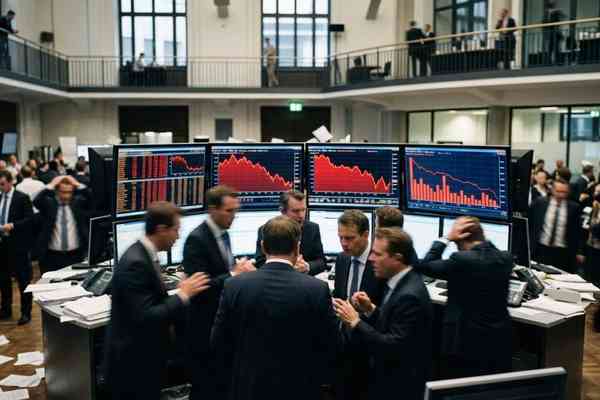
Three companies, two setbacks – and one strategic opportunity. While Almonty Industries is successfully ramping up its tungsten project in South Korea and positioning itself as a Western commodity pillar, SAP and Gerresheimer have recently experienced difficult stock market phases. The cloud company fell well short of its quarterly targets and lost 17%, while the pharmaceutical equipment supplier is struggling with its third consecutive decline in revenue despite booming GLP-1 therapies. Almonty, SAP, and Gerresheimer are prime examples of how different strategic importance and market volatility can be at present. We analyze the current situations.
time to read: 5 minutes | Author: Armin Schulz
ISIN: ALMONTY INDUSTRIES INC. | CA0203987072 , SAP SE O.N. | DE0007164600 , GERRESHEIMER AG | DE000A0LD6E6
Table of contents:
Author

Armin Schulz
Born in Mönchengladbach, he studied business administration in the Netherlands. In the course of his studies he came into contact with the stock exchange for the first time. He has more than 25 years of experience in stock market business.
Tag cloud
Shares cloud
Almonty Industries – The strategic tungsten supplier continues to gain momentum
The global raw materials landscape is undergoing fundamental change – and tungsten is becoming the focus of geopolitical strategies. China controls over 80% of global production and has recently imposed massive restrictions on its exports. The US, in turn, will no longer allow Chinese tungsten to be used for defense procurement from 2027 onwards. This environment is creating a supply gap that someone will have to fill. Almonty has positioned itself precisely there, as a Western-oriented producer with projects in South Korea, Portugal, and the US. The timing could hardly be better, as tungsten prices will have more than doubled by 2025 and will remain at elevated levels.
The Sangdong mine in South Korea is at the heart of Almonty's expansion. In December 2025, the first truck carrying ore was driven to the processing plant, marking the symbolic transition from the construction phase to the production phase. Commercial production is scheduled to start in the first quarter of 2026, with a second expansion phase already planned for 2027. Sangdong could then supply over 460,000 MTU of tungsten annually. Long-term purchase agreements with the US defense industry provide visibility. At the same time, Almonty is pushing ahead with the exploration of a high-grade molybdenum deposit and has expanded its footprint in the US with the acquisition of a project in Montana. The Gentung Browns Lake project is also scheduled to go into production in 2026.
Almonty placed two capital increases in the US in 2025, raising over USD 219 million gross. The coffers are therefore well filled for the growth phase. The management team has been deliberately staffed with experienced minds. A retired brigadier general is responsible for logistics as COO, and two national security experts sit on the supervisory board. This underscores the company's commitment to being a reliable partner to Western governments. For investors who are betting on the structural shortage of critical raw materials and are willing to take operational risks, Almonty is currently one of the most direct ways to profit from this megatrend. The stock is currently trading at USD 14.51 on the NASDAQ.
SAP - Transformation gains momentum
SAP delivered in the past fiscal year 2025. Cloud revenue climbed 26% to just under EUR 21.7 billion, while total revenue increased by 11% on a currency-adjusted basis. The cloud order backlog reached a record level of EUR 77 billion, an increase of 30%. This figure is so important because it already secures revenue for the coming years through contracts. At the same time, the operating margin improved to 28.2%, and free cash flow nearly doubled to EUR 8.2 billion. These are not superficial growth figures, but evidence of a transformation that is slowly but surely making its way onto the income statement.
Artificial intelligence is no longer a topic for the future at SAP, but has already arrived in day-to-day business. Two-thirds of all new cloud contracts in the fourth quarter included AI components. In the case of the largest deals, this was even true in 90% of cases. The strategy of integrating AI deeply into business processes rather than just docking it superficially seems to be paying off. Customers such as adidas and Daimler Truck are relying on a combination of cloud migration and AI functionality. Support for the old SAP ECC system will end in 2027, and for thousands of companies, 2026 will be the year they decide whether and how to move to the cloud. This is creating a clear surge in demand.
Despite solid operational performance, the market reacted negatively because growth in the short-term cloud order backlog was slightly lower than hoped for. The stock came under pressure, and SAP temporarily lost its status as Germany's most valuable company. Management countered with a new share buyback program worth up to EUR 10 billion, while the dividend is set to rise by 6.4% to EUR 2.50. This underscores the company's confidence in its own cash flow strength. For investors, this means that they are getting a transforming company with a stable order situation, a clear AI strategy, and a valuation that seems more realistic after the setback. The stock is currently trading at EUR 173.02.
Gerresheimer – Between a crisis of confidence and operational substance
The turmoil at Gerresheimer has left deep scars. At the heart of the crisis are tangible financial problems. The company had to admit that revenues from 2023 and 2024 were booked prematurely, a violation of international accounting standards. The corrections amount to EUR 35 million in revenue and EUR 24 million in operating income. In addition, there are impending value adjustments of over EUR 200 million, primarily at the subsidiaries Sensile Medical and the US glass business. BaFin has launched an investigation, and the audited annual financial statements for 2025 are not yet available. Until clarity prevails, the case remains difficult to assess.
However, the new management team led by interim CEO Uwe Röhrhoff is acting decisively. The planned sale of the US subsidiary Centor, a supplier of drug packaging, could provide noticeable relief for the balance sheet. According to industry circles, proceeds of up to EUR 1 billion are under discussion. This money is urgently needed to reduce the mountain of debt of just under EUR 2 billion. At the same time, the "gto" cost-cutting program is being tightened. A plant in the US is being closed and production relocated to Europe. Despite the crisis, the operating margin is expected to be a solid 18-19% in 2026. This is not just a promise on paper, but a reflection of an intact core business.
For investors, the situation is ambivalent. On the one hand, the valuation is historically low with an expected price-to-earnings ratio of around seven. Demand for pharmaceutical packaging remains structurally stable, with long-term purchase agreements with major customers securing the foundation. On the other hand, the unresolved balance sheet issues weigh heavily. Anyone who gets in now is betting on a clean-up of the legacy issues and a successful sale of Centor. This is a classic turnaround bet with corresponding potential, but also the risk of further negative surprises. Rationally minded investors are therefore waiting at least until the audited annual financial statements are published. The share price is currently trading at EUR 21.32.
While Almonty Industries is becoming a strategic pillar of western raw material security with the ramped-up Sangdong mine, SAP is demonstrating, despite a dip in its share price, unbroken transformational strength with a record-high cloud order backlog and integrated AI. Gerresheimer, on the other hand, is struggling with legacy liabilities, the resolution of which through the sale of Centor could pave the way for operational substance.
Conflict of interest
Pursuant to §85 of the German Securities Trading Act (WpHG), we point out that Apaton Finance GmbH as well as partners, authors or employees of Apaton Finance GmbH (hereinafter referred to as "Relevant Persons") currently hold or hold shares or other financial instruments of the aforementioned companies and speculate on their price developments. In this respect, they intend to sell or acquire shares or other financial instruments of the companies (hereinafter each referred to as a "Transaction"). Transactions may thereby influence the respective price of the shares or other financial instruments of the Company.
In this respect, there is a concrete conflict of interest in the reporting on the companies.
In addition, Apaton Finance GmbH is active in the context of the preparation and publication of the reporting in paid contractual relationships.
For this reason, there is also a concrete conflict of interest.
The above information on existing conflicts of interest applies to all types and forms of publication used by Apaton Finance GmbH for publications on companies.
Risk notice
Apaton Finance GmbH offers editors, agencies and companies the opportunity to publish commentaries, interviews, summaries, news and the like on news.financial. These contents are exclusively for the information of the readers and do not represent any call to action or recommendations, neither explicitly nor implicitly they are to be understood as an assurance of possible price developments. The contents do not replace individual expert investment advice and do not constitute an offer to sell the discussed share(s) or other financial instruments, nor an invitation to buy or sell such.
The content is expressly not a financial analysis, but a journalistic or advertising text. Readers or users who make investment decisions or carry out transactions on the basis of the information provided here do so entirely at their own risk. No contractual relationship is established between Apaton Finance GmbH and its readers or the users of its offers, as our information only refers to the company and not to the investment decision of the reader or user.
The acquisition of financial instruments involves high risks, which can lead to the total loss of the invested capital. The information published by Apaton Finance GmbH and its authors is based on careful research. Nevertheless, no liability is assumed for financial losses or a content-related guarantee for the topicality, correctness, appropriateness and completeness of the content provided here. Please also note our Terms of use.