April 30th, 2026 | 07:15 CEST
CleanTech Stock Takes Off! Energy Crisis Powers dynaCERT!
Is this cleantech stock really taking off now? In April, dynaCERT saw a strong upward move. This could be just the beginning of a broader revaluation. According to analysts, a tenfold increase is possible. The company is benefiting noticeably from its new German management team and, more broadly, from the ongoing energy crisis. The core concept is to make existing diesel engines more environmentally friendly and efficient with relatively low implementation effort—that is dynaCERT's approach. This allows the company to clearly benefit from the current market environment. The company is currently reporting promising progress in Asia, where the energy crisis is particularly acute. The management presentation at the upcoming investor conference is expected to be especially interesting.
time to read: 4 minutes | Author: Fabian Lorenz
ISIN: DYNACERT INC. | CA26780A1084 | TSX: DYA , OTCQB: DYFSF
Table of contents:
Author

Fabian Lorenz
For more than twenty years, the Cologne native has been intensively involved with the stock market, both professionally and privately. He is particularly passionate about national and international small and micro caps.
Tag cloud
Shares cloud
Energy Crisis Drives Demand for Energy Efficiency
The global energy crisis is affecting many economies to varying degrees. While Germany debates the merits of fuel subsidies, the situation in parts of Asia is significantly more serious. Rapidly growing industries, rising electricity demand, and a high dependence on energy imports have created structural vulnerabilities. And this vulnerability is now making itself painfully felt. In Vietnam, there have recently been repeated regional power shortages, as the grid cannot keep pace with strong economic growth, and weather-related fluctuations in hydropower add to the strain. At the same time, volatile prices for imported energy sources are driving up costs for businesses and the population. Thailand is also under pressure. The country is heavily dependent on natural gas imports and is facing rising electricity prices, which are weighing on industry and consumers alike. Both countries are responding with investments in renewable energy and efficiency technologies. And that is where dynaCERT comes in.
German Management Goes Full Throttle
The core concept of dynaCERT is to make existing diesel engines more environmentally friendly and efficient with minimal effort. To achieve this, the cleantech company has developed its proprietary HydraGEN™ technology. These are retrofit modules that use electrolysis of distilled water to produce small amounts of hydrogen and oxygen, which are then injected into the engine's air intake. This results in more complete combustion, allowing the engine to deliver more power while using the same amount of diesel and emitting less CO₂, soot particles, and nitrogen oxides. The technology can be retrofitted in just a few hours and is designed for a wide range of applications. The sales focus is on heavy-duty road transport, off-road mining, construction, the oil and gas industry, and stationary power generation. All these sectors are characterized by high diesel consumption.
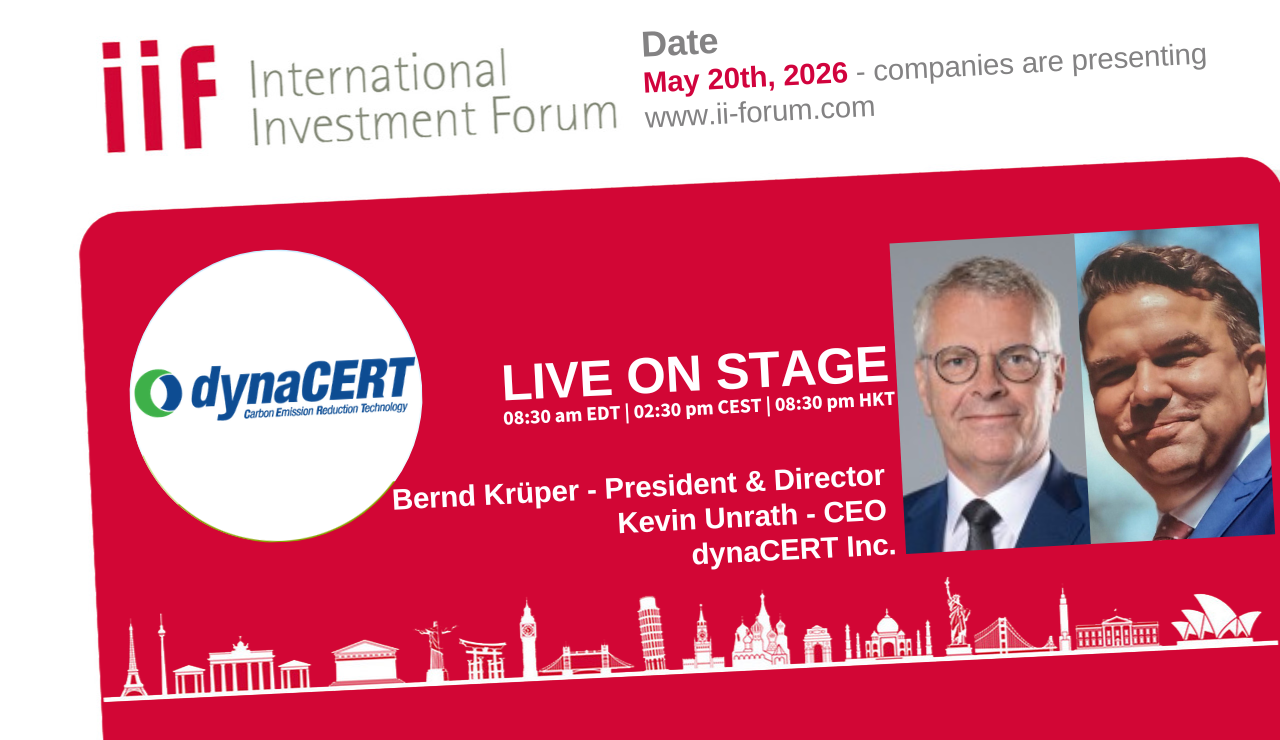
The technology has been tested in practice, and pilot projects have been successfully implemented. Yet a commercial breakthrough has not materialized, at least until now. Under new German management, the breakthrough appears to be taking shape. President Bernd Krüper and CEO Kevin Unrath have been with dynaCERT for just over a year and have realigned the company toward mass production and sales success. Both draw on decades of industry experience at internationally successful companies such as MAN Truck & Bus, Rolls-Royce Power Systems, and Motorenfabrik Hatz.
Save the Date: Both executives will report on current developments at the International Investment Forum (IIF) on May 20, 2026. Registration for the virtual investor conference is free.
The latest breakthrough demonstrates the potential
The announcement released on Monday is yet another breakthrough. dynaCERT is accelerating the international rollout of its technology. In this context, Vietnam—which, as described, is in the midst of a genuine energy crisis—appears to be emerging as a key market. The technology company reported on strategic partnerships with government institutions as well as successfully launched pilot projects. Given a massive fleet of diesel-powered commercial vehicles and growing pressure for energy efficiency and emissions reduction, dynaCERT is entering a market that is ripe, both economically and regulatorily, for efficient decarbonization solutions.
Particularly compelling is the combination of political support, industrial demand, and scientific validation. Collaborations with leading universities and a major oil and gas company create a solid foundation for scaling up. With pilot plants already operational in key logistics hubs, dynaCERT is now moving into practical implementation. These reference projects not only provide performance data but also serve as a gateway to broader market penetration. Regulatory tailwinds, such as planned emissions trading systems, are likely to further accelerate demand. Vietnam could thus serve as a strategic bridgehead for expansion throughout Southeast Asia. This presents dynaCERT with the opportunity to establish its technology early on as the industry standard for cleaner diesel applications in high-growth markets.
Analysts see potential for the stock to multiply
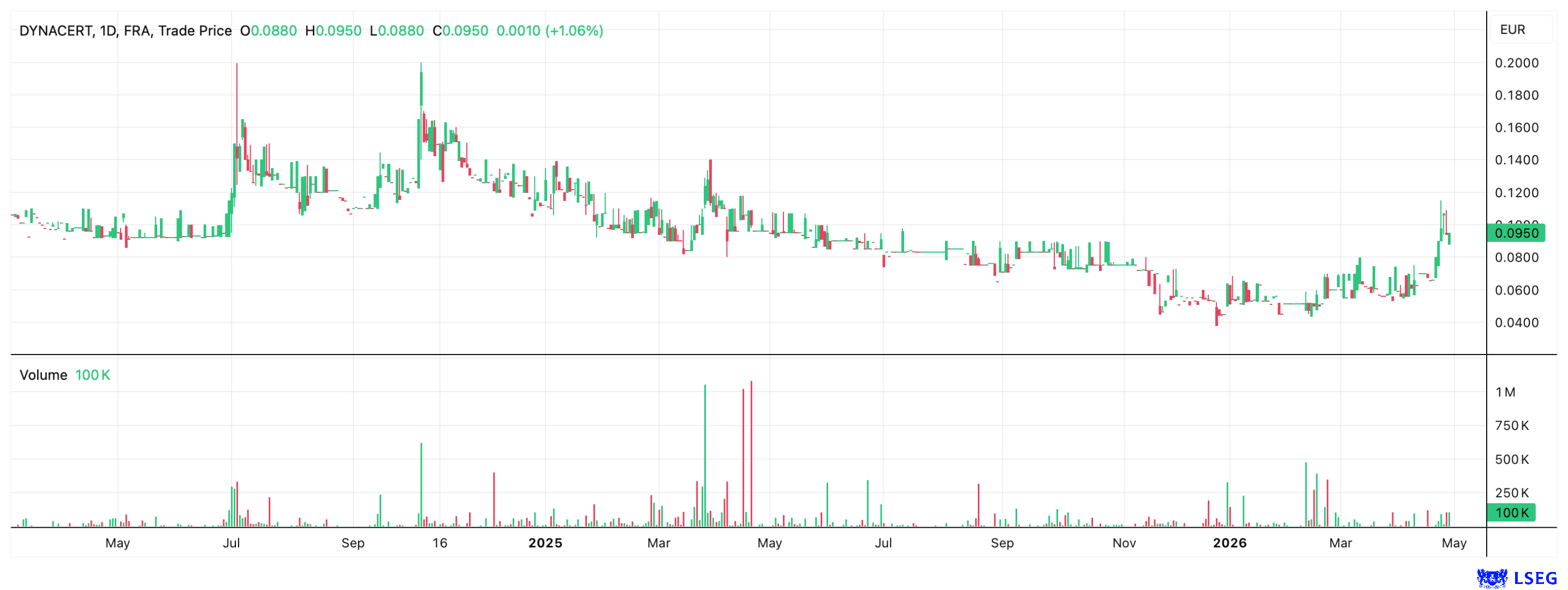
With the new focus on sales and scaling, analysts' price targets are becoming more plausible again. GBC Research, for instance, believes dynaCERT's stock has the potential to multiply. In their view, the fair value of the stock is EUR 0.48. The cleantech company's stock is currently trading at EUR 0.098. Analysts also point to successes in Mexico. The order from Hydrofuel Technologies for 100 HydraGEN™ units marked a successful market entry in Mexico, one of the world's largest markets for diesel trucks. The strategy of bringing local partners on board through distribution rights is the right one. Furthermore, dynaCERT has already made a significant mark on the European market. They point out that the French port of Rochefort, Tonnay-Charente, is successfully using the HydraGEN™ technology in its cranes. There, the dynaCERT technology has become established as a tool for reducing the greenhouse gas footprint.
Conclusion: The Comeback Has Begun
The comeback of the dynaCERT share price has started. The current environment is clearly working in favour of the cleantech company. If positive news flow continues, the price gains of recent weeks are likely to be only the beginning. With further sales success, the stock has the potential to multiply in value.
Conflict of interest
Pursuant to §85 of the German Securities Trading Act (WpHG), we point out that Apaton Finance GmbH as well as partners, authors or employees of Apaton Finance GmbH (hereinafter referred to as "Relevant Persons") may hold shares or other financial instruments of the aforementioned companies in the future or may bet on rising or falling prices and thus a conflict of interest may arise in the future. The Relevant Persons reserve the right to buy or sell shares or other financial instruments of the Company at any time (hereinafter each a "Transaction"). Transactions may, under certain circumstances, influence the respective price of the shares or other financial instruments of the Company.
In addition, Apaton Finance GmbH is active in the context of the preparation and publication of the reporting in paid contractual relationships.
For this reason, there is a concrete conflict of interest.
The above information on existing conflicts of interest applies to all types and forms of publication used by Apaton Finance GmbH for publications on companies.
Risk notice
Apaton Finance GmbH offers editors, agencies and companies the opportunity to publish commentaries, interviews, summaries, news and the like on news.financial. These contents are exclusively for the information of the readers and do not represent any call to action or recommendations, neither explicitly nor implicitly they are to be understood as an assurance of possible price developments. The contents do not replace individual expert investment advice and do not constitute an offer to sell the discussed share(s) or other financial instruments, nor an invitation to buy or sell such.
The content is expressly not a financial analysis, but a journalistic or advertising text. Readers or users who make investment decisions or carry out transactions on the basis of the information provided here do so entirely at their own risk. No contractual relationship is established between Apaton Finance GmbH and its readers or the users of its offers, as our information only refers to the company and not to the investment decision of the reader or user.
The acquisition of financial instruments involves high risks, which can lead to the total loss of the invested capital. The information published by Apaton Finance GmbH and its authors is based on careful research. Nevertheless, no liability is assumed for financial losses or a content-related guarantee for the topicality, correctness, appropriateness and completeness of the content provided here. Please also note our Terms of use.