July 8th, 2026 | 07:05 CEST
Canada and Europe Are Jointly Securing Raw Materials: Why BMW and Volkswagen Should Keep an Eye on Power Metallic Mines
The automotive industry's transition to electric mobility is disrupting traditional supply chains. While efficient assembly used to be the key factor, in the era of electric vehicles, secure, environmentally responsible access to critical minerals matters most. Above all, strict legal requirements, such as the European Supply Chain Due Diligence Act, are forcing automakers to fully document the origin of their raw materials all the way back to the mine. In this complex landscape, Canada has emerged as one of the most important partners for European industry. The standards and mineral content are just right here—we introduce the market and potential beneficiaries.
time to read: 3 minutes | Author: Nico Popp
ISIN: POWER METALLIC MINES INC. | CA73929R1055 | TSXV: PNPN , OTCBB: PNPNF , BAY.MOTOREN WERKE AG ST | DE0005190003 , VOLKSWAGEN AG VZO O.N. | DE0007664039
Table of contents:
Author

Nico Popp
At home in Southern Germany, the passionate stock exchange expert has been accompanying the capital markets for about twenty years. With a soft spot for smaller companies, he is constantly on the lookout for exciting investment stories.
Tag cloud
Shares cloud
BMW Steps on the Gas with the "Local-for-Local" Principle
BMW leaves nothing to chance when it comes to supply security and is stepping on the gas with the "Local-for-Local" principle. Starting in 2025, the so-called "New Class" will form the technological foundation of all new electric models from the Munich-based automaker, with the introduction of the sixth-generation battery expected to enable a significant increase in range of up to 30%, reaching a maximum of 800 km. To meet the enormous demand for battery cells, the company has already awarded contracts worth billions to CATL and EVE Energy for the construction of dedicated cell factories in Europe, China, and North America. The Bavarian premium automaker no longer relies solely on traditional suppliers but is making targeted moves into the upstream market through direct investments and off-take agreements, as evidenced by a binding agreement for the initial purchase of lithium hydroxide from the Wolfsberg project in Austria. Since European regulations require comprehensive CO2 accounting, the procurement of green Class 1 nickel and copper is considered an absolute necessity by management.
Volkswagen Under Pressure to Consolidate
Volkswagen is currently pursuing a completely different level of vertical integration, even as the Wolfsburg-based company faces enormous operational pressure. PowerCo SE, the battery subsidiary founded for this purpose, is building a global network of gigafactories, including the Canadian mega-factory in St. Thomas, Ontario, which is expected to deliver 90 GWh of capacity per year starting in 2027. However, this intensive, extremely capital-intensive push into the raw materials sector coincides with a phase of historic cost-cutting measures and a massive 44% drop in net income in fiscal year 2025. According to media reports from Reuters and Manager Magazin, the restructuring program launched calls for drastic cuts, including the spin-off of the core VW brand and the planned closure of long-standing German locations such as Hanover, Zwickau, and Emden. Despite this unprecedented consolidation pressure and politically sensitive negotiations with defense contractors regarding the sale of underutilized plants, CEO Oliver Blume reportedly emphasized at the earnings conference call that the company remains committed to strategic investments in the Canadian supply chain.
Power Metallic Mines: Spectacular Drilling Results for Several Future Metals at Once
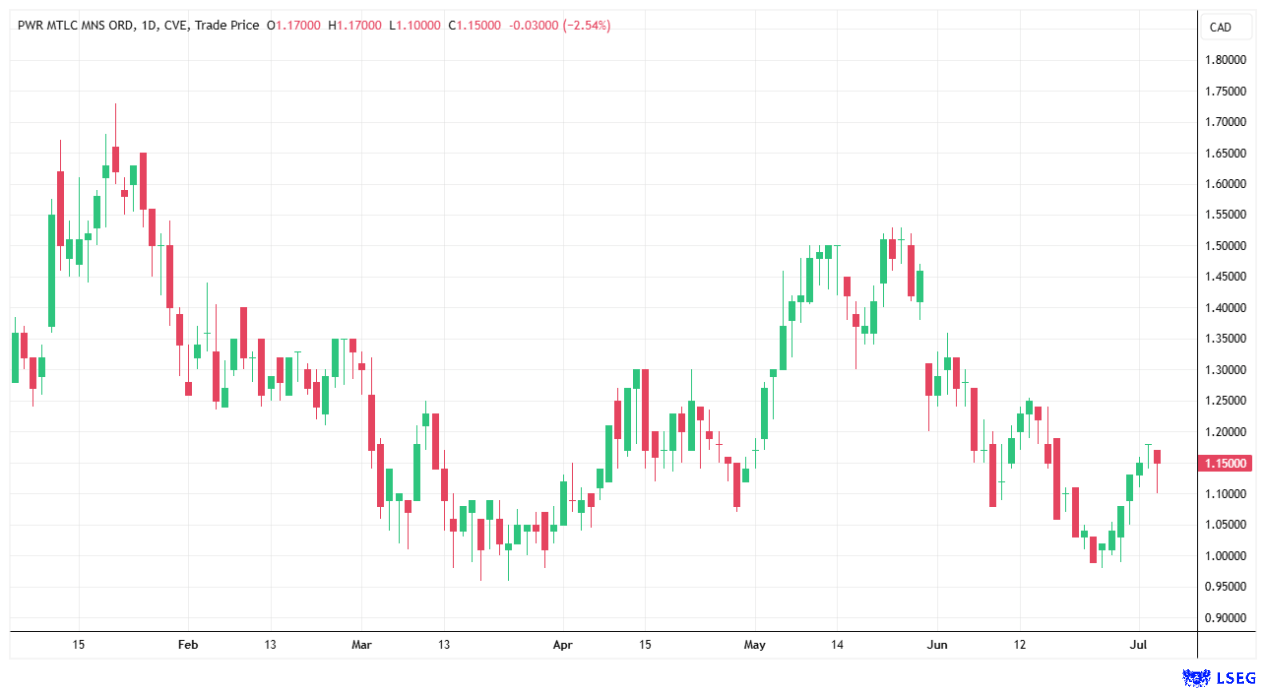
Amid this tension, a Canadian mineral developer is drawing attention for holding exactly the right piece of the puzzle for automakers: Power Metallic Mines. The company controls the flagship NISK project in Québec, Canada, a nickel-copper-sulphide deposit with significant concentrations of platinum group metals, cobalt, gold, and silver that could solve several of the industry's challenges at once. The Lion discovery zone is particularly impressive, where drilling in the first half of 2026 intersected spectacular intervals with an 11.46% copper-equivalent recovery over 22.00 m. Metallurgical locked-cycle tests conducted by SGS Canada also confirmed outstanding recovery rates of 98.9% for copper and 96.8% for platinum, which minimizes metallurgical risk. Analysts at GBC Research were impressed by these results and set a price target of exactly CAD 3.00 for Power Metallic shares. The stock is currently trading at only around CAD 1.15. Power Metallic Mines' ambitious drilling program, which calls for approximately 100,000 drill meters by the end of 2026, is also solidly funded through a recently completed, oversubscribed private placement with gross proceeds of CAD 28.2 million.
Power Metallic Mines Offers More Than NISK
In addition to its core project in Québec, the explorer is also demonstrating foresight in its global expansion and has secured strategic acquisition options. Through its wholly owned subsidiary Power Metallic Arabia, the company acquired the Jabul Baudan exploration license in Saudi Arabia's Jabal Said Belt as part of a joint venture with Amaar Mining. The area, spanning over 200 km², is considered promising for volcanogenic massive-sulphide deposits and serves as a strategic diversification for the company outside North America. Power Metallic Mines' stock represents a high-potential story driven primarily by the industry's hunger for raw materials. Potential catalysts for a revaluation of the stock could include the updated resource estimate scheduled for summer 2026 and the preliminary economic assessment (PEA) due in December 2026. With NISK, Power Metallic Mines has a promising, already advanced project. The risk is likely to be more manageable compared to many other junior companies.
Watch YouTube videoConflict of interest
Pursuant to §85 of the German Securities Trading Act (WpHG), we point out that Apaton Finance GmbH as well as partners, authors or employees of Apaton Finance GmbH (hereinafter referred to as "Relevant Persons") currently hold or hold shares or other financial instruments of the aforementioned companies and speculate on their price developments. In this respect, they intend to sell or acquire shares or other financial instruments of the companies (hereinafter each referred to as a "Transaction"). Transactions may thereby influence the respective price of the shares or other financial instruments of the Company.
In this respect, there is a concrete conflict of interest in the reporting on the companies.
In addition, Apaton Finance GmbH is active in the context of the preparation and publication of the reporting in paid contractual relationships.
For this reason, there is also a concrete conflict of interest.
The above information on existing conflicts of interest applies to all types and forms of publication used by Apaton Finance GmbH for publications on companies.
Risk notice
Apaton Finance GmbH offers editors, agencies and companies the opportunity to publish commentaries, interviews, summaries, news and the like on news.financial. These contents are exclusively for the information of the readers and do not represent any call to action or recommendations, neither explicitly nor implicitly they are to be understood as an assurance of possible price developments. The contents do not replace individual expert investment advice and do not constitute an offer to sell the discussed share(s) or other financial instruments, nor an invitation to buy or sell such.
The content is expressly not a financial analysis, but a journalistic or advertising text. Readers or users who make investment decisions or carry out transactions on the basis of the information provided here do so entirely at their own risk. No contractual relationship is established between Apaton Finance GmbH and its readers or the users of its offers, as our information only refers to the company and not to the investment decision of the reader or user.
The acquisition of financial instruments involves high risks, which can lead to the total loss of the invested capital. The information published by Apaton Finance GmbH and its authors is based on careful research. Nevertheless, no liability is assumed for financial losses or a content-related guarantee for the topicality, correctness, appropriateness and completeness of the content provided here. Please also note our Terms of use.