September 25th, 2026 | 07:50 CEST
Breakthroughs in Skin Cancer Treatment: New Approaches from Biofrontera and Moderna – Vidac Pharma Faces a Busy Fall
For a long time, the treatment of skin cancer and its precancerous stages resembled a makeshift compromise: Doctors used scalpels, froze affected areas, or prescribed aggressive creams that destroyed tissue. It was not uncommon for patients to suffer pain and weeks of delayed wound healing. But a completely new dynamic is currently emerging in the sector. Suddenly, innovations involving light beams, messenger RNA (mRNA), and the metabolic reprogramming of cancer cells are making headlines. We present the latest developments in skin cancer and its precancerous stages. The race for innovation has only just begun.
time to read: 3 minutes | Author: Nico Popp
ISIN: BIOFRONTERA AG NA O.N. | DE0006046113 , MODERNA INC. DL-_0001 | US60770K1079 , VIDAC PHARMA HOLDING PLC | GB00BM9XQ619
Table of contents:
Author

Nico Popp
At home in Southern Germany, the passionate stock exchange expert has been accompanying the capital markets for about twenty years. With a soft spot for smaller companies, he is constantly on the lookout for exciting investment stories.
Tag cloud
Shares cloud
Biofrontera: Flashes of Light Against Tumors
In mid-September 2026, the US Food and Drug Administration (FDA) opened a new chapter for Biofrontera. The specialty pharmaceutical company secured US approval for its photodynamic therapy, Ameluz, to treat superficial basal cell carcinoma. Until now, doctors in the US were only permitted to use the drug to treat mild to moderate actinic keratoses on the face and scalp. Estimates suggest that over half a million cases of this condition are diagnosed in the US each year. In the pivotal trial, the primary lesion in the tissue was free of cancer cells in nearly 76% of those treated. The combined primary endpoint of clinical and histological healing was achieved by 66% of patients (placebo: 5%). Biochemically, the treatment works by inducing cell oxidation through red light irradiation. However, this precision comes at a price. Over 95% of those treated reported pain at the application site, mostly during irradiation, and just under 70% experienced skin redness. In addition, the treatment requires a lamp in the clinic.
Moderna: Tailored mRNA Against Melanoma Recurrences
In August, Moderna, in collaboration with Merck & Co., announced a groundbreaking success: For the first time, an individualized mRNA cancer vaccine achieved its primary endpoint in a Phase 3 trial. When combined with the immunotherapy drug Keytruda, Intismeran autogen significantly reduced the risk of recurrence in high-risk melanoma patients. To achieve this, doctors extract tissue from the previously removed tumor and use algorithms to calculate precisely tailored antigens. The body then mounts an immune response against microscopic metastases. In the preceding Phase 2b trial, the risk of distant metastases or death fell by approximately 59%. The news caused Moderna's market capitalization to more than double at one point. However, the technology is not suitable for superficial precancerous lesions: It is produced from the patient's surgically removed tumor and is therefore a complex process.
Vidac Pharma: The "Cut" to Cancer Metabolism
Vidac Pharma positions itself between local destruction via red light and immunotherapy. The British-Israeli company aims to cut off the tumor's energy supply. Active ingredients such as VDA-1102 target the Warburg effect, which malignant cells use to satisfy their extreme hunger. The synthetic molecule detaches the enzyme hexokinase-2 from the mitochondrial membrane, thereby reactivating programmed cell death in the tumor cell. Since healthy skin cells primarily rely on a different variant of the enzyme, this tissue is expected to be spared—suggesting that the therapy is well tolerated.
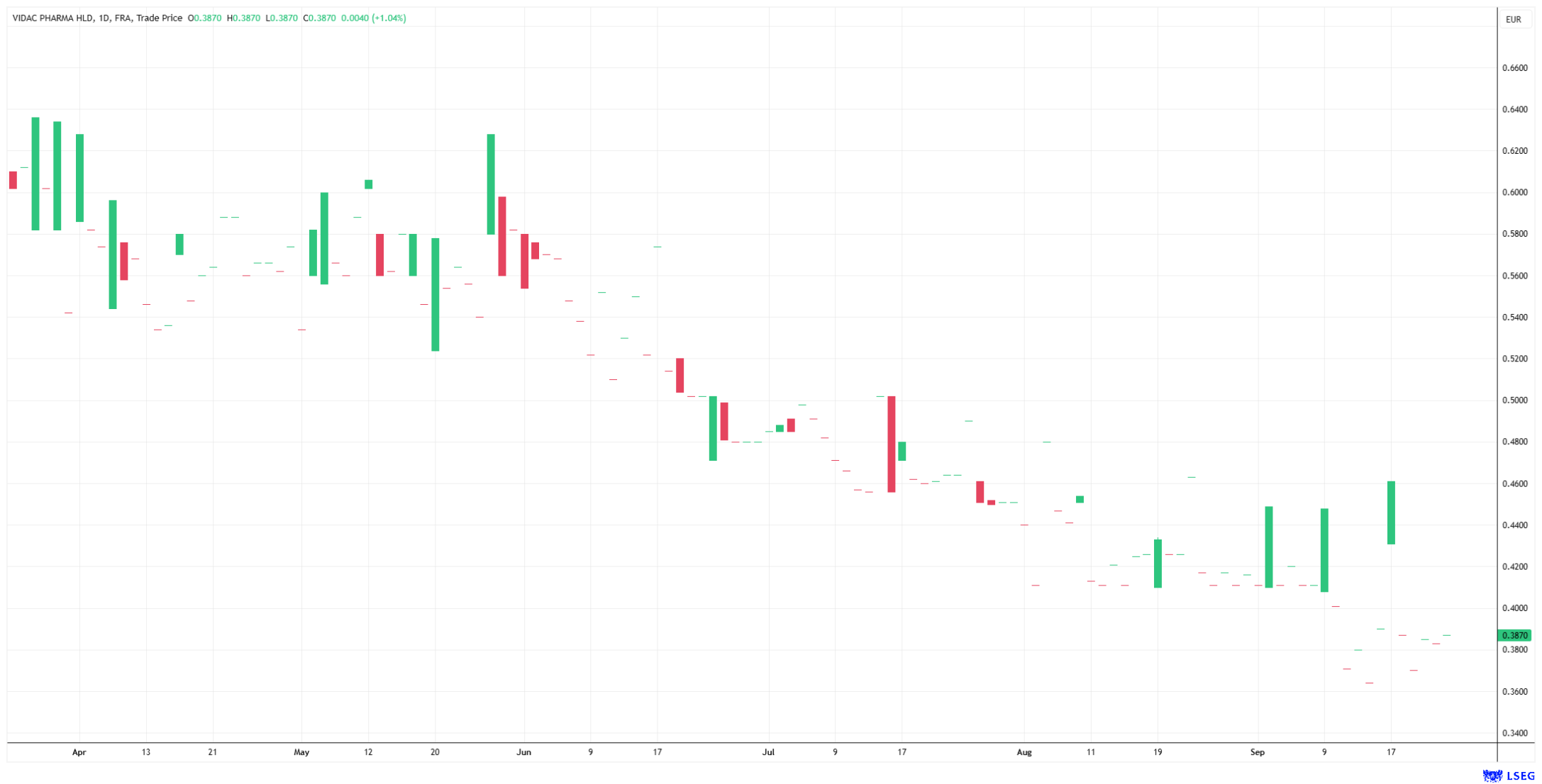
Almost simultaneously with the FDA's decision on Biofrontera, Vidac Pharma announced the completion of patient visits for a European Phase 2b trial at the CentroDerm research centre in Wuppertal, led by Professor Thomas Dirschka. The study focuses on 39 patients with highly proliferative actinic keratosis. The next step is data analysis, including tissue samples. The results are expected in the coming weeks. Clinical data to date provide initial indications of efficacy. In an open-label US study, 22.5% of participants using the 20% ointment had all AK lesions in the treatment area healed after 16 weeks. According to the company, the number of lesions on the face decreased by an average of over 62%. A potential advantage over aggressive creams is tolerability: According to the company, no serious treatment-related side effects have been reported to date. Patients could apply the ointment once daily at home without worrying about weeks of pain. Treatment at a clinic, as is the case with Biofrontera's Ameluz light therapy, would also not be necessary.
Vidac Pharma: Pipeline and Financing
In addition to its primary focus on precancerous skin lesions, Vidac Pharma is advancing its research. Through its planned French subsidiary, Eutopos Pharma, the group intends to expand its research in Europe. Preclinical evaluations of the molecule VDA-1275 suggest synergistic effects with conventional chemotherapies. In cutaneous T-cell lymphoma, VDA-1102 has already demonstrated a 56% response rate in an interim Phase 2a analysis.
Financially, the company is navigating very uncharted waters. With a market capitalization of approximately EUR 25 to 30 million, the company has so far been financed primarily through capital inflows from its shareholders. For a global registration trial, Vidac will likely need to rely on a licensing or development partner in the field of dermatology. The ongoing data analysis could open the door to such discussions. However, one thing is also clear: if the data turns out to be weaker than hoped or if a partner fails to materialize, the company will face challenges. The coming weeks will show how things will unfold for the company and its stock.
Conflict of interest
Pursuant to §85 of the German Securities Trading Act (WpHG), we point out that Apaton Finance GmbH as well as partners, authors or employees of Apaton Finance GmbH (hereinafter referred to as "Relevant Persons") may hold shares or other financial instruments of the aforementioned companies in the future or may bet on rising or falling prices and thus a conflict of interest may arise in the future. The Relevant Persons reserve the right to buy or sell shares or other financial instruments of the Company at any time (hereinafter each a "Transaction"). Transactions may, under certain circumstances, influence the respective price of the shares or other financial instruments of the Company.
In addition, Apaton Finance GmbH is active in the context of the preparation and publication of the reporting in paid contractual relationships.
For this reason, there is a concrete conflict of interest.
The above information on existing conflicts of interest applies to all types and forms of publication used by Apaton Finance GmbH for publications on companies.
Risk notice
Apaton Finance GmbH offers editors, agencies and companies the opportunity to publish commentaries, interviews, summaries, news and the like on news.financial. These contents are exclusively for the information of the readers and do not represent any call to action or recommendations, neither explicitly nor implicitly they are to be understood as an assurance of possible price developments. The contents do not replace individual expert investment advice and do not constitute an offer to sell the discussed share(s) or other financial instruments, nor an invitation to buy or sell such.
The content is expressly not a financial analysis, but a journalistic or advertising text. Readers or users who make investment decisions or carry out transactions on the basis of the information provided here do so entirely at their own risk. No contractual relationship is established between Apaton Finance GmbH and its readers or the users of its offers, as our information only refers to the company and not to the investment decision of the reader or user.
The acquisition of financial instruments involves high risks, which can lead to the total loss of the invested capital. The information published by Apaton Finance GmbH and its authors is based on careful research. Nevertheless, no liability is assumed for financial losses or a content-related guarantee for the topicality, correctness, appropriateness and completeness of the content provided here. Please also note our Terms of use.