September 8th, 2026 | 09:40 CEST
Biotech: Time to Bet on the Rebound! Evotec and BioNxt in the Takeover Spotlight, Bayer and BioNTech Flush with Cash
After a long dry spell, the biotech sector is on the cusp of a spectacular turnaround, offering bold investors the potential for significant returns. Many innovative biotech stocks are trading well below their all-time highs, yet almost unnoticed, the next major rally is already taking shape behind the scenes. The huge cash reserves of industry giants Bayer and BioNTech are currently fueling takeover speculation across the sector. This colossal capital, running into the billions, is desperately seeking new growth drivers, suddenly putting smaller players on the radar of potential acquirers. At the very top of the hunters' watchlist are the hard-hit Evotec and the disruptive newcomer BioNxt. Both companies boast top-class technology platforms, which, at current levels, almost seem like an exclusive clearance sale. Investors who keep their eyes open and position themselves strategically for the major rebound could get ahead of the looming wave of consolidation. The conditions for an explosive catch-up rally have rarely been this favorable.
time to read: 6 minutes | Author: André Will-Laudien
ISIN: Bionxt Solutions Inc. | CA0909741062 | CSE:BNXT , OTCQB: BNXTF , EVOTEC SE INH O.N. | DE0005664809 , BAYER AG NA O.N. | DE000BAY0017 , BIONTECH SE SPON. ADRS 1 | US09075V1026
Table of contents:
Author

André Will-Laudien
Born in Munich, he first studied economics and graduated in business administration at the Ludwig-Maximilians-University in 1995. As he was involved with the stock market at a very early stage, he now has more than 30 years of experience in the capital markets.
Tag cloud
Shares cloud
Evotec – Bid Rejected: How Low Can It Go?
The share price of Hamburg-based drug discovery firm Evotec cannot find stability and is once again under significant pressure following the collapse of the Halozyme takeover. Following the rejected bid, investors are anxiously wondering where the share price can find stable ground in the current market environment. The recently published half-year results for 2026 reinforced investors' scepticism, as revenue plummeted by a staggering 19% year-on-year. In addition, adjusted consolidated EBITDA slipped deep into the red at a loss of EUR 42.7 million. Although the management team led by the new CEO, Dr Christian Wojczewski, emphasized that this severe setback was primarily due to postponed partnerships rather than lost business, the delayed milestone payments and a slow start to new collaborations nevertheless took a heavy toll on the balance sheet. The management team therefore felt compelled to drastically lower the official annual forecast for 2026, which led to a persistent crisis of confidence on the stock market. As a strategic move to turn the situation around, Evotec is now advancing the "Horizon" cost-cutting and transformation program to boost operational efficiency. This restructuring plan is expected to deliver up to 30% of the targeted cost savings as early as this year, though its operational impact will be delayed. For the full year, the Executive Board is now forecasting significantly lower turnover and a clearly negative adjusted EBITDA. The company's management has therefore declared 2026 a transitional phase and assured shareholders that a noticeable recovery will follow in 2027. Following an 85% fall in the share price over three years to around EUR 3.20, a fresh start with a financially strong partner is likely to be required.
BioNxt Solutions: On the Verge of a Breakthrough
Things are now getting exciting in Vancouver and Munich. This is because BioNxt Solutions is approaching a decisive turning point with its leading cladribine program, BNT23001, following the completion of the full IMPD dossier for the planned European human trial. This marks the completion of a significant part of the regulatory groundwork, and the next logical step is to submit the Clinical Trial Application, followed by the bioequivalence study with Mavenclad. The key difference from traditional biotech models is that BioNxt is not developing a new active substance but is instead seeking to administer an established active substance more comfortably and potentially more efficiently via a patented sublingual, orally dissolvable film (ODF). Particularly for MS patients with difficulty swallowing, the anhydrous, orally disintegrating formulation could offer a tangible practical benefit. The preclinical pharmacokinetic data are encouraging, with BNT23001 demonstrating higher systemic bioavailability than the reference tablet in a large-animal model.
Should this effect be confirmed in the human trial, it could result in an attractive combination of a lower active ingredient dose, potentially better tolerability and improved cost-effectiveness. At the same time, BNT23001 already enjoys long-term protection through the European and Eurasian patent valid through 2043, while further markets are to be tapped via ongoing proceedings. The actually more significant investment opportunity, however, lies beyond cladribine: the ODF technology could be transferred to other established active substances, thereby turning a single product into a reusable development toolkit. With everolimus and, in particular, semaglutide, BioNxt has already opened up corresponding new areas of application. The semaglutide program, which has been under active development since July in collaboration with Gen-Plus, is also positioning the company for entry into the GLP-1 market, which, depending on forecasts, could grow to well over USD 200 billion by the mid-2030s.
The strategic advantage here does not lie in copying Novo Nordisk or Eli Lilly's active ingredient, but in developing an alternative delivery form for complex peptides. And this is where the ODF market becomes really interesting: in principle, transmucosal systems can bypass the gastrointestinal tract and first-pass metabolism, thereby opening up new possibilities for active substances that are difficult to deliver orally. A scientific review of transmucosal drug delivery highlights the ongoing research focus on improved absorption, bioavailability and patient comfort – precisely at the interface where BioNxt positions its technology. Should semaglutide prove successful, the platform could also potentially be adapted for other GLP-1 agonists such as tirzepatide. This would not only expand the pipeline but also enhance the strategic appeal to larger pharmaceutical companies seeking patentable drug-delivery solutions for existing blockbuster drugs.
Financially, BioNxt has created additional scope for clinical and technological development by extending convertible debentures worth CAD 5.475 million through 2027/28, whilst 16.9 million warrants at CAD 0.50 represent a potential future capital inflow. At a share price of just CAD 0.35 and a market capitalization of just under CAD 50 million, the valuation appears remarkably low given the company's multiple areas of development. This could make the Canadian company an attractive technology acquisition target for the big players. However, this is still speculation, and clinical, regulatory and technological risks remain. That is what makes the share so exciting at the moment.
BioNTech and Bayer: Full Coffers Fuel Takeover Appetite
Full coffers, great ideas! The two German pharmaceutical giants, BioNTech and Bayer, still have considerable liquidity reserves, which need to be invested strategically in the current industry environment. MRNA specialist BioNTech, thanks to the billions it has raked in from COVID vaccines, sits on a massive cash cushion of just under EUR 17 billion but is soon to lose its founding team. What is needed now are capable leadership experts to steady the group's course once again. At Bayer, too, the pressure to revitalize operations is prompting the company to consider targeted pipeline acquisitions, despite its debt reduction efforts. Both groups are desperately seeking innovative technologies to future-proof their existing portfolios and cushion the impact of impending patent expiries. For the Mainz-based company, acquiring an established drug discovery company such as Evotec would be the perfect complement to significantly scale up its own AI-powered drug discovery platform. In particular, Evotec's highly advanced biologics production platform, Just – Evotec Biologics, could be an ideal fit for BioNTech's oncology and mRNA strategy, as it can drastically accelerate clinical manufacturing. These are merely possibilities and assumptions that we view in an opportunistic context.
Bayer, for its part, could strategically enhance its traditionally strong but innovation-deficient pharmaceutical division in the field of cell and gene therapies through an acquisition in the biotech sector. The advanced multi-omics platforms and the wide range of partnerships with smaller biotech firms would provide the Leverkusen-based group immediate access to validated target molecules in immunology and cardiology. Through such acquisitions, buyers secure not only ready-made product candidates but, above all, research expertise built over many years and highly efficient laboratory infrastructure. Instead of protracted and high-risk in-house development at an early stage, the acquisition enables an immediate leap into later clinical phases. This saves large corporations valuable time in the global race for next-generation medicine. With the valuations of many potential takeover targets at historically low levels following the market correction, the financial outlay for cash-rich buyers remains manageable. As mentioned, we are giving our imaginations free rein.
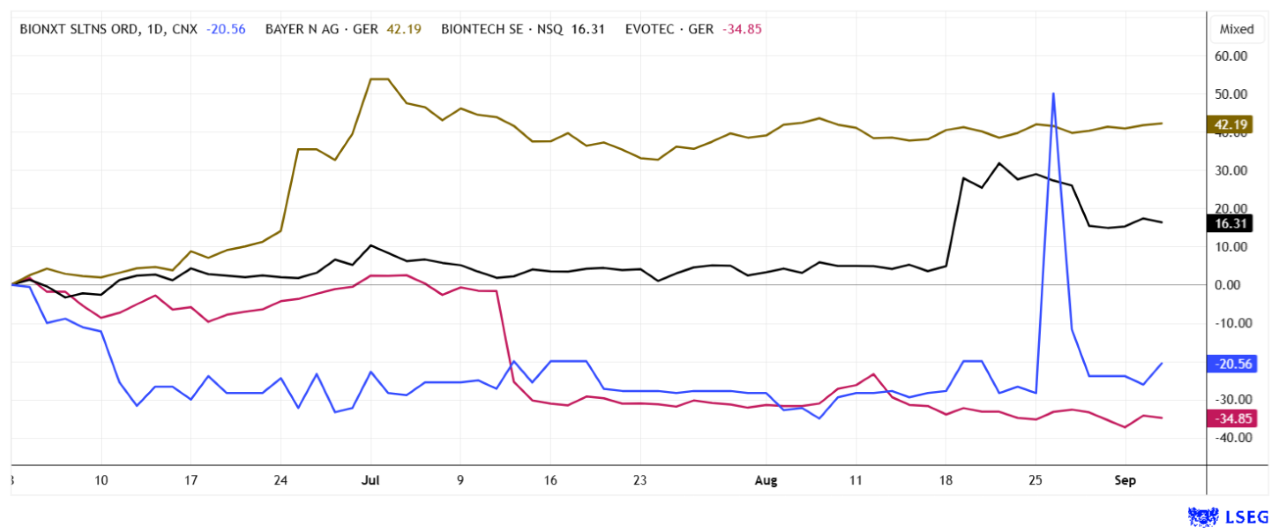
The biotech sector is showing its first signs of life again. The industry's major players, such as Bayer and BioNTech, are once again generating positive returns and building up additional war chests through their surplus cash flow. Smaller players like Evotec and BioNxt simply need to continue advancing their promising research programs and bide their time. One or two offers are bound to come their way!
Conflict of interest
Pursuant to §85 of the German Securities Trading Act (WpHG), we point out that Apaton Finance GmbH as well as partners, authors or employees of Apaton Finance GmbH (hereinafter referred to as "Relevant Persons") currently hold or hold shares or other financial instruments of the aforementioned companies and speculate on their price developments. In this respect, they intend to sell or acquire shares or other financial instruments of the companies (hereinafter each referred to as a "Transaction"). Transactions may thereby influence the respective price of the shares or other financial instruments of the Company.
In this respect, there is a concrete conflict of interest in the reporting on the companies.
In addition, Apaton Finance GmbH is active in the context of the preparation and publication of the reporting in paid contractual relationships.
For this reason, there is also a concrete conflict of interest.
The above information on existing conflicts of interest applies to all types and forms of publication used by Apaton Finance GmbH for publications on companies.
Risk notice
Apaton Finance GmbH offers editors, agencies and companies the opportunity to publish commentaries, interviews, summaries, news and the like on news.financial. These contents are exclusively for the information of the readers and do not represent any call to action or recommendations, neither explicitly nor implicitly they are to be understood as an assurance of possible price developments. The contents do not replace individual expert investment advice and do not constitute an offer to sell the discussed share(s) or other financial instruments, nor an invitation to buy or sell such.
The content is expressly not a financial analysis, but a journalistic or advertising text. Readers or users who make investment decisions or carry out transactions on the basis of the information provided here do so entirely at their own risk. No contractual relationship is established between Apaton Finance GmbH and its readers or the users of its offers, as our information only refers to the company and not to the investment decision of the reader or user.
The acquisition of financial instruments involves high risks, which can lead to the total loss of the invested capital. The information published by Apaton Finance GmbH and its authors is based on careful research. Nevertheless, no liability is assumed for financial losses or a content-related guarantee for the topicality, correctness, appropriateness and completeness of the content provided here. Please also note our Terms of use.