August 5th, 2026 | 07:25 CEST
Between All-Time Highs and M&A Fever: Adidas, Commerzbank, Desert Gold, and Unicredit in Focus
This week's stock market action, with indices hitting new all-time highs, also presents investors with a mix of operational transformations, M&A speculation, and opportunities to capitalize on temporary price volatility. In the consumer goods sector, short-term margin concerns are leading to drastic sell-offs despite strong record sales, while commodity stocks are benefiting from robust international demand. At the same time, the banking sector is coming into focus due to record profits and an intensifying takeover battle in Germany. Read here to find out which three highly exciting investment stories are likely to be driving market participants right now.
time to read: 7 minutes | Author: Stefan Bode
ISIN: DESERT GOLD VENTURES | CA25039N4084 | TSXV: DAU , OTCQB: DAUGF , ADIDAS AG NA O.N. | DE000A1EWWW0 , COMMERZBANK AG | DE000CBK1001 , UNICREDIT | IT0005239360
Table of contents:
Author

Stefan Bode
A native of the Eichsfeld region in the heart of Germany, he has more than 30 years of experience in the capital markets, with broad expertise spanning financial markets, history, and geopolitics. He founded his own business more than 20 years ago while still a student and today advises clients, foundations, and asset managers across four continents.
Tag cloud
Shares cloud
Adidas After the Plunge: Is the Sell-off Exaggerated?
Adidas shares (WKN: A1EWWW | ISIN: DE000A1EWWW0 | Ticker: ADS) have seen significant volatility following the latest quarterly results. On July 30, the share price plummeted by double digits to EUR 147.05 compared to the previous closing price, losing around 19% at times during the trading day. Although the stock subsequently managed to recover somewhat, it is currently trading at only around EUR 160. Since the beginning of the year, the stock has thus posted a decline of about 1.5%, and over the past twelve months, the decline stands at 1.2%, only slightly less. The market capitalization of the German sporting goods manufacturer is approximately EUR 28.5 billion. The sharp drop in the share price seems surprising at first glance, as Adidas by no means reported a weak quarter.
Revenue rose 14% on a currency-adjusted basis in the second quarter to a record EUR 6.74 billion. With this result, Adidas even exceeded the average analyst estimate of EUR 6.63 billion. Operating profit improved by 5% to EUR 574 million. However, analysts had expected around EUR 623 million, and it was precisely this failure to meet profit expectations that triggered the share's plunge. The main factor was significantly higher marketing expenses related to the World Cup, which rose by about 30% during the quarter. Adidas invested an additional more than EUR 200 million in advertising and outfitted a total of 14 national teams, including the two finalists, Spain and Argentina. The strategy generated significant attention and strong sales but weighed on profit margins in the short term.
Adidas raised its revenue forecast for 2026. Instead of high-single-digit growth, the company now expects currency-adjusted growth of 9 to 10%. However, the forecast for operating profit remained unchanged at around EUR 2.3 billion. Investors had apparently anticipated a simultaneous increase in the profit target. Furthermore, the outlook points to slower growth in the second half of the year. From an operational standpoint, Adidas continues to have strong prospects. The group sells sports and casual apparel, shoes, and accessories worldwide and has recently achieved double-digit growth in nearly all regions. At the same time, the previous momentum behind well-known lifestyle models such as Samba and Gazelle is slowly waning. In Europe, deep retail discounts have created additional pressure. As a result, Adidas must successfully launch new models to hold its ground against Nike, Puma, On, and Hoka.
From a technical analysis perspective, the picture is mixed. The share continues to trade above the 100- and 200-day moving averages but remains below the short-term 20- and 50-day moving averages. On the positive side, the range between EUR 150 and 155 has held so far, and the stock has seen buying interest over the past three trading days. For a more significant recovery, the price would first need to rise toward EUR 175 and then above EUR 180. This would brighten the short-term technical outlook. If, on the other hand, the stock falls back toward EUR 150, sentiment could quickly turn negative again, and the stock could head toward its annual low of approximately EUR 130.
Desert Gold: From Explorer to High-Margin Gold Producer
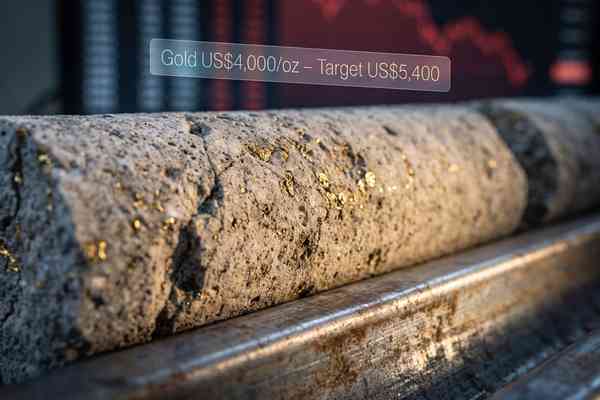
Amid ongoing geopolitical tensions, the gold price has stabilized above the USD 4,000 per ounce mark in the current market environment. In this robust macroeconomic environment, Desert Gold (WKN: A14X09 | ISIN: CA25039N4084 | Ticker Symbol: QXR2) is undergoing a strategic transformation at its West African SMSZ project, shifting from a pure-play exploration company to a gold producer. The start of oxide gold production, scheduled for the third quarter, marks a decisive operational milestone. The logistical foundation is already in place, with the arrival of the ordered gravity separation plant at the Port of Dakar and its ongoing overland transport to the SMSZ property. According to the schedule, half of the gravity separation plant's components are expected to have already arrived at the prepared construction site.
This dynamic corporate development was initiated by an oversubscribed capital increase of CAD 7.18 million in the spring of 2026, which made the upcoming transition to the next cash flow phase possible in the first place. Despite this fundamental and measurable progress, the company currently has a market capitalization of only EUR 24 million or CAD 40 million. However, a recent feasibility study demonstrates an impressive after-tax net present value of USD 124 million based on an assumed gold price of USD 4,100. A reported internal rate of return of 101% underscores the project's high profitability and highlights the massive analytical discrepancy with the current market valuation.
With a current valuation of just under USD 9 per ounce of gold in the ground, the stock is trading well below the industry-standard acquisition premiums. Historically, these have typically ranged between USD 66 and USD 100 per ounce in the ground. To optimize future earnings potential for further mine expansion, management has implemented strict cost-cutting measures, including the efficiency-enhancing switch to semi-annual reporting.
In conjunction with future first production, the company is consistently driving its organic growth through a targeted drilling program covering 4,250 m. Initial results impressively underscore the property's geological potential, revealing excellent intervals of 12.41 g/t gold over a length of 45 m. In addition, Desert Gold has diversified its portfolio with the Tieba Gold project in Côte d'Ivoire, which is expected to expand the resource profile in the coming years. Analysts at GBC Research consider the current valuation discount relative to the industry to be unjustified and, based on the fundamentals, issue a clear "Buy" recommendation. The price target of EUR 0.59 per share signals, based on the current level of around EUR 0.07, a substantial upside potential of 842%.
Commerzbank Ahead of Earnings: Takeover Speculation Meets Record Profits
Commerzbank (WKN: CBK100 | ISIN: DE000CBK1001 | Ticker: CBK) is facing a critical few days. On August 6, the Frankfurt-based bank will release its second-quarter 2026 earnings. At the same time, the takeover battle with the major Italian bank UniCredit (WKN: A2DJV6 | ISIN: IT0005239360 | Ticker Symbol: CRIN) continues to intensify. This brings together solid financial results, political interests, and takeover speculation—a combination that could once again trigger significant price movements in the stock.
Commerzbank shares are currently trading at around EUR 38.60. Since the beginning of the year, the stock has gained about 6%; over the past twelve months, the gain is approximately 16%. The market capitalization stands at roughly EUR 43.6 billion. Commerzbank is one of Germany's leading commercial banks. It serves retail customers as well as small and medium-sized enterprises (SMEs), but also provides financing to larger companies and supports German foreign trade. Another key component is its Polish subsidiary, mBank. For investors, net interest income, fee income, costs, and potential loan losses are particularly crucial.
The outlook ahead of the quarterly results is positive, as operating profit rose by 11% in the first quarter to a record high of EUR 1.36 billion. Net income improved by 9% to EUR 913 million, and revenue increased by 5% to EUR 3.2 billion. The corporate banking segment performed particularly strongly: the loan volume in that segment grew by 16% to EUR 120 billion. Following this strong start to the year, the bank raised its profit target for 2026 to at least EUR 3.4 billion. The expected net interest income was also raised to around EUR 8.6 billion. On Thursday, therefore, the key question will be whether Commerzbank confirms these targets or possibly raises them again. Investors are also likely to pay close attention to costs, credit risks, and further share buybacks.
However, even more attention is being focused on UniCredit's takeover bid. The Italian bank has now secured approximately 47.6% of Commerzbank's shares and is thus on the verge of gaining control. The German government still holds about 12%. Chancellor Friedrich Merz recently stated that the government would not prevent a takeover but criticized UniCredit's approach. Commerzbank CEO Bettina Orlopp has since indicated that further talks between the two banks are on the horizon.
A great deal of optimism is already priced into the valuation. Analysts' average price target is around EUR 40, which is only slightly above the current share price. Estimates range from about EUR 32 to 45. Significantly higher prices would therefore likely require stronger financial results, an upgraded outlook, or an improved offer from UniCredit. From a technical analysis perspective, the picture remains positive. The share price is above the 100- and 200-day moving averages. A breakout above EUR 39.50 could trigger a new Buy signal. If, on the other hand, the stock falls back below about EUR 36, the short-term outlook would deteriorate.
Fundamentally, Adidas continues to grow—but given the high expectations, the company must now demonstrate that rising revenue is once again leading to stronger profit growth.
The transformation of gold explorer Desert Gold into a producer in the current second half of the year is likely to lead to a revaluation of the stock following the first gold sales. Accordingly, investors can use the current sideways phase to accumulate shares.
Tomorrow's quarterly results from Commerzbank will determine whether the stock can break above its recent high or will initially enter a consolidation phase.
Conflict of interest
Pursuant to §85 of the German Securities Trading Act (WpHG), we point out that Apaton Finance GmbH as well as partners, authors or employees of Apaton Finance GmbH (hereinafter referred to as "Relevant Persons") currently hold or hold shares or other financial instruments of the aforementioned companies and speculate on their price developments. In this respect, they intend to sell or acquire shares or other financial instruments of the companies (hereinafter each referred to as a "Transaction"). Transactions may thereby influence the respective price of the shares or other financial instruments of the Company.
In this respect, there is a concrete conflict of interest in the reporting on the companies.
In addition, Apaton Finance GmbH is active in the context of the preparation and publication of the reporting in paid contractual relationships.
For this reason, there is also a concrete conflict of interest.
The above information on existing conflicts of interest applies to all types and forms of publication used by Apaton Finance GmbH for publications on companies.
Risk notice
Apaton Finance GmbH offers editors, agencies and companies the opportunity to publish commentaries, interviews, summaries, news and the like on news.financial. These contents are exclusively for the information of the readers and do not represent any call to action or recommendations, neither explicitly nor implicitly they are to be understood as an assurance of possible price developments. The contents do not replace individual expert investment advice and do not constitute an offer to sell the discussed share(s) or other financial instruments, nor an invitation to buy or sell such.
The content is expressly not a financial analysis, but a journalistic or advertising text. Readers or users who make investment decisions or carry out transactions on the basis of the information provided here do so entirely at their own risk. No contractual relationship is established between Apaton Finance GmbH and its readers or the users of its offers, as our information only refers to the company and not to the investment decision of the reader or user.
The acquisition of financial instruments involves high risks, which can lead to the total loss of the invested capital. The information published by Apaton Finance GmbH and its authors is based on careful research. Nevertheless, no liability is assumed for financial losses or a content-related guarantee for the topicality, correctness, appropriateness and completeness of the content provided here. Please also note our Terms of use.