April 13th, 2026 | 07:25 CEST
Almonty Drives the Tungsten Market: Between Shortages, Price Surges, and Revaluation
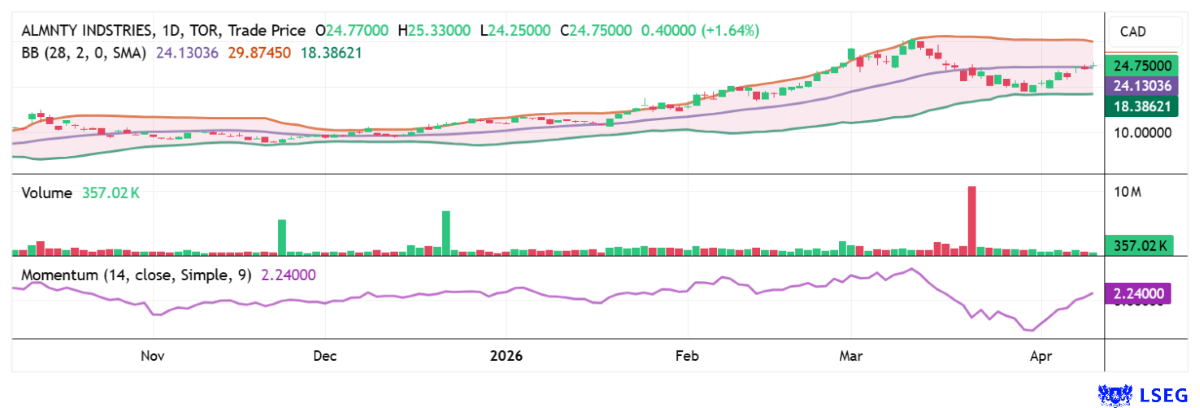
Major stock indices are currently experiencing heightened volatility. Following the strong rally of the past 24 months, both the S&P 500 and the DAX 40 have recently corrected by between 5% and 10%. Rising interest rates and little prospect of peace in one of the many global hotspots are weighing particularly heavily on the market. Commodities paint a different picture: industrial metals and critical materials remain in demand, led by tungsten, whose price has increased roughly tenfold over the past 24 months. Producer Almonty Industries is benefiting particularly from this; with the start of production in Sangdong, it is now entering a new operational phase and, with a market capitalization of more than EUR 4.2 billion, has made its way onto the buy lists of institutional investors. The recent consolidation appears to be over. What should investors be watching for now?
time to read: 5 minutes | Author: André Will-Laudien
ISIN: ALMONTY INDUSTRIES INC. | CA0203987072 | TSX: AII , NASDAQ: ALM , ASX: AII
Table of contents:
Author

André Will-Laudien
Born in Munich, he first studied economics and graduated in business administration at the Ludwig-Maximilians-University in 1995. As he was involved with the stock market at a very early stage, he now has more than 30 years of experience in the capital markets.
Tag cloud
Shares cloud
Consolidation Following the Start of Production in Sangdong
With the start of production at the Sangdong mine, a new phase has begun for Almonty. The company has transitioned from a project developer to an operational producer—a shift that rarely proceeds without friction in the commodities sector. Following a strong price rally in recent months, it is therefore not surprising that the market is taking a breather for now. This consolidation coincides precisely with the start of production and reflects not so much doubts about the project as the typical readjustment of expectations following a major milestone. At the same time, it shows that operational reality is now gradually being factored into the valuation. Investors are closely watching how quickly production ramps up and how stable the supply chains are. The market is thus shifting from vision to implementation. It is precisely during this phase that short-term fluctuations often arise, while fundamental data prevails in the long term.
Why Is The Current Consolidation No Big Deal?
A correction following a strong upward trend is not unusual in cyclical industries. In the commodities sector in particular, dynamic price increases are regularly followed by phases of stabilization. These serve to temper overheated expectations and create a solid foundation for the next trend. Historically, such setbacks have often proven to be necessary intermediate stages. Fundamentally, however, little has changed in the long-term outlook. Demand for critical metals such as tungsten continues to grow, while new production capacity is emerging only slowly. This combination creates a structurally supportive market environment. From this perspective, the current consolidation appears less as a warning signal and more as a phase of reorientation within an overarching growth trend.
IIF host Lyndsay Malchuk in conversation with Christopher Ecclestone of Hallgarten and Partners about the strategic importance of the Strait of Hormuz and the Middle East conflict, along with their effects on supply chains and the global supply of raw materials.
Tungsten Prices Reach the USD 3,000 Level – What Is Next?
The tungsten market has experienced extraordinary price movements in recent months. Within a short period, the price has risen from under USD 1,000 per metric ton unit (MTU) to around USD 3,000. Such a surge is not merely a reflection of short-term demand but an indication of profound structural changes in the global commodities system. A key driver of this development is export restrictions from China, which controls approximately 80% of global production. At the same time, demand is growing across multiple industries simultaneously, ranging from defense to electric mobility and semiconductor manufacturing. The chip industry, in particular, could face shortages in the coming months, as key process materials are in limited supply. The crucial question, therefore, is not whether prices will remain high, but how stable the new level will be. Many market observers assume that the market will not return to the low prices of the past. Instead, a permanently higher price range could establish itself, making new investments in production capacity economically viable. In this environment, producers with low-cost structures benefit disproportionately from every additional price increase. Almonty is at the forefront here!
IIF host Lyndsay Malchuk in conversation with CEO Lewis Black about Almonty Industries' strategic direction for the current year.
And Now Molybdenum Comes Into Play
In addition to tungsten, a second raw material is increasingly coming into focus: molybdenum. The deposit at the Sangdong property is among the highest-grade in the world and could generate an additional revenue stream in the long term. In the steel and energy industries, demand for molybdenum is growing by about 4 to 6% annually, particularly due to infrastructure and energy projects. Strategically, this represents an important diversification, because while tungsten is heavily influenced by geopolitical developments, molybdenum is more closely tied to traditional industrial sectors. A second revenue stream reduces risks and stabilizes earnings. In practice, even an additional 10 to 15% share of production can significantly alter the profit structure. Another advantage lies in infrastructure. When multiple raw materials are mined at a single site, unit costs often drop by 5 to 10% because facilities and logistics are shared. In a market with rising prices, this cost advantage acts as a multiplier. Efficiency then becomes a decisive competitive advantage.
What Are Analysts Saying for the Next 12 Months?
The analyst consensus currently paints an unusually clear picture of an upward trend, although the market is rising faster than individual analysts can present their results. Since operating estimates depend heavily on underlying commodity prices, there is a natural range in price targets. After all, tungsten has gained around 40% in just 4 weeks. Bank of America sees a price target of around USD 20 or CAD 27.60 over the next 12 months. German analysts at GBC AG are at about CAD 28.60, while analysts at Cantor Fitzgerald are positioned at the upper end of the scale, with their models even projecting a price target of up to CAD 36. This valuation is based on the assumption that production and prices will rise simultaneously and that EBITDA can grow by well over 100% over the next two years. What is interesting here is the valuation leverage. Many models conservatively assume a tungsten price of about USD 1,500 per MTU, while the current market price recently reached around USD 3,000—that is, about 100% higher. Should this price level remain stable, additional profit potential automatically arises without the need for new investments.
Conflict of interest
Pursuant to §85 of the German Securities Trading Act (WpHG), we point out that Apaton Finance GmbH as well as partners, authors or employees of Apaton Finance GmbH (hereinafter referred to as "Relevant Persons") currently hold or hold shares or other financial instruments of the aforementioned companies and speculate on their price developments. In this respect, they intend to sell or acquire shares or other financial instruments of the companies (hereinafter each referred to as a "Transaction"). Transactions may thereby influence the respective price of the shares or other financial instruments of the Company.
In this respect, there is a concrete conflict of interest in the reporting on the companies.
In addition, Apaton Finance GmbH is active in the context of the preparation and publication of the reporting in paid contractual relationships.
For this reason, there is also a concrete conflict of interest.
The above information on existing conflicts of interest applies to all types and forms of publication used by Apaton Finance GmbH for publications on companies.
Risk notice
Apaton Finance GmbH offers editors, agencies and companies the opportunity to publish commentaries, interviews, summaries, news and the like on news.financial. These contents are exclusively for the information of the readers and do not represent any call to action or recommendations, neither explicitly nor implicitly they are to be understood as an assurance of possible price developments. The contents do not replace individual expert investment advice and do not constitute an offer to sell the discussed share(s) or other financial instruments, nor an invitation to buy or sell such.
The content is expressly not a financial analysis, but a journalistic or advertising text. Readers or users who make investment decisions or carry out transactions on the basis of the information provided here do so entirely at their own risk. No contractual relationship is established between Apaton Finance GmbH and its readers or the users of its offers, as our information only refers to the company and not to the investment decision of the reader or user.
The acquisition of financial instruments involves high risks, which can lead to the total loss of the invested capital. The information published by Apaton Finance GmbH and its authors is based on careful research. Nevertheless, no liability is assumed for financial losses or a content-related guarantee for the topicality, correctness, appropriateness and completeness of the content provided here. Please also note our Terms of use.