September 10th, 2026 | 09:40 CEST
AI: The Game-Changer for Industry - VW, Strategic Resources, BYD and NIO in Focus
The next major upheaval is here! Industry is facing a radical transformation as artificial intelligence disrupts established market structures at record speed. Industrial companies and service providers alike must adapt now to avoid falling behind in global competition. In this context, the long-established German manufacturer VW is under immense pressure to accelerate its digitalization efforts and finally resolve its software issues. The electric mobility market, long driven by highly sophisticated algorithms, is proving particularly dynamic. The Chinese giant BYD is impressively showing how vertical integration and smart manufacturing can drive unprecedented market share. But premium competitor NIO is not resting on its laurels either and is setting new standards in vehicle connectivity and autonomous driving systems. Furthermore, innovative players in the raw materials sector, such as Strategic Resources, are coming into focus as they aim to play a decisive role in the AI-driven value chain. The spectrum ranges from traditional industry through digital disruption to the procurement sector—a compelling area of activity for dynamic investors.
time to read: 6 minutes | Author: André Will-Laudien
ISIN: VOLKSWAGEN AG VZO O.N. | DE0007664039 , STRATEGIC RESOURCES INC | CA86277X4093 | TSXV: SR , BYD CO. LTD H YC 1 | CNE100000296 , NIO INC.A S.ADR DL-_00025 | US62914V1061
Table of contents:
Author

André Will-Laudien
Born in Munich, he first studied economics and graduated in business administration at the Ludwig-Maximilians-University in 1995. As he was involved with the stock market at a very early stage, he now has more than 30 years of experience in the capital markets.
Tag cloud
Shares cloud
BYD and NIO: Two Sides of the Same Coin
There has been a lot of news coverage about the automotive industry in recent days. These reports point to massive disruption across the industrial sector—especially the automotive industry, a darling of Germany's technology landscape. As complex software floods electric mobility, the demand for creativity is rising sharply. Right now, the provider that can create seamless harmony between battery control and operating software is coming out on top. Above all, Chinese pioneers are entering the market at an enormous pace and posing existential challenges to traditional manufacturers. The conquest of Europe has long since begun, as these players continue to seize an ever-greater share of the market.
The two Chinese manufacturers, BYD and NIO, take particularly divergent approaches. Despite their shared origins, the two giants differ fundamentally. BYD pursues a strategy of maximum vertical integration and controls the entire value chain, from its own battery cells to the finished vehicle. This allows the company to produce extremely cost-effectively and flood broad mass markets with affordable models. In stark contrast, NIO positions itself as a pure premium lifestyle brand that focuses on an exclusive customer experience and technological innovation. The biggest technological difference is the approach to charging infrastructure, as NIO consistently relies on its proprietary battery-swapping concept. While BYD customers charge their vehicles the traditional way via cable, NIO vehicles swap out their empty batteries fully automatically at special stations in just a few minutes. NIO also takes significantly more risks with software architecture and invests heavily in autonomous driving, as well as AI-powered driver-assistance systems in the cockpit.
BYD, on the other hand, excels with unbeatable economies of scale and an extremely robust, pragmatic lineup of vehicles for everyday use. Ultimately, both companies reflect the two dominant survival strategies in the new era of mobility. Whether maximum cost efficiency or a focus on premium technology will prevail in the end remains one of the most exciting questions of the coming years. BYD is currently valued at EUR 84 billion, while the specialist NIO is valued at just EUR 9.8 billion. Their stock performance also reflects this stark contrast: BYD's share price has quadrupled since 2020, while NIO has lost 50% of its value since its NASDAQ IPO and is not expected to turn a profit until 2028. According to analysts on the LSEG Refinitiv platform, BYD has a 2027 P/E ratio of 7. Solid fundamentals versus leveraged speculation—there is something for every investor type.
Strategic Resources: Critical Metals Meet AI, E-Mobility and Green Steel
The car of the future will not only be electric but will increasingly become a rolling computer, thereby driving up demand for energy, semiconductors, and a whole range of critical metals. A recent McKinsey analysis predicts that the automotive sector is on the verge of a profound technological transformation driven by generative AI, autonomous driving systems, and increasing computing power. According to experts, the ADAS and autonomous driving market could grow by about 16% annually through 2035, while demand for automotive processing semiconductors is projected to rise by more than 30%. This highlights the strategic importance of raw materials, as every additional step toward electrification, automation, and digitization requires physical infrastructure that can only be developed through secure supply chains. The Canadian company Strategic Resources is addressing this trend with the BlackRock project in Québec, which has a potential 39-year mine life, 127.8 million metric tonnes of reserves, and exceptional economic scale.
Management is proceeding cautiously. Instead of immediately bringing the entire mine online, Strategic Resources first plans to build a pelletizing plant with an annual capacity of 4 million metric tonnes at the deep-water port of Port Saguenay, initially using external material. Québec offers several locational advantages, including affordable hydroelectric power, natural gas infrastructure, and direct access to maritime shipping, while the facility can later become part of an integrated value chain with its own mine and direct reduction capacity. The permitting process has now progressed further. Following inquiries from the authorities, Strategic Resources has submitted the required responses to the Québec Ministry of the Environment, thereby taking an important step toward final approval.
IIF host Lyndsay Malchuk speaks with CEO Sean Cleary about the planned construction of the processing plant in Québec.
Even more excitement is coming from Finland, where the former Mustavaara project is getting an unexpected second chance. Strategic Resources' vanadium-rich magnetite concentrate has been selected for the University of Oulu's EUR 17 million FutSteel research program, which, in collaboration with SSAB, is investigating the entire steel production chain for electrified and hydrogen-based manufacturing. This not only makes Mustavaara an attractive raw material deposit but also provides technological validation for Europe's transition toward low-carbon steel. In addition, Strategic Resources has entered into a partnership with Tyfast Energy to establish a Canadian vanadium-to-battery value chain for the electrification of heavy-duty vehicles.
In recent weeks, the current valuation has continued to stand in striking contrast to the economic scale of the BlackRock project. The stock most recently traded in the range of CAD 0.24–0.26, after having already risen to CAD 0.33 in early September. The decisive trigger now remains the approval and subsequent financing of the first 4-million-metric-tonne phase. With a market capitalization of around CAD 15 million, the entry price is still very low—making this an extremely exciting opportunity.
VW: Restructuring Plan Now Finalized
After months of negotiations, German automotive giant VW has laid the final groundwork for a radical corporate restructuring. Facing massive margin pressure and fierce overseas competition, the long-established Wolfsburg-based manufacturer has no choice but to implement a tough cost-cutting program. The agreed measures include far-reaching capacity adjustments at its plants to drastically reduce fixed costs and improve efficiency. At the same time, the restructuring is intended to free up urgently needed financial resources for the sluggish software and battery development. The focus is thus shifting away from pure volume markets toward a highly profitable, digitized model lineup. Unions and management now face the enormous task of implementing this historic transformation as responsibly as possible for more than 600,000 employees. Incidentally, the elimination of at least 50,000 jobs affects only the German operations. In Valencia, Spain, a new battery plant creating 3,600 new jobs is set to begin operations at the end of 2026. Germany has apparently become too expensive, and shareholders want to see rising profits. For VW, this marks the beginning of what is likely the most decisive phase in the company's history, one that will determine its future competitiveness in the global automotive industry. With share prices hovering around EUR 70, the downward trend has paused for now; yesterday, the price was already back up to EUR 81.50. Analysts on the LSEG Refinitiv platform estimate a 2027 P/E ratio of 3.8 and anticipate a dividend yield of just under 8%. Is that the right message to send amid a tough restructuring?
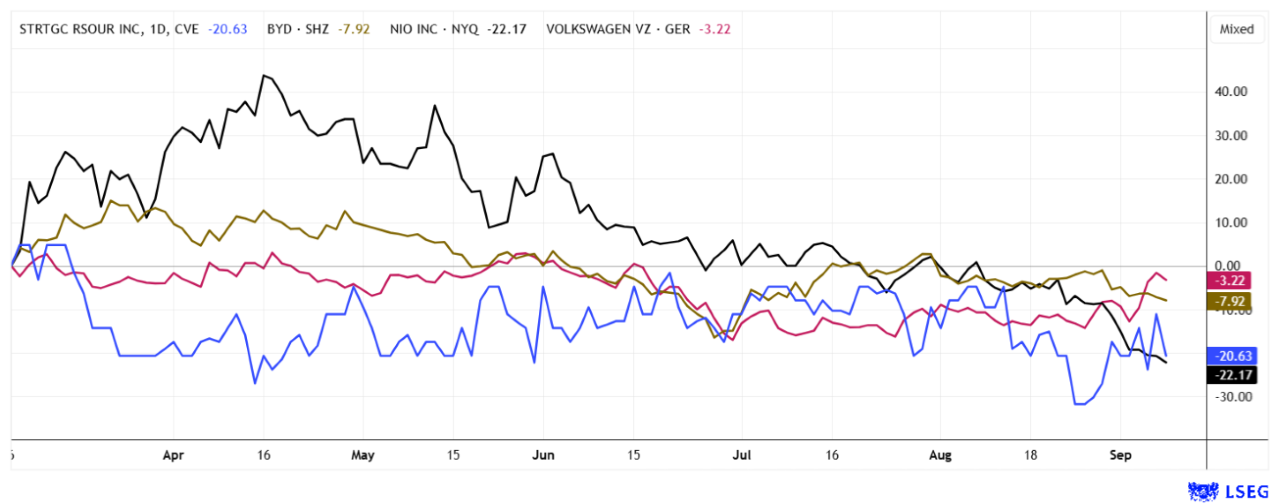
In the current market environment, the interplay between artificial intelligence and strategic transformation will determine the long-term survival of the automotive industry. While the established giant VW must secure its competitiveness through painful restructuring and the reduction of fixed costs, Chinese challengers are demonstrating the dynamism of the new era. Players such as Strategic Resources, as commodity developers, form the foundation of the future value chain. A healthy mix protects against excessive volatility.
Conflict of interest
Pursuant to §85 of the German Securities Trading Act (WpHG), we point out that Apaton Finance GmbH as well as partners, authors or employees of Apaton Finance GmbH (hereinafter referred to as "Relevant Persons") currently hold or hold shares or other financial instruments of the aforementioned companies and speculate on their price developments. In this respect, they intend to sell or acquire shares or other financial instruments of the companies (hereinafter each referred to as a "Transaction"). Transactions may thereby influence the respective price of the shares or other financial instruments of the Company.
In this respect, there is a concrete conflict of interest in the reporting on the companies.
In addition, Apaton Finance GmbH is active in the context of the preparation and publication of the reporting in paid contractual relationships.
For this reason, there is also a concrete conflict of interest.
The above information on existing conflicts of interest applies to all types and forms of publication used by Apaton Finance GmbH for publications on companies.
Risk notice
Apaton Finance GmbH offers editors, agencies and companies the opportunity to publish commentaries, interviews, summaries, news and the like on news.financial. These contents are exclusively for the information of the readers and do not represent any call to action or recommendations, neither explicitly nor implicitly they are to be understood as an assurance of possible price developments. The contents do not replace individual expert investment advice and do not constitute an offer to sell the discussed share(s) or other financial instruments, nor an invitation to buy or sell such.
The content is expressly not a financial analysis, but a journalistic or advertising text. Readers or users who make investment decisions or carry out transactions on the basis of the information provided here do so entirely at their own risk. No contractual relationship is established between Apaton Finance GmbH and its readers or the users of its offers, as our information only refers to the company and not to the investment decision of the reader or user.
The acquisition of financial instruments involves high risks, which can lead to the total loss of the invested capital. The information published by Apaton Finance GmbH and its authors is based on careful research. Nevertheless, no liability is assumed for financial losses or a content-related guarantee for the topicality, correctness, appropriateness and completeness of the content provided here. Please also note our Terms of use.