March 17th, 2026 | 07:30 CET
80% Margins from SKYDRA: Why Volatus Aerospace Is More Than a Drone Manufacturer
CAD 81.8 billion is a figure that immediately grabs attention. With this amount, the Canadian government has not simply increased its budget, but has laid out a new industrial framework for the country's defense policy. The old rules of procurement no longer apply. In recent years, Canadian defense companies have faced protracted decision-making processes, years-long procurement cycles, and a significant portion of the hoped-for budget flowing overseas. The new Defense Industrial Strategy is no ordinary policy document. It is a clear commitment to a "Build in Canada" philosophy. In the future, 70% of procurement spending is to go to domestic companies. At the same time, unmanned systems and autonomous technologies are officially declared "core sovereign capabilities." This sector, in which Volatus Aerospace is well-positioned, is granted strategic status and will be prioritized in the future.
time to read: 4 minutes | Author: Armin Schulz
ISIN: VOLATUS AEROSPACE INC | CA92865M1023 | TSXV: FLT , OTCQB: TAKOF
Table of contents:
Author

Armin Schulz
Born in Mönchengladbach, he studied business administration in the Netherlands. In the course of his studies he came into contact with the stock exchange for the first time. He has more than 25 years of experience in stock market business.
Tag cloud
Shares cloud
A Company That Is Ready
The more exciting question for investors, however, is who will actually benefit from this structural transformation. Not every company that builds drones today will automatically become a favorite of the new strategy. What is needed are companies that are not just jumping on the bandwagon now, but already have the infrastructure, personnel, and technology to deliver immediately.
Volatus Aerospace appears to fit this description well. While many market participants are still studying the new guidelines, the company has already set the course in recent months. By acquiring an extensive IP portfolio for long-range drones from the UK and ramping up production in Mirabel, Quebec, the company secured capacity early on. The logic behind this is simple. A company that already has a production line for drones capable of staying airborne for 35 hours or even several days is in a completely different position when the government suddenly demands sovereignty in the far north.
The facility in Mirabel is designed for mass production, 7–10 systems per month, each with an estimated commercial value of around CAD 1.5 million. The production capacity is sufficient to support drone sales of over CAD 150 million per year, with margins that could be well over 20%. This is not a pipe dream, but a reality in the making.
From Pipeline Drone to Arctic Scout
This is precisely where the circle closes on the new strategy. Arctic sovereignty is a central tenet of this new approach. Canada's vast, sparsely populated territories can only be monitored using autonomous systems. Volatus positions itself here not only as a drone manufacturer, but as a provider of a service that has already been tested on a large scale in the civilian sector.
The company already monitors extensive pipeline networks for the oil and gas industry every year. This data collection can be directly applied, technologically speaking, to the surveillance of borders, coastlines, or even the Arctic. It is this "dual-use" approach that reduces the risk for investors. The business model does not rely solely on the defense budget but is built on a broad civilian foundation. More than 30 ongoing government contracts and activities in several NATO countries underscore this.
The recent acquisition of the remaining shares in Synergy Aviation adds another piece to the puzzle. Under one roof, Volatus can now offer a comprehensive security and surveillance portfolio ranging from manned helicopters to drones and software. This vertical integration is not an end in itself, but a strategic asset. This is particularly true when it comes to complex tenders where the customer wants a single point of contact for everything.
The Software Lever
At the same time, the company is working on another growth area that could permanently transform its margin structure. SKYDRA, the new SaaS platform for drone defense and mission planning, addresses the growing market for counter-drone solutions. Industry experts estimate that this segment could double to over USD 20 billion by 2030.
What makes SKYDRA so strategically valuable is its business model. As a pure software solution, the platform promises gross margins of 80–85%, a fundamentally different margin profile compared to the hardware business. While initial revenues in 2026 will still be modest, management expects noticeable growth starting in 2027. This is a key factor for the company's overall valuation. Software businesses are typically valued in the markets using very different multiples than pure product manufacturers.
The Valuation Gap
Investors would do well to take a step back and view the situation objectively. Yes, the announcements from Ottawa send a strong signal. The demand for domestic solutions is now clearly defined, which increases predictability and should lower the cost of capital in the long term. Until now, Canadian defense stocks have often traded at a discount to their US counterparts, simply because the domestic market was unpredictable. This narrative is beginning to shift.
Comparing Volatus with a group of publicly traded peers reveals a significant disparity. The valuation metrics are significantly lower than those of comparable companies, even though, unlike many competitors, Volatus already generates broadly diversified revenue and has an international presence.
This is an aspect that should not be overlooked by investors. Over 20% of the shares are held by insiders. Since the IPO, there have been no significant sales, not even during periods of sharp price movements. All full-time employees hold shares through an equity program. This creates strong alignment between management and shareholders.
What the Analysts Say
Recent analyst coverage shows broad agreement. bVentum Capital Markets sees Volatus in the right market at the right time. Haywood highlights the company's regulatory expertise and its BVLOS lead. Desjardins points to Ottawa's defense strategy and the 70% quota for domestic firms. Maxim Group emphasizes the solid foundation of approximately CAD 40 million in cash and a CAD 600 million pipeline. And Stifel underscores the data advantage as a strategic core. The range of price targets lies between CAD 0.85 and CAD 1.25, and thus above the current level. What unites them all is the conviction that the market has so far only partially priced in the company's transformation.
The stock is currently trading at CAD 0.84.
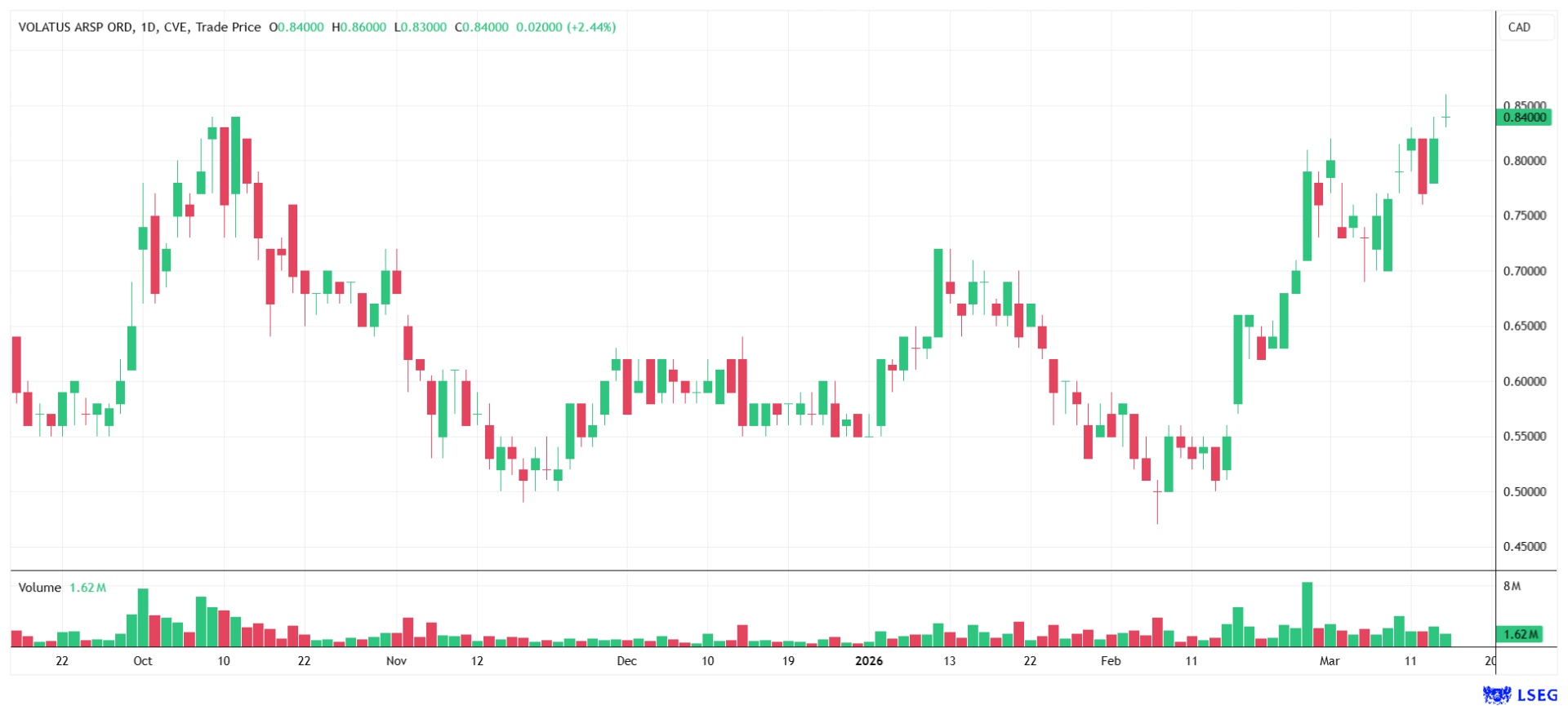
For investors, the picture is clear. The Canadian defense industry is being reevaluated. The government has presented a roadmap that identifies clear winners. It is no longer about isolated projects, but rather a long-term, strategic partnership between the government and industry. Volatus positioned itself early on, with its own manufacturing capabilities, strategic IP, and an operational foundation that extends far beyond the defense sector. The rally is not driven by the news, but by the ability to turn the new billions into tangible revenue. Anyone looking to invest in the intersection of commercial aviation, unmanned systems, and defense will find a package here that is already flying - in the truest sense of the word.
Conflict of interest
Pursuant to §85 of the German Securities Trading Act (WpHG), we point out that Apaton Finance GmbH as well as partners, authors or employees of Apaton Finance GmbH (hereinafter referred to as "Relevant Persons") currently hold or hold shares or other financial instruments of the aforementioned companies and speculate on their price developments. In this respect, they intend to sell or acquire shares or other financial instruments of the companies (hereinafter each referred to as a "Transaction"). Transactions may thereby influence the respective price of the shares or other financial instruments of the Company.
In this respect, there is a concrete conflict of interest in the reporting on the companies.
In addition, Apaton Finance GmbH is active in the context of the preparation and publication of the reporting in paid contractual relationships.
For this reason, there is also a concrete conflict of interest.
The above information on existing conflicts of interest applies to all types and forms of publication used by Apaton Finance GmbH for publications on companies.
Risk notice
Apaton Finance GmbH offers editors, agencies and companies the opportunity to publish commentaries, interviews, summaries, news and the like on news.financial. These contents are exclusively for the information of the readers and do not represent any call to action or recommendations, neither explicitly nor implicitly they are to be understood as an assurance of possible price developments. The contents do not replace individual expert investment advice and do not constitute an offer to sell the discussed share(s) or other financial instruments, nor an invitation to buy or sell such.
The content is expressly not a financial analysis, but a journalistic or advertising text. Readers or users who make investment decisions or carry out transactions on the basis of the information provided here do so entirely at their own risk. No contractual relationship is established between Apaton Finance GmbH and its readers or the users of its offers, as our information only refers to the company and not to the investment decision of the reader or user.
The acquisition of financial instruments involves high risks, which can lead to the total loss of the invested capital. The information published by Apaton Finance GmbH and its authors is based on careful research. Nevertheless, no liability is assumed for financial losses or a content-related guarantee for the topicality, correctness, appropriateness and completeness of the content provided here. Please also note our Terms of use.