June 16th, 2026 | 07:20 CEST
Vonovia is Struggling, Evotec is Reinventing Itself, and dynaCERT is Expanding—Three Stocks Under the Microscope! Who has the Upper Hand?
Three stocks, three completely different stories, yet all three are currently at a point that is likely to determine their performance over the coming months. Vonovia, for example, is struggling with rising interest rates and a real estate market that refuses to recover. Evotec is in the midst of a profound restructuring and has just reshuffled its supervisory board. And dynaCERT, the Canadian cleantech specialist, is pushing ahead in Southeast Asia: Vietnam could be the next step. On top of that, a geopolitical shock is shaking up markets: the US and Iran have reportedly reached a deal, and the Strait of Hormuz is set to reopen. Oil prices have fallen sharply in response. What this means for energy costs, real estate markets, and cleantech companies is still unclear. But a closer look reveals that all three stocks offer more than just headlines. Where should investors enter now?
time to read: 6 minutes | Author: Matthias Schomber
ISIN: DYNACERT INC. | CA26780A1084 | TSX: DYA , OTCQB: DYFSF , EVOTEC SE INH O.N. | DE0005664809 , VONOVIA SE NA O.N. | DE000A1ML7J1
Table of contents:
Author

Matthias Schomber
Raised in Giessen, Hesse, Matthias Schomber discovered his passion for the financial markets as early as the 1990s—at a time when stock trading was still largely the domain of true, die-hard traders. After completing his banking apprenticeship, he worked for a private bank there and witnessed the rise and fall of the Neuer Markt firsthand on the trading floor of the Frankfurt Stock Exchange, drawing lessons from the experience that continue to shape his thinking as a trader, author, and trading system developer to this day.
Tag cloud
Shares cloud
Vonovia: June 30 Could Be a Fateful Date
Hardly any date in the German real estate sector is being watched as closely right now as June 30 at Vonovia. That is when Europe's largest residential real estate group will revalue its entire property portfolio. And the timing could hardly be worse, as the European Central Bank raised interest rates by another 25 basis points shortly before. The deposit facility now stands at 2.25%. For a company like Vonovia, whose valuations are closely tied to interest rates, this could become a problem, as rising rates typically push real estate values down—and that would likely come at exactly the wrong time.
Inflation in the eurozone climbed to 3.2% in May, well above the ECB's 2% target. For 2026, ECB economists expect an inflation rate of 3.0% alongside meagre GDP growth of just 0.8%. Further interest rate hikes are therefore still on the table, and that bodes ill for Vonovia.
Operations have nevertheless remained surprisingly stable recently. The average rent rose by 3.8% in the first quarter of 2026 to EUR 8.46 per square meter per month. The vacancy rate stands at just 2.3%, which is a very respectable figure for the German market. Adjusted EBITDA grew by 1.4% to EUR 711.6 million. And management has not yet revised downward its full-year target of adjusted EBITDA between EUR 2.95 and 3.05 billion. However, financing costs are weighing on profits. Adjusted profit fell by 7.2% to EUR 365.6 million. Debt is eating into earnings. A total of around EUR 5 billion in bonds will mature by the end of 2027. The group is responding with a broad issuance strategy, including Eurobonds, yen-denominated bonds, and pound- and Australian-dollar issues. This broadens the investor base, and as a result, the S&P rating remains stable at "BBB+."
The stock reflects the market's view of all this. Trading at around EUR 21, it is near its 52-week low of just under EUR 20—well below book value and also significantly down since the start of the year. Over a twelve-month period, the decline exceeds 25%. Goldman Sachs nevertheless maintains a "Buy" recommendation with a price target of EUR 34.30 and points to positive sector trends.
The gap between the price target and the current price is huge, and whether it closes depends largely on the portfolio valuation at the end of June and the half-year results on August 5. Structurally, there is indeed a lot going for Vonovia.
In 2025, only around 207,000 apartments were completed in Germany, the lowest level since 2012. New building permits mean additional supply will not hit the market until 2028 at the earliest. Rental pressure is therefore likely to remain high. Those with a long-term perspective might see Vonovia as a value candidate. But in the short term, the risk remains. Add it to the watchlist!
Evotec: A Breath of Fresh Air on the Supervisory Board
From Vonovia's concrete to biotechnology. Hamburg-based Evotec tells a very different story, and yet the Hamburg life sciences specialist is also well aware of market pressures.
At the Annual General Meeting on June 11, 2026, all agenda items were approved by the required majority, and two new members joined the Supervisory Board: Dieter Weinand and Dr. Wolfgang Hofmann. Weinand immediately assumed the chairmanship, succeeding Prof. Dr. Iris Löw-Friedrich. Additionally, Dr. Duncan McHale and Wesley Wheeler were re-elected. A total of 43.10% of the registered share capital was represented at the meeting.
Evotec is in the midst of a structural reorganization under the project name "Project Horizon." The company is consolidating its global locations to become more efficient and has raised fresh capital through a convertible bond; nevertheless, the stock came under pressure afterward, but that is a familiar pattern with such measures. What sets Evotec apart, however, is that the company is not a small niche player. Evotec has collaborations with all of the world's top 20 pharmaceutical companies, including Bayer, Bristol Myers Squibb, Novo Nordisk and Takeda. In addition, it has over 800 biotech partners and academic institutions, including the University of Oxford and the Gates Foundation.
Its technology is also broadly diversified: this includes AI-supported drug discovery, proprietary platforms for molecular patient data and cell therapies, small-molecule compounds, and biologics. Over 100 in-house research projects are running in parallel. The focus is on oncology, cardiovascular and metabolic diseases, neurology, and immunology.
The share price has suffered in recent months; one could charitably describe it as a downward-sloping sideways trend. At around EUR 4.80, the stock is trading well below its highs from a few years ago. In 2021, the share was still above EUR 40. Nevertheless, the ongoing restructuring could serve as a catalyst in the medium term. The key will be whether the new leadership team on the supervisory board credibly supports the strategic realignment and whether "Project Horizon" lives up to its name. Stay on the sidelines and set an alert if the EUR 5.50 level is broken to the upside.
dynaCERT: Vietnam and a Consolidation Phase
And now to Canada—or rather, to Southeast Asia as well—because Toronto-based dynaCERT is on an expansion course with its HydraGEN™ technology. The latest move takes the company directly to Vietnam.
The idea behind HydraGEN is simple yet effective, as the hydrogen-on-demand retrofit system uses electrolysis to split distilled water into hydrogen and oxygen. These gases are fed into the combustion process of a diesel engine, ensuring more efficient combustion. The result is lower fuel consumption and reduced emissions of pollutants such as carbon oxides and particulate matter.
This basic concept is highly relevant in light of global efforts to use fossil fuels more efficiently and reduce CO₂ emissions. As long as diesel fleets remain in use worldwide—and they will for years to come—solutions like HydraGEN™ offer tangible benefits without requiring costly conversions to pure-electric drives.
Vietnam fits perfectly into this logic, as the country has several million heavy-duty vehicles, buses, and construction machines—naturally, a great many, and likely even the majority, of which are diesel-powered. The economy is growing strongly, and the government has set climate goals, namely climate neutrality by 2050. To this end, an emissions trading system is to be introduced that creates incentives to invest in green technologies.
During its trip to Vietnam, dynaCERT signed two significant letters of intent. A collaboration with Ho Chi Minh City University of Technology (HCMUT) aims to scientifically validate the HydraGEN™ technology under Vietnamese conditions. Additionally, an agreement was signed with a Vietnamese oil and gas company to carry out joint pilot projects in the state-controlled energy infrastructure sector. Technical forums in Ho Chi Minh City with representatives from government agencies, logistics companies, and universities underscore how seriously the Vietnamese are taking this issue. Even the Canadian Trade Commissioner on site supports the initiative.
In addition, the company's proprietary telematics system, HydraLytica™, enables real-time measurement of savings and the generation of emission certificates. The dynaCERT methodology is also Verra-certified, providing access to the global market for tradable CO₂ credits.
Technical Analysis
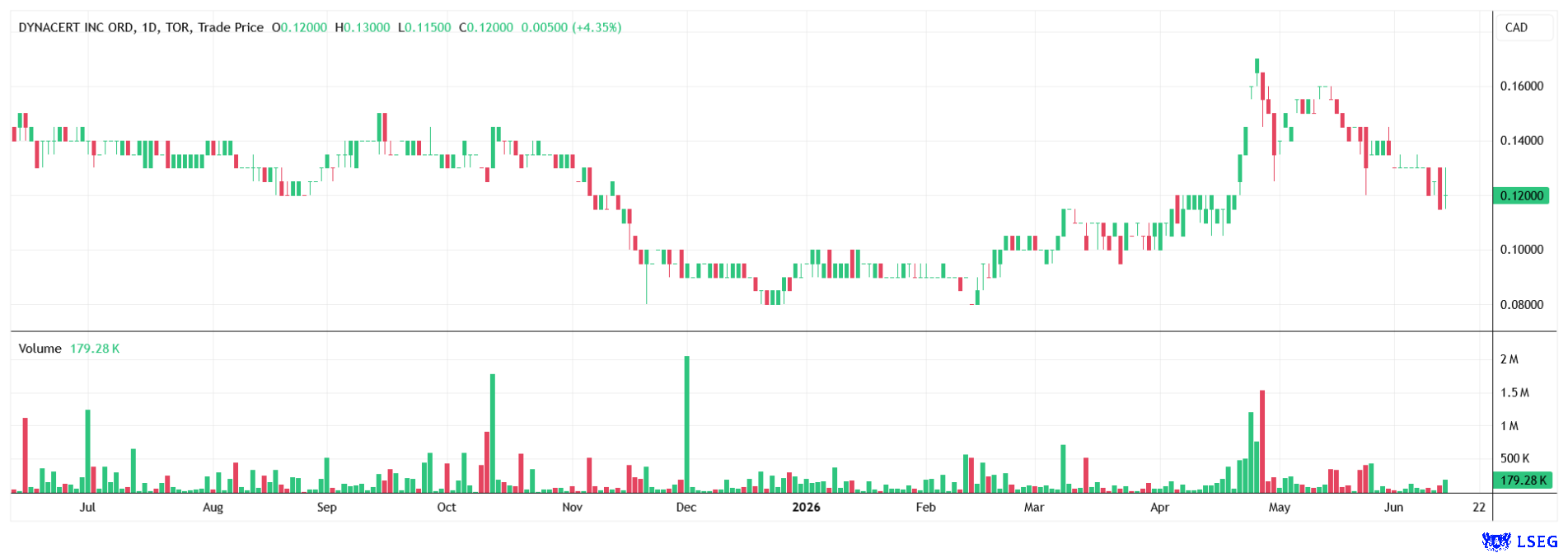
The share price has recently retreated again following a temporary upward move to CAD 0.17. What appears to be a pullback could turn out to be a normal consolidation phase in the future. The range between CAD 0.10 and CAD 0.12 potentially offers a more favourable entry level than seen recently. Speculative investors could cautiously consider making initial partial entries!
At current levels, Vonovia offers a high dividend yield and operational support, driven by tight housing supply. Still, the headwind from interest rates is real, and only June 30 will bring clarity on how much substance truly remains.
Evotec is undergoing a much-needed restructuring. The new leadership on the supervisory board, the broad scientific base, and the deep partnerships with the global pharmaceutical industry are solid arguments for investors with a medium-term focus.
dynaCERT is the most speculative of the three stories, but potentially also quite interesting. The combination of proven technology, growing markets, and the hint of an entry into Vietnam is worth paying attention to. The ongoing consolidation of the share price could be an attractive entry opportunity. Investors who can tolerate risk and take emissions reduction in the diesel sector seriously should keep dynaCERT on their radar.
Conflict of interest
Pursuant to §85 of the German Securities Trading Act (WpHG), we point out that Apaton Finance GmbH as well as partners, authors or employees of Apaton Finance GmbH (hereinafter referred to as "Relevant Persons") may hold shares or other financial instruments of the aforementioned companies in the future or may bet on rising or falling prices and thus a conflict of interest may arise in the future. The Relevant Persons reserve the right to buy or sell shares or other financial instruments of the Company at any time (hereinafter each a "Transaction"). Transactions may, under certain circumstances, influence the respective price of the shares or other financial instruments of the Company.
In addition, Apaton Finance GmbH is active in the context of the preparation and publication of the reporting in paid contractual relationships.
For this reason, there is a concrete conflict of interest.
The above information on existing conflicts of interest applies to all types and forms of publication used by Apaton Finance GmbH for publications on companies.
Risk notice
Apaton Finance GmbH offers editors, agencies and companies the opportunity to publish commentaries, interviews, summaries, news and the like on news.financial. These contents are exclusively for the information of the readers and do not represent any call to action or recommendations, neither explicitly nor implicitly they are to be understood as an assurance of possible price developments. The contents do not replace individual expert investment advice and do not constitute an offer to sell the discussed share(s) or other financial instruments, nor an invitation to buy or sell such.
The content is expressly not a financial analysis, but a journalistic or advertising text. Readers or users who make investment decisions or carry out transactions on the basis of the information provided here do so entirely at their own risk. No contractual relationship is established between Apaton Finance GmbH and its readers or the users of its offers, as our information only refers to the company and not to the investment decision of the reader or user.
The acquisition of financial instruments involves high risks, which can lead to the total loss of the invested capital. The information published by Apaton Finance GmbH and its authors is based on careful research. Nevertheless, no liability is assumed for financial losses or a content-related guarantee for the topicality, correctness, appropriateness and completeness of the content provided here. Please also note our Terms of use.