August 14th, 2026 | 08:20 CEST
Drones, Energy Crisis and NASDAQ! DroneShield, HPQ Silicon, Siemens Energy and Nordex in Focus
All quiet on the western front! Whether it is war, bankruptcies, or new tariffs, the party goes on! The drone sector, booming thanks to increased defence spending, stands in stark contrast to the simmering EU energy crisis, which continues to pose major challenges for Brussels. Counter-drone specialist DroneShield is experiencing a massive surge in demand and orders in the field of electronic warfare, yet its share price is falling significantly. Canadian company HPQ Silicon is also benefiting from the West's need to independently establish critical supply chains for high-purity silicon and innovative battery materials. Siemens Energy also sits at the epicentre of the infrastructure transition, with its historically full order books serving as an unshakable engine of growth amid the energy crunch. This sustained rebound is flanked by Hamburg-based wind power pioneer Nordex, which is reporting double-digit margin improvements. This compelling combination of high-tech defence, clean energy generation, and raw material sovereignty is attracting substantial capital directly into investors' coffers. We take a closer look at four future-oriented sector favourites.
time to read: 5 minutes | Author: André Will-Laudien
ISIN: HPQ SILICON INC | CA40444L1031 | TSXV: HPQ , OTCQB: HPQFF , DRONESHIELD LTD | AU000000DRO2 , SIEMENS ENERGY AG NA O.N. | DE000ENER6Y0 , NORDEX SE O.N. | DE000A0D6554
Table of contents:
Author

André Will-Laudien
Born in Munich, he first studied economics and graduated in business administration at the Ludwig-Maximilians-University in 1995. As he was involved with the stock market at a very early stage, he now has more than 30 years of experience in the capital markets.
Tag cloud
Shares cloud
DroneShield: A Plunge Despite the Defence Boom
What happened here? Australian defence specialist DroneShield slid into a painful correction despite a global military boom and most recently posted a significant annual loss of nearly 50%. This abrupt price drop surprised many investors, as the company had achieved explosive revenue growth of 74% to AUD 125.8 million in the first half of 2026. However, the stock was hurt by management's recent downward revision of its full-year forecast to AUD 250–270 million, which was well below the high expectations of the Wall Street consensus. Compounding the problem was noticeable margin pressure, as the gross margin corrected from 65% to around 60% in the first half of the year due to relocation efforts and an ERP system migration. Despite these operational setbacks, the long-term fundamentals remain intact thanks to a record order backlog of AUD 206 million for the current year, which is already contractually secured. This is therefore likely "merely" a healthy correction of the previously massive valuation excess.
HPQ Silicon: The global battery push is now moving toward commercialization
Similar sector – different approach! HPQ Silicon, a developer of innovative silicon technologies, is increasingly transforming into a provider where technical progress and commercial validation go hand in hand. The business model rests on three pillars: silicon-based batteries, novel processes for fumed silica, and technologies for clean hydrogen and energy conversion. The most important value driver at present is battery technology, as HPQ's Gen4 platform has reached a stage of development where regulatory and industrial practicality, not just performance metrics, count. In July, the 21700 Gen4 cell received UL 1642 safety certification, confirming a capacity of 6,500 mAh—approximately 8.3% more than the previously certified Gen3 version, which had a capacity of 6,000 mAh.
The next step appears even more important. UN 38.3 certification followed in early August, clearing a major hurdle for the international transport of batteries to customers, integrators, and potential industry partners. For a young battery supplier, this is more than just another certificate, as each qualification level passed reduces technological, regulatory, and ultimately commercial risks. At this point, HPQ could hold a decisive advantage, as the silicon anode technology developed in collaboration with Novacium is designed for integration into existing lithium-ion manufacturing processes and thus does not require a complete industrial overhaul.
President, Chairman, and CEO Bernard Tourillon outlined his strategy at the 19th International Investment Forum.
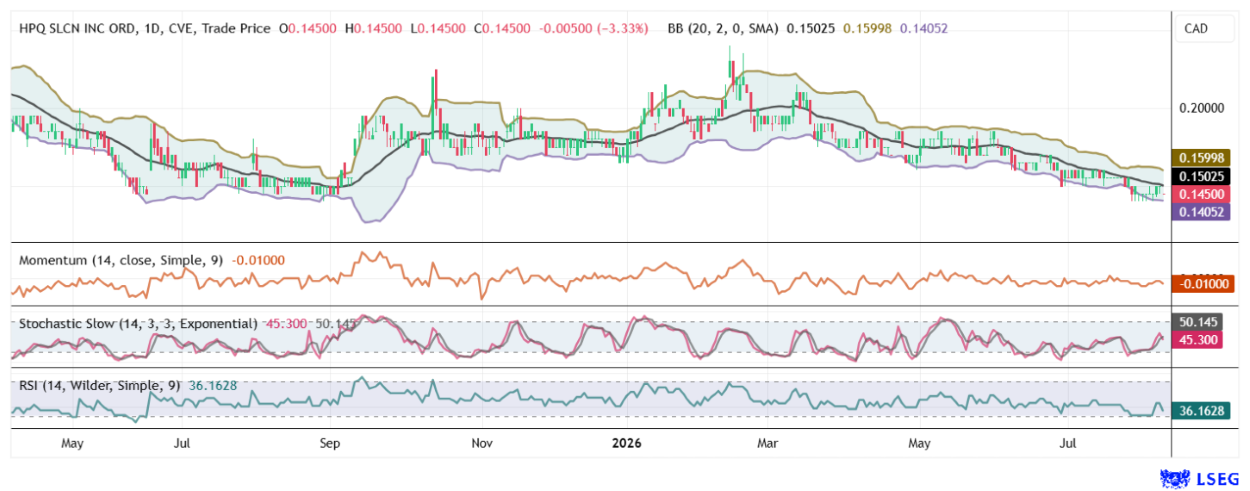
The emerging technology's focus on drones and defence makes strategic sense, as performance gains in these sectors have significantly higher economic value than in the mass market for ordinary consumer electronics. HPQ projects global defence demand for batteries to exceed 4 GWh by 2025, with drone systems already accounting for nearly 40% of this volume—a share that has more than doubled within five years. The playing field is even larger in the military drone market, which, according to market data, could grow from approximately USD 35 billion in 2026 to more than USD 109 billion by 2031. North America stands out, accounting for about 40% of the global market, as HPQ holds exclusive marketing rights for its Endura+ technology in this region. With the AA Nova 6S3P, Novacium is already developing a specific high-performance battery for a European drone manufacturer, while several market participants are currently evaluating the technology as part of qualification programs. In addition, the fumed silica project remains a second potential driver of share price growth, while hydrogen and waste-to-energy technologies complement the portfolio with further future markets. With a market capitalization most recently at around CAD 68 million, HPQ continues to trade at a modest valuation, even though its technology platform is gradually moving toward industrial application. The Squirrel Strategy could pay off handsomely this winter!
Conflict of interest
Pursuant to §85 of the German Securities Trading Act (WpHG), we point out that Apaton Finance GmbH as well as partners, authors or employees of Apaton Finance GmbH (hereinafter referred to as "Relevant Persons") currently hold or hold shares or other financial instruments of the aforementioned companies and speculate on their price developments. In this respect, they intend to sell or acquire shares or other financial instruments of the companies (hereinafter each referred to as a "Transaction"). Transactions may thereby influence the respective price of the shares or other financial instruments of the Company.
In this respect, there is a concrete conflict of interest in the reporting on the companies.
In addition, Apaton Finance GmbH is active in the context of the preparation and publication of the reporting in paid contractual relationships.
For this reason, there is also a concrete conflict of interest.
The above information on existing conflicts of interest applies to all types and forms of publication used by Apaton Finance GmbH for publications on companies.
Risk notice
Apaton Finance GmbH offers editors, agencies and companies the opportunity to publish commentaries, interviews, summaries, news and the like on news.financial. These contents are exclusively for the information of the readers and do not represent any call to action or recommendations, neither explicitly nor implicitly they are to be understood as an assurance of possible price developments. The contents do not replace individual expert investment advice and do not constitute an offer to sell the discussed share(s) or other financial instruments, nor an invitation to buy or sell such.
The content is expressly not a financial analysis, but a journalistic or advertising text. Readers or users who make investment decisions or carry out transactions on the basis of the information provided here do so entirely at their own risk. No contractual relationship is established between Apaton Finance GmbH and its readers or the users of its offers, as our information only refers to the company and not to the investment decision of the reader or user.
The acquisition of financial instruments involves high risks, which can lead to the total loss of the invested capital. The information published by Apaton Finance GmbH and its authors is based on careful research. Nevertheless, no liability is assumed for financial losses or a content-related guarantee for the topicality, correctness, appropriateness and completeness of the content provided here. Please also note our Terms of use.