April 16th, 2026 | 07:05 CEST
Volatus Aerospace on the Rise – From Aerial Imagery to a Question of Power: Drone Technology Is Shaping the Future
The skies no longer belong solely to airplanes. Drones are rapidly evolving from niche tools into a core technology across industries. They are man-made, but ultimately superior, because they see better and act without emotion according to predefined patterns. They enhance data collection, automate processes, and expand operational capabilities—from agriculture to security. What was once experimental is now becoming systemically relevant. Autonomous systems secure energy supplies, facilitate rescue operations, and modernize global supply chains. Their dual utility makes them a key infrastructure of the digital age. For whoever possesses drone technologies increasingly controls the flow of data and resources and optimizes protection against unwanted threats. A trend that is clearly gaining momentum in the financial markets, with one name at the forefront: Volatus Aerospace.
time to read: 5 minutes | Author: André Will-Laudien
ISIN: VOLATUS AEROSPACE INC | CA92865M1023 | TSXV: FLT , OTCQB: TAKOF
Table of contents:
Author

André Will-Laudien
Born in Munich, he first studied economics and graduated in business administration at the Ludwig-Maximilians-University in 1995. As he was involved with the stock market at a very early stage, he now has more than 30 years of experience in the capital markets.
Tag cloud
Shares cloud
From the Farm to the Battlefield: Drones Are Becoming Critical Infrastructure
The military and economic significance of drones has fundamentally changed in recent years. What was once considered a supplementary tactical tool is now evolving into a standalone infrastructure technology, comparable to satellite communications or cyber defense. In modern conflicts, drones play a decisive role in reconnaissance, logistics, target acquisition, and the protection of critical infrastructure. At the same time, they secure pipelines, power grids, and transportation routes in civilian areas. This dual role as a security and economic technology explains why nations are massively increasing their budgets for autonomous systems and building their own industrial capabilities. In this environment, the Canadian company Volatus Aerospace positions itself as an integrated provider of drone systems, data platforms, and training solutions. The company's strategic relevance stems not from its current size, but from its position in a market that is accelerating structurally and becoming increasingly charged with security policy implications.
Drones as a Systems Business: Long-Term Integration Is Key
The decisive competitive advantage in today's drone market no longer lies in the hardware itself, but in the ability to provide complete operational systems. This is precisely where Volatus's business model comes into play. The company combines development, operations, data analysis, and training into an integrated platform. This structure enables recurring revenue throughout the entire lifecycle of a system. A military or government customer does not just buy a drone, but a long-term operational concept that includes software, maintenance, spare parts, and training. And they enter into a technological dependency that, with responsible and high-quality use, secures a long-term contractual basis.
This system logic is highly attractive economically because it leads to stable cash flows. While the initial sale of a system often involves low margins, the actual profits are generated in subsequent years through service contracts and operational support. This is precisely why defense companies are increasingly investing in training capabilities and data platforms. Whoever controls training controls smooth operations in the long term. As a result, the market is shifting technologically toward autonomous systems that must function even under difficult conditions. This development significantly raises the barriers to entry for new competitors and favors companies that established integrated platforms early on.
NATO Contract: Strategic Entry into Government Security Structures
The training contract with a NATO ally announced in April 2026 holds particular strategic significance. The contract covers the development and implementation of specialized training programs for security and emergency response forces over an initial period of two years. The potential contract value of approximately CAD 2.1 million appears modest compared to large defense projects, but its economic impact lies in long-term integration into government systems. In the defense industry, training is considered one of the most important entry points into new markets. Once a company is responsible for training personnel, it becomes part of a client's operational infrastructure. For Volatus, this contract represents an additional reference in the NATO environment, which could be decisive in future tenders. Defense projects are frequently awarded to companies that can already demonstrate operational experience in comparable programs. Every successful collaboration thus increases the likelihood of further contracts and strengthens the company's market position.
Defense Dynamics: Drones Are Becoming the New Core Technology of Modern Armed Forces
The growing importance of drones can also be observed in quantitative terms. In modern conflicts, unmanned systems now account for a significant portion of the reconnaissance and attack assets deployed. At the same time, NATO countries are investing billions in new drone programs to expand their capabilities in surveillance, logistics, and electronic warfare. This development is creating a structural demand for technology providers capable of delivering rapidly scalable solutions.
In this environment, a classic industrial multiplier effect emerges. An initial training or pilot contract leads to further projects, such as the delivery of systems or the establishment of maintenance centers. These projects, in turn, generate long-term service contracts that ensure stable revenue over many years. The economic significance of a single contract therefore stems not from its short-term revenue, but from its potential to trigger future programs.
For Volatus, this presents a clear strategic opportunity. The company has its own production capabilities, integrated software platforms, and growing international experience. This combination enables it not only to deliver individual systems but also to offer complete operational solutions. In a market increasingly characterized by system integration, this can become a decisive competitive advantage.
CEO Glen Lynch outlined his medium-term strategy at the 18th International Investment Forum.
The Drone Market Is Gaining Global Momentum—and Volatus Is Well Positioned
The strategic importance of drones is currently accelerating visibly, and the political signals are clear. In early April, the US government under Donald Trump released its defense budget for fiscal year 2027 with a record volume of approximately USD 1.5 billion, about 44% higher than the previous year. Particularly relevant is the massive focus on autonomous systems. According to initial analyses, around USD 63 billion is set to flow into unmanned and autonomous technologies, a sharp increase from approximately USD 10 billion in 2026. In the logic of the defense economy, this marks a clear turning point, as it is not individual programs but an entire technology sector that is being scaled up. For the drone market, this development marks the beginning of a multi-year investment cycle. Autonomous systems are increasingly becoming the foundational technology of modern security architecture, comparable to satellites or cyber defense. This structural demand directly impacts providers of integrated solutions, particularly companies that combine technology, operations, and training. This is precisely where Volatus Aerospace is positioned.
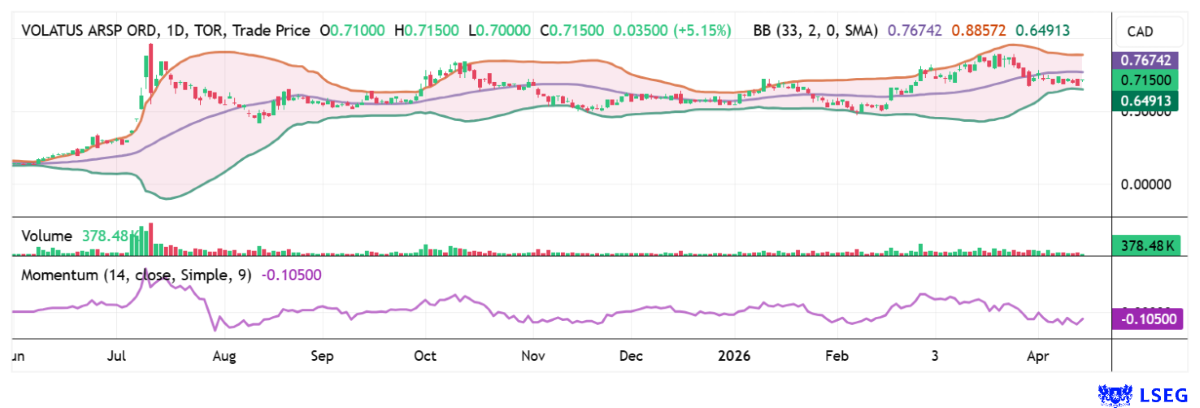
From an analytical perspective, Volatus is thus at a classic turning point: The infrastructure is in place, the first government references are available, and the market is just beginning to invest heavily. And they are going all out here! Anyone investing in drone technology today isn't just betting on a short-term trend, but on a new core industrial technology. Yesterday, Volatus shares were available for EUR 0.43 or CAD 0.72. Analyst targets range between CAD 0.46 and 0.75. Act now!
Conflict of interest
Pursuant to §85 of the German Securities Trading Act (WpHG), we point out that Apaton Finance GmbH as well as partners, authors or employees of Apaton Finance GmbH (hereinafter referred to as "Relevant Persons") currently hold or hold shares or other financial instruments of the aforementioned companies and speculate on their price developments. In this respect, they intend to sell or acquire shares or other financial instruments of the companies (hereinafter each referred to as a "Transaction"). Transactions may thereby influence the respective price of the shares or other financial instruments of the Company.
In this respect, there is a concrete conflict of interest in the reporting on the companies.
In addition, Apaton Finance GmbH is active in the context of the preparation and publication of the reporting in paid contractual relationships.
For this reason, there is also a concrete conflict of interest.
The above information on existing conflicts of interest applies to all types and forms of publication used by Apaton Finance GmbH for publications on companies.
Risk notice
Apaton Finance GmbH offers editors, agencies and companies the opportunity to publish commentaries, interviews, summaries, news and the like on news.financial. These contents are exclusively for the information of the readers and do not represent any call to action or recommendations, neither explicitly nor implicitly they are to be understood as an assurance of possible price developments. The contents do not replace individual expert investment advice and do not constitute an offer to sell the discussed share(s) or other financial instruments, nor an invitation to buy or sell such.
The content is expressly not a financial analysis, but a journalistic or advertising text. Readers or users who make investment decisions or carry out transactions on the basis of the information provided here do so entirely at their own risk. No contractual relationship is established between Apaton Finance GmbH and its readers or the users of its offers, as our information only refers to the company and not to the investment decision of the reader or user.
The acquisition of financial instruments involves high risks, which can lead to the total loss of the invested capital. The information published by Apaton Finance GmbH and its authors is based on careful research. Nevertheless, no liability is assumed for financial losses or a content-related guarantee for the topicality, correctness, appropriateness and completeness of the content provided here. Please also note our Terms of use.