March 27th, 2026 | 07:15 CET
Volatus Aerospace – A Billion-Dollar Market Gaining Momentum from Security & Industry
The global drone market is poised for a structural growth surge. According to industry forecasts, unmanned systems are gaining importance not only in the military sector but also in infrastructure, energy, and disaster response. In particular, the increasing use of autonomous technologies and the need for efficient monitoring of critical facilities are driving demand. At the same time, a new billion-dollar market is emerging around drone defense, which could grow to over USD 20 billion by 2030. Companies that combine hardware, software, and operational services are positioning themselves as key players in a new aviation industry.
time to read: 3 minutes | Author: Stefan Feulner
ISIN: VOLATUS AEROSPACE INC | CA92865M1023 | TSXV: FLT , OTCQB: TAKOF
Table of contents:
Author

Stefan Feulner
The native Franconian has more than 20 years of stock exchange experience and a broadly diversified network.
He is passionate about analyzing a wide variety of business models and investigating new trends.
Tag cloud
Shares cloud
Platform Instead of Product
Volatus Aerospace is positioning itself in one of the most dynamic technology markets of the current decade. According to the company, the Canadian provider does not see itself as a pure drone manufacturer, but rather as an integrated aviation platform. The company combines drone systems, manned aviation, autonomy software, and training and mission solutions. This integration enables applications ranging from pipeline inspection and offshore logistics to security-related missions.
A key advantage lies in the business model. In addition to its project business, Volatus is increasingly building recurring revenue, for example, through service contracts and software solutions. The launch of its own SaaS platform for drone defense marks an important step toward high-margin, scalable revenue. At the same time, the company has an order pipeline of over CAD 600 million, which already offers high visibility today.
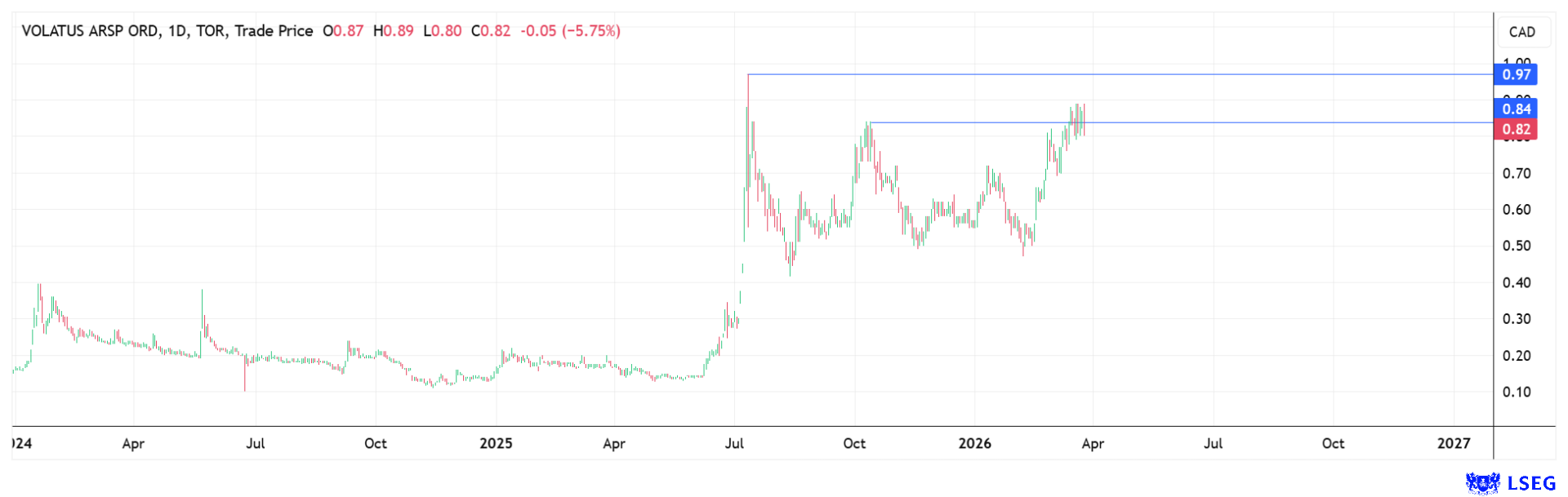
The company is also coming into sharper focus on the stock market. The uplisting to the Toronto Stock Exchange laid the groundwork for institutional investors. Several analysts see further upside potential. Both Desjardins and the Maxim Group have set a price target of CAD 1.25, reflecting potential of over 50% relative to the current price.
Tailwind from Policy and Market Structure
A key driver is Canada's new defense strategy. In the future, approximately 70% of procurement is to take place domestically, accompanied by investment programs worth billions. This creates a structural advantage for domestic suppliers. Volatus invested early in autonomous systems, operational capabilities, and in-house manufacturing, and is thus strategically well-positioned.
Added to this is the growing importance of integrated solutions. Government clients are not just looking for individual technologies, but for complete systems comprising hardware, software, and operational implementation. This is where Volatus's platform model demonstrates its strength. The combination of experience in civilian applications and a growing presence in the defense sector creates a rare intersection that can facilitate both short-term contracts and long-term programs.
Global Expansion – Training as an Additional Growth Driver
In addition to its core business, Volatus is strategically expanding its education and training division. A new partnership with the University of Technology in Jamaica marks the next step in its international expansion. Starting in 2026, the university will offer programs for drone pilots, with a focus on disaster response, mission planning, and operational applications.
The company is thus pursuing a clear strategy: education, technology, and operational services are to be more closely integrated. According to its own figures, Volatus has already trained over 100,000 professionals worldwide. The expansion into the Caribbean opens up additional markets, such as environmental monitoring, agriculture, and research. At the same time, training boosts demand for the company's own technologies and services.
Volatus Aerospace combines several structural growth drivers into a single business model. The global expansion of drone technologies, rising defense spending, and the growing need for autonomous solutions in industry are creating an environment in which integrated platform providers could benefit particularly.
Added to this is the company's strategically favorable position. With an extensive order pipeline, growing software expertise, and recurring revenue from service and training operations, revenue visibility is increasing. The move to the Toronto Stock Exchange, along with positive analyst assessments, suggests that the capital market is beginning to recognize this potential more fully.
Should the company succeed in converting its pipeline into concrete large-scale contracts while simultaneously further expanding high-margin business segments such as software and training, Volatus could evolve in the long term from a specialized provider into a globally relevant player in the drone and security market. This presents risk-aware investors with the opportunity to participate early on in a market that is only at the beginning of its development.
Conflict of interest
Pursuant to §85 of the German Securities Trading Act (WpHG), we point out that Apaton Finance GmbH as well as partners, authors or employees of Apaton Finance GmbH (hereinafter referred to as "Relevant Persons") may hold shares or other financial instruments of the aforementioned companies in the future or may bet on rising or falling prices and thus a conflict of interest may arise in the future. The Relevant Persons reserve the right to buy or sell shares or other financial instruments of the Company at any time (hereinafter each a "Transaction"). Transactions may, under certain circumstances, influence the respective price of the shares or other financial instruments of the Company.
In addition, Apaton Finance GmbH is active in the context of the preparation and publication of the reporting in paid contractual relationships.
For this reason, there is a concrete conflict of interest.
The above information on existing conflicts of interest applies to all types and forms of publication used by Apaton Finance GmbH for publications on companies.
Risk notice
Apaton Finance GmbH offers editors, agencies and companies the opportunity to publish commentaries, interviews, summaries, news and the like on news.financial. These contents are exclusively for the information of the readers and do not represent any call to action or recommendations, neither explicitly nor implicitly they are to be understood as an assurance of possible price developments. The contents do not replace individual expert investment advice and do not constitute an offer to sell the discussed share(s) or other financial instruments, nor an invitation to buy or sell such.
The content is expressly not a financial analysis, but a journalistic or advertising text. Readers or users who make investment decisions or carry out transactions on the basis of the information provided here do so entirely at their own risk. No contractual relationship is established between Apaton Finance GmbH and its readers or the users of its offers, as our information only refers to the company and not to the investment decision of the reader or user.
The acquisition of financial instruments involves high risks, which can lead to the total loss of the invested capital. The information published by Apaton Finance GmbH and its authors is based on careful research. Nevertheless, no liability is assumed for financial losses or a content-related guarantee for the topicality, correctness, appropriateness and completeness of the content provided here. Please also note our Terms of use.