March 23rd, 2026 | 07:00 CET
Use Gold's Pullback: Desert Gold Is Poised for a Revaluation - What Comes Next
The past trading week brought a sharp correction in the gold market. The price briefly fell below the USD 4,500 mark and recorded its steepest weekly loss in months. But for savvy investors, this could be exactly the right opportunity to buy. While prices remain under short-term pressure, the long-term drivers remain intact. Top investment firms like Goldman Sachs and JPMorgan are reaffirming their optimistic forecasts. In Mali, Desert Gold has a clear goal in sight. It is no longer about drilling dreams, but about a concrete construction site. With fresh capital of over CAD 7 million and a defined timeline, the transition from explorer to producer is imminent. This is the final piece of the puzzle needed to re-evaluate the company.
time to read: 4 minutes | Author: Armin Schulz
ISIN: DESERT GOLD VENTURES INC | CA25039N4084 | TSXV: DAU , OTCQB: DAUGF
Table of contents:
Author

Armin Schulz
Born in Mönchengladbach, he studied business administration in the Netherlands. In the course of his studies he came into contact with the stock exchange for the first time. He has more than 25 years of experience in stock market business.
Tag cloud
Shares cloud
Operational Homework Done
Capital markets tend to reward clear, executable development stories. At Desert Gold Ventures, this is exactly what is emerging. It is no longer just about potential ounces, but about a concrete roadmap leading to operational implementation. While many junior explorers continue to hope for the next capital raise, the company not only raised fresh capital with a CAD 7.2 million private placement in February but also demonstrated that professional investors support its strategic direction.
The Bridge to Cash Flow
What happens with this money is the core of the story. In Mali, at the Barani East project, preparations for an initial production phase are underway. The strategy is simple: start small, generate cash to further explore the vast land areas, and scale up later. Specifically, a modular gravity plant is being built at Barani East. Preliminary work on site is already underway, and the plant components have been ordered. According to the company, commissioning is scheduled for June.
The technical detail is crucial here. The Preliminary Economic Assessment (PEA) actually envisaged a more complex CIL (carbon-in-leach) plant. Instead, Desert Gold is now starting with the gravity plant, which, according to metallurgical tests, achieves a recovery rate of 68%. At current gold price levels, this is an economically sensible entry point. The processed material is not disposed of but stored. Later, once cash flow is established, a CIL line is to be retrofitted to increase the recovery rate to just under 90%. This phased development is more than a technical footnote. It is the result of a well-thought-out financing strategy aimed at breaking the typical dilution spiral. The goal is to finance further exploration from operating cash flow and thus become less dependent on the capital market in the long term.
Exploration as the Second Engine
Those who think the exploration story is over are mistaken. It is merely shifting to a more solid foundation. Management continues to view resource growth as a key value driver. However, unlike in the days of pure speculative stocks, this growth is now to be fueled by the company's own cash flows.
There is plenty of work to be done on the massive, 440 sq km SMSZ project in Mali. The current indicated and inferred resource of over 1.2 million ounces of gold covers only about 10% of the near-surface oxide mineralization. The deeper portions of the rock have not yet been accounted for. This is a deliberate choice. First, the company will extract what industry experts refer to as "low-hanging fruit" - freely accessible material - in one of the most cost-effective jurisdictions.
The 2026 drilling plan follows a clear two-part approach. One category targets confirmed expansions of existing resource areas, such as Mogoyafara South, Farala South, and Gourbassi West. The goal here is to extend known zones by 150–200 m. The second category is classic greenfield exploration. One example is the SOA area, where a shallow borehole beneath an old artisanal mining site yielded 2 g/t over 30 m. This story was never fully told. That is exactly what we intend to do now.
The Second Pillar in Côte d'Ivoire
In parallel, the Tiegba Gold project in Côte d'Ivoire is emerging as a second growth axis. The approximately 300 sq km area is geologically exciting because it is located in the same district as the Bonikro and Boa projects. A key factor is an existing geochemical soil anomaly discovered by Newmont, which is 4.5 km long and over 2 km wide. No drilling has been done there as yet. The company has validated the anomaly and plans to test it in the first half of 2026. An aeromagnetic drone survey is scheduled to precede this as early as March. For investors, this is a classic upside scenario. There is a clearly defined target with manageable testing costs, coupled with a vast, untouched area. If a discovery is made here, it could open a completely new chapter for the company's valuation.
The Environment is Playing Along
The timing could hardly be better. West Africa is experiencing a renaissance as a gold region. In Mali, tensions with Barrick appear to be easing. The Canadian Embassy in Mali emphasizes the good cooperation with the authorities, and with B2Gold, another major has highlighted the location as attractive at PDAC 2026. At the same time, Côte d'Ivoire is experiencing a veritable mining boom and is positioning itself as one of Africa's most dynamic markets.
The fact that the region is ripe for consolidation is demonstrated by the recent acquisition of Allied Gold by the Chinese conglomerate Zijin Mining. Allied is a direct neighbor of Desert Gold. In an environment where major producers must replace their reserves, well-positioned explorers with a clear development roadmap are coming into focus.
Analysts at GBC also see this potential and have recently raised their price target to CAD 0.93. Their reasoning is that the SMSZ Gold Project is no longer just a project but is transitioning from a pure asset value to an operational value. From the analysts' perspective, this transition is the core driver of a potential revaluation. The stock is currently trading at CAD 0.11.
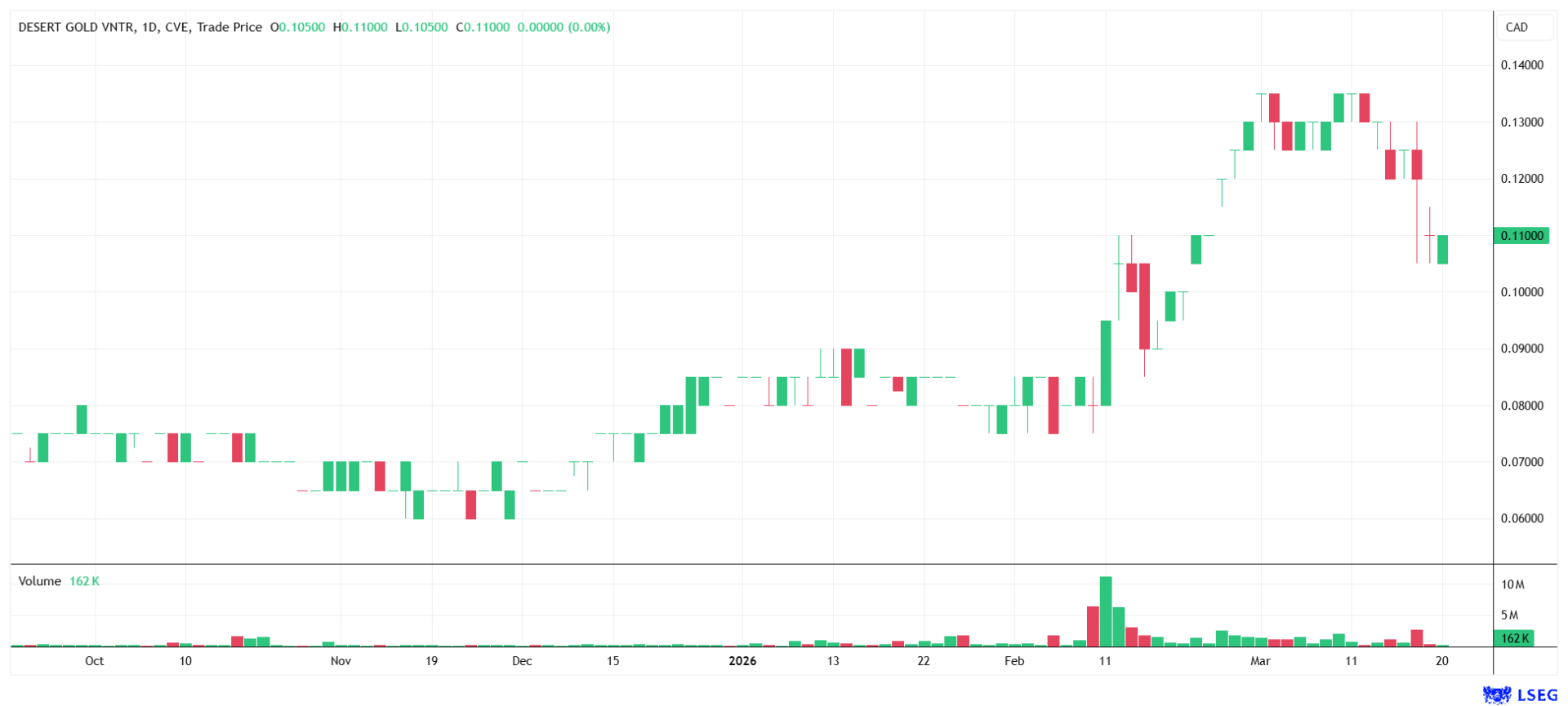
Desert Gold Ventures combines two rare attributes: the short-term catalyst of upcoming production with the long-term leverage of a massive exploration portfolio. The construction of the gravity plant is not mere lip service but will become a reality in the foreseeable future. If the transition is successful, the market will see a completely new valuation profile with its own cash flows, reduced risk, and a clear position in one of the world's best gold belts.
Conflict of interest
Pursuant to §85 of the German Securities Trading Act (WpHG), we point out that Apaton Finance GmbH as well as partners, authors or employees of Apaton Finance GmbH (hereinafter referred to as "Relevant Persons") currently hold or hold shares or other financial instruments of the aforementioned companies and speculate on their price developments. In this respect, they intend to sell or acquire shares or other financial instruments of the companies (hereinafter each referred to as a "Transaction"). Transactions may thereby influence the respective price of the shares or other financial instruments of the Company.
In this respect, there is a concrete conflict of interest in the reporting on the companies.
In addition, Apaton Finance GmbH is active in the context of the preparation and publication of the reporting in paid contractual relationships.
For this reason, there is also a concrete conflict of interest.
The above information on existing conflicts of interest applies to all types and forms of publication used by Apaton Finance GmbH for publications on companies.
Risk notice
Apaton Finance GmbH offers editors, agencies and companies the opportunity to publish commentaries, interviews, summaries, news and the like on news.financial. These contents are exclusively for the information of the readers and do not represent any call to action or recommendations, neither explicitly nor implicitly they are to be understood as an assurance of possible price developments. The contents do not replace individual expert investment advice and do not constitute an offer to sell the discussed share(s) or other financial instruments, nor an invitation to buy or sell such.
The content is expressly not a financial analysis, but a journalistic or advertising text. Readers or users who make investment decisions or carry out transactions on the basis of the information provided here do so entirely at their own risk. No contractual relationship is established between Apaton Finance GmbH and its readers or the users of its offers, as our information only refers to the company and not to the investment decision of the reader or user.
The acquisition of financial instruments involves high risks, which can lead to the total loss of the invested capital. The information published by Apaton Finance GmbH and its authors is based on careful research. Nevertheless, no liability is assumed for financial losses or a content-related guarantee for the topicality, correctness, appropriateness and completeness of the content provided here. Please also note our Terms of use.