January 12th, 2026 | 07:05 CET
USD 16 trillion in transition: How Finexity is rewriting the rules of Wall Street alongside Deutsche Bank and Bank of America
2025 marked a historic turning point for global capital markets. What was long considered a futuristic experiment is now a harsh economic reality: the tokenization of assets, known in technical jargon as "real world assets" (RWA), is breaking down the entrenched structures of the old economy. According to recent studies by leading consulting firms such as the Boston Consulting Group, this market is heading for a gigantic volume of USD 16 trillion by 2030. Two worlds are colliding in this new ecosystem. On the one hand, there are the established top dogs such as Deutsche Bank and Bank of America, which are posting record results and using blockchain to become even more profitable. On the other hand, Finexity AG, a German disruptor, is challenging the status quo. Since its IPO in September 2025, it has been proving that the future belongs not to the management but to the democratization of wealth. For investors, the question arises: Should they bet on the gentle evolution of the giants or on the radical innovation of the challenger?
time to read: 3 minutes | Author: Nico Popp
ISIN: FINEXITY AG | DE000A40ET88 , DEUTSCHE BANK AG NA O.N. | DE0005140008 , BANK AMERICA DL 0_01 | US0605051046
Table of contents:
Author

Nico Popp
At home in Southern Germany, the passionate stock exchange expert has been accompanying the capital markets for about twenty years. With a soft spot for smaller companies, he is constantly on the lookout for exciting investment stories.
Tag cloud
Shares cloud
The giants: Efficiency instead of real innovation at Deutsche Bank and Bank of America
The balance sheets of the big banks speak clearly of strength. As data from Investing.com shows, both Deutsche Bank and Bank of America posted record results in the third quarter of 2025. Driven by a normalization of yield curves and disciplined cost control, these institutions appear to be rocks in the surf. But appearances are deceiving, because in the engine room, transformation is in full swing. For Deutsche Bank, tokenization is not a tool for improving the world, but an instrument for tough efficiency gains.
As part of initiatives such as "Project Guardian," the institution is using blockchain technology to speed up transaction processing and reduce asset management costs. The aim is to make illiquid assets on its own balance sheet more tradable and to shorten processes that used to take days to seconds. Bank of America is also integrating digital assets into its existing infrastructure to give institutional clients faster access to liquidity. But the business model remains conservative at its core: banks are using the new technology to protect their old margins, not to open up the market to the masses. They remain exclusive clubs whose bouncers now simply keep digital lists.
Finexity: The key to locked treasure chambers
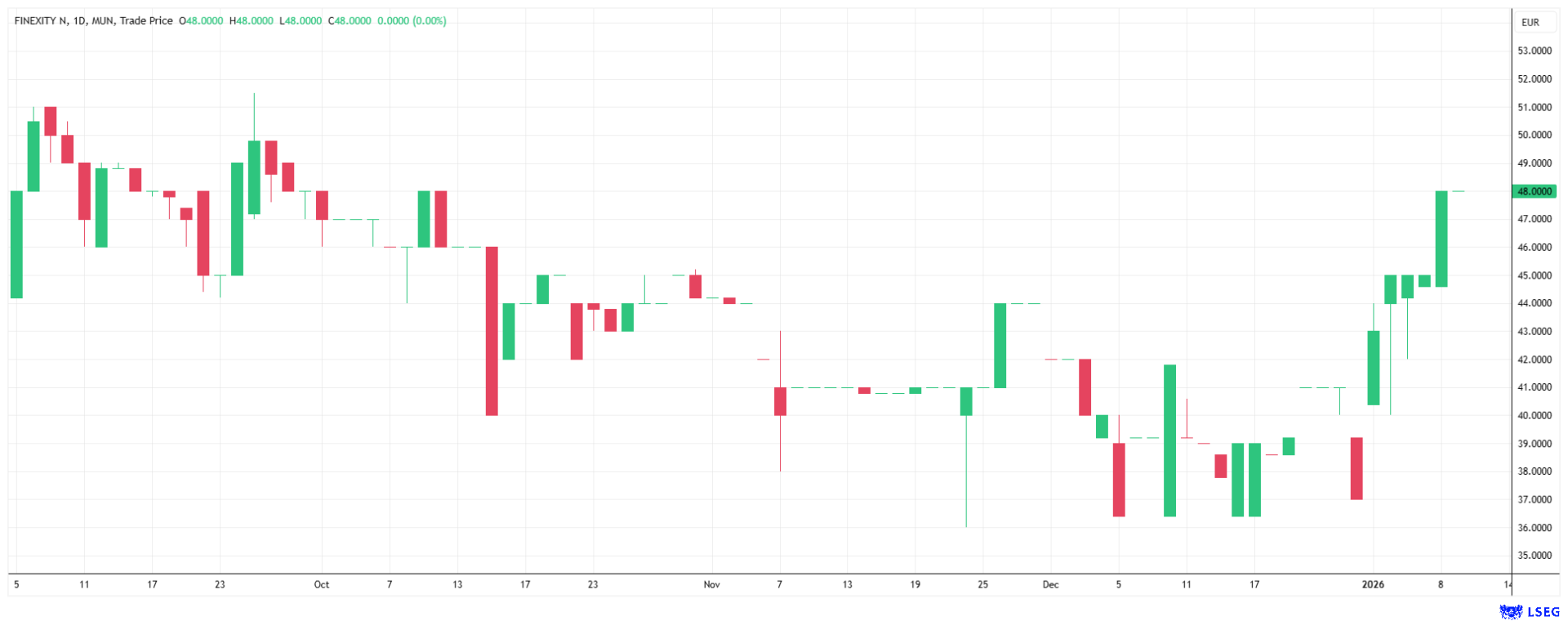
Finexity has positioned itself quite differently. With its successful IPO in September 2025, the Hamburg-based fintech company has left its niche and is now operating on the big stage. Its business model is not aimed at optimizing banking processes, but at democratizing exclusive asset classes. As highlighted on the crowdinform.com platform, Finexity is breaking down the barriers that have previously prevented private investors from accessing the world's most lucrative markets. Whether fine art, rare wines, or commercial real estate in prime locations - what used to require minimum investments of hundreds of thousands of euros is now divided into digital shares via the Finexity marketplace, making it possible to invest even the smallest amounts.
The Company acts as a "marketplace as a service." According to its own information on finexity.com, it not only offers its own curated assets, but also makes the technical infrastructure available to third parties. This is the decisive scaling factor: Finexity provides the technological highway on which asset managers can tokenize their own products and make them tradable. The Company is thus strategically positioning itself as the infrastructure provider for the RWA economy. The vision is a liquid secondary market that operates 24/7 and makes illiquid tangible assets as tradable as a stock.
The investors' verdict: Infrastructure beats administration
The comparison reveals a fundamental divergence in the investment story. Anyone buying shares in Deutsche Bank or Bank of America is betting on the stability of the existing financial system and the ability of institutions to use technology to save costs and secure dividends. This is a valid, defensive scenario in uncertain times. However, the explosive growth fantasy inherent in the forecasts of a USD 16 trillion market volume is hardly reflected in these tankers.
Finexity, on the other hand, is betting on structural change itself. The Company benefits directly from every asset that migrates to the blockchain. In a world where investors are increasingly looking for real value and inflation protection, Finexity offers one of the few direct access channels that is both regulatory compliant and technologically mature. While banks use blockchain to manage themselves, Finexity uses it to create new markets. For risk-conscious investors who understand the potential of tokenization not only as an efficiency tool but as a business model, the German technology leader is the logical alternative to the sluggish giants from Frankfurt or Wall Street. The valuation gap between a traditional financial institution and a scalable platform ecosystem is likely to widen dramatically in the coming years, in parallel with the growth of the RWA market.
Watch YouTube videoConflict of interest
Pursuant to §85 of the German Securities Trading Act (WpHG), we point out that Apaton Finance GmbH as well as partners, authors or employees of Apaton Finance GmbH (hereinafter referred to as "Relevant Persons") may hold shares or other financial instruments of the aforementioned companies in the future or may bet on rising or falling prices and thus a conflict of interest may arise in the future. The Relevant Persons reserve the right to buy or sell shares or other financial instruments of the Company at any time (hereinafter each a "Transaction"). Transactions may, under certain circumstances, influence the respective price of the shares or other financial instruments of the Company.
In addition, Apaton Finance GmbH is active in the context of the preparation and publication of the reporting in paid contractual relationships.
For this reason, there is a concrete conflict of interest.
The above information on existing conflicts of interest applies to all types and forms of publication used by Apaton Finance GmbH for publications on companies.
Risk notice
Apaton Finance GmbH offers editors, agencies and companies the opportunity to publish commentaries, interviews, summaries, news and the like on news.financial. These contents are exclusively for the information of the readers and do not represent any call to action or recommendations, neither explicitly nor implicitly they are to be understood as an assurance of possible price developments. The contents do not replace individual expert investment advice and do not constitute an offer to sell the discussed share(s) or other financial instruments, nor an invitation to buy or sell such.
The content is expressly not a financial analysis, but a journalistic or advertising text. Readers or users who make investment decisions or carry out transactions on the basis of the information provided here do so entirely at their own risk. No contractual relationship is established between Apaton Finance GmbH and its readers or the users of its offers, as our information only refers to the company and not to the investment decision of the reader or user.
The acquisition of financial instruments involves high risks, which can lead to the total loss of the invested capital. The information published by Apaton Finance GmbH and its authors is based on careful research. Nevertheless, no liability is assumed for financial losses or a content-related guarantee for the topicality, correctness, appropriateness and completeness of the content provided here. Please also note our Terms of use.