February 20th, 2026 | 07:15 CET
Uranium scarcity meets AI boom: Why Cameco, Perpetua Resources, and American Atomics are the real winners of this decade
The energy industry is undergoing radical change, driven largely by the exponentially growing energy appetite of tech giants and artificial intelligence. Current market analyses by Goldman Sachs Research expect the electricity demand of data centers to increase by a staggering 165% by 2030. This surge in demand for carbon-free base load electricity has triggered a veritable nuclear renaissance. While industry giants such as Cameco are impressively demonstrating in this environment that control over the entire fuel cycle is the key to enormous company valuations in the uranium sector, the example of Perpetua Resources shows another significant trend. Securing critical raw materials on American soil is no longer purely an economic decision, but has become a fundamental issue of national security. It is precisely in this force field of market power and geopolitical resilience that American Atomics is positioning itself as an up-and-coming innovator.
time to read: 3 minutes | Author: Nico Popp
ISIN: CAMECO CORP. | CA13321L1085 , PERPETUA RESOURCES CORP | CA7142661031 , AMERICAN ATOMICS INC | CA0240301089
Table of contents:
Author

Nico Popp
At home in Southern Germany, the passionate stock exchange expert has been accompanying the capital markets for about twenty years. With a soft spot for smaller companies, he is constantly on the lookout for exciting investment stories.
Tag cloud
Shares cloud
Cameco: Comprehensive value creation pays off
Cameco's success illustrates how lucrative an integrated business model is in today's world. The Canadian company posted record operating results last year and is benefiting from the fact that Western energy suppliers are desperately seeking alternatives to Russian service providers for the conversion and refinement of uranium concentrate. A key component of this far-reaching strategy is its 49% stake in Westinghouse Electric Company. This clever strategic move gives Cameco direct access to modern reactor technology and secures highly profitable, long-term maintenance contracts, as the current major project in Dukovany in the Czech Republic impressively demonstrates. This development underscores once again that in the modern energy market, simply extracting raw materials is no longer enough to capture the full value and hedge against price fluctuations.
Watch YouTube videoBillions from the government for critical raw materials and domestic uranium assets
At the same time, the story of Perpetua Resources illustrates how strongly the government is now emerging as a strategic anchor investor. The company plans to meet a significant portion of American antimony demand with its Stibnite project in Idaho and has already received approximately USD 59 million in support from the US Department of Defense. In addition, as part of the Project Vault Initiative, the US Export-Import Bank is considering a massive project financing package of up to USD 1.8 billion to finally break the dependence on Chinese supply chains for this important defense metal. Perpetua Resources is also taking a clever ecological approach, as the development of the mine is contractually linked to the remediation of historical environmental damage on the site, which greatly increases social acceptance. Such immense sums of public and private capital are flowing into the sector because, in the modern age, control of raw materials is synonymous with the ability to act, and active environmental protection acts as a catalyst for rapid approvals.
American Atomics scores twice
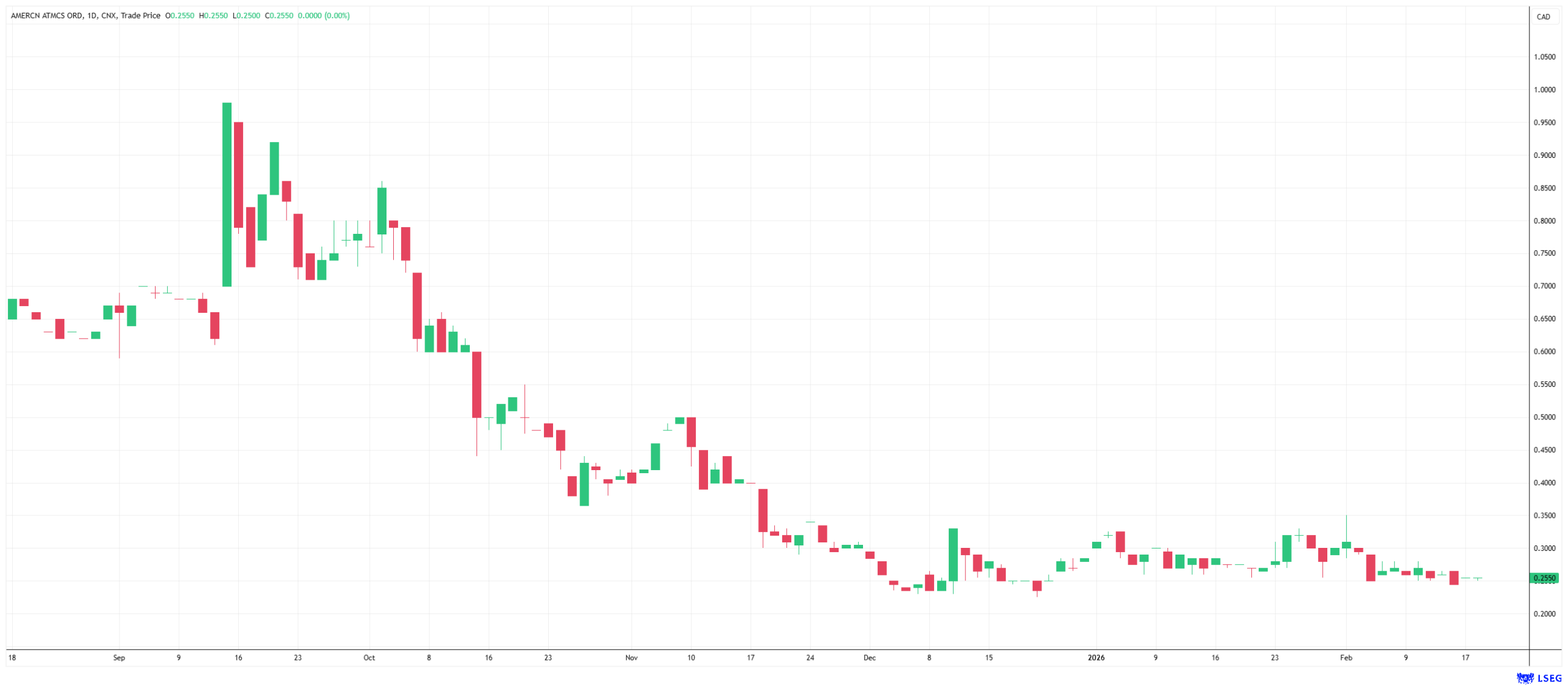
American Atomics is now transferring these two success factors to the nuclear sector and aims to establish one of the first fully integrated, US-controlled supply chains for nuclear fuels. The company's ambitious strategy combines the consistent securing of its own domestic uranium assets with the scaling of a disruptive refining technology. On the production side, the company has strategically positioned itself in areas that allow for a rapid resumption of production. This includes the Nuvemco project in the Uravan Mineral Belt in the US state of Colorado, which not only has significant uranium resources but also offers considerable amounts of vanadium for modern battery technologies. American Atomics is also aggressively advancing the Big Indian project in Lisbon Valley, Utah, where modern 3D modeling and historical drilling data are being used to redevelop the full potential of a formerly highly productive region.

Technological breakthrough for the next generation of reactors
However, American Atomics' real technological breakthrough has come in the field of refinement through a forward-looking joint venture with CVMR. This far-reaching partnership enables the implementation of modular gas-phase metallurgy, which can convert uranium ore extremely efficiently and with minimal environmental impact directly into high-purity uranium compounds for downstream enrichment steps. Unlike conventional, chemically intensive processes, this innovative system is hermetically sealed, produces virtually no toxic waste, and is expected to drastically reduce bureaucratic hurdles.
The HALEU produced by this process is the irreplaceable fuel for the next generation of reactors. Novel micro reactors, such as those being developed by the Pentagon for remote bases, and small modular reactors (SMRs) for the tech giants' massive data centers, require precisely this special fuel. Since there is currently only very limited commercial HALEU capacity outside the US, and only one industrial-scale demonstration plant is in operation in the US (Centrus), American Atomics is filling a strategic gap of great economic value. In an extremely tense market environment, with the Pentagon and global technology leaders desperately searching for secure fuel, American Atomics can provide the foundation for America's nuclear future through its closed value chain. Investors looking for real problem solvers in times of geopolitical tension will find a promising answer in this approach.
Conflict of interest
Pursuant to §85 of the German Securities Trading Act (WpHG), we point out that Apaton Finance GmbH as well as partners, authors or employees of Apaton Finance GmbH (hereinafter referred to as "Relevant Persons") may hold shares or other financial instruments of the aforementioned companies in the future or may bet on rising or falling prices and thus a conflict of interest may arise in the future. The Relevant Persons reserve the right to buy or sell shares or other financial instruments of the Company at any time (hereinafter each a "Transaction"). Transactions may, under certain circumstances, influence the respective price of the shares or other financial instruments of the Company.
In addition, Apaton Finance GmbH is active in the context of the preparation and publication of the reporting in paid contractual relationships.
For this reason, there is a concrete conflict of interest.
The above information on existing conflicts of interest applies to all types and forms of publication used by Apaton Finance GmbH for publications on companies.
Risk notice
Apaton Finance GmbH offers editors, agencies and companies the opportunity to publish commentaries, interviews, summaries, news and the like on news.financial. These contents are exclusively for the information of the readers and do not represent any call to action or recommendations, neither explicitly nor implicitly they are to be understood as an assurance of possible price developments. The contents do not replace individual expert investment advice and do not constitute an offer to sell the discussed share(s) or other financial instruments, nor an invitation to buy or sell such.
The content is expressly not a financial analysis, but a journalistic or advertising text. Readers or users who make investment decisions or carry out transactions on the basis of the information provided here do so entirely at their own risk. No contractual relationship is established between Apaton Finance GmbH and its readers or the users of its offers, as our information only refers to the company and not to the investment decision of the reader or user.
The acquisition of financial instruments involves high risks, which can lead to the total loss of the invested capital. The information published by Apaton Finance GmbH and its authors is based on careful research. Nevertheless, no liability is assumed for financial losses or a content-related guarantee for the topicality, correctness, appropriateness and completeness of the content provided here. Please also note our Terms of use.