March 6th, 2026 | 07:10 CET
Uranium ensures energy sovereignty: How investors can profit with Stallion Uranium, NexGen Energy, and Constellation Energy - which stock is the favorite?
In times of war, uranium rises from a cyclical commodity to a strategic asset. Even in Germany, people are aware of the dilemma that the energy policy of recent years has maneuvered them into: either they are dependent on imports, or they have to think more openly about technology, for example, nuclear power. The Canadian Athabasca Basin is considered the center for securing the West's supply of uranium. Reports from the International Energy Agency (IEA) show that market dynamics are no longer driven solely by traditional demand from utilities. Tech giants such as Microsoft, Meta, and Google have long seen nuclear power as one of the few scalable solutions for the base load requirements of their AI data centers. As a result of this surge in demand and years of underinvestment in exploration, spot prices for uranium exceeded the USD 100 per pound mark in January. The combination of Stallion Uranium's exploration potential, NexGen Energy's industrial implementation, and Constellation Energy's hunger for energy illustrates how investors can benefit from securing the Western energy chain. We present the companies and our favorites.
time to read: 3 minutes | Author: Nico Popp
ISIN: STALLION URANIUM CORP | CA8529192087 | TSXV: STUD , OTCQB: STLNF , NEXGEN ENERGY LTD | CA65340P1062 , CONSTELLATION ENERGY CORPORATION | US21037T1097 | NASDAQ: CEG
Table of contents:
Author

Nico Popp
At home in Southern Germany, the passionate stock exchange expert has been accompanying the capital markets for about twenty years. With a soft spot for smaller companies, he is constantly on the lookout for exciting investment stories.
Tag cloud
Shares cloud
Constellation Energy and rising demand from tech companies
As the largest producer of clean energy in the US, Constellation Energy operates several nuclear power plants that provide the American base load supply. In a market that is increasingly looking for reliable, CO2-free energy for AI data centers, the company has taken on a central role. The results for fiscal year 2025 underscore this dominance, as the company increased its total revenue to USD 25.5 billion. To combine the uninterrupted base load of nuclear power with the flexibility of natural gas power plants, Constellation completed the acquisition of Calpine Corporation for approximately USD 26.6 billion in early 2026. The strategic realignment is underpinned by long-term contracts with technology companies. The planned restart of the Crane Clean Energy Center, formerly known as Three Mile Island, is made possible by a 20-year contract with Microsoft, as this guarantees the utility predictable revenue.
NexGen Energy sets the industrial standard
To meet the needs of power plant operators such as Constellation Energy, the market is dependent on new, politically stable sources of raw materials. NexGen Energy has positioned itself as a leading developer with the development of the Arrow deposit in the Athabasca Basin. The 100% company-owned project is the largest of its kind in Canada. It is expected to become the most cost-effective large-scale uranium mine with a planned annual production of approximately 21.7 million pounds of U3O8. In February 2026, NexGen completed hearings before the Canadian regulatory authority and received the official recommendation for approval, which is accompanied by the formal consent of indigenous nations in the region. With cash reserves of over CAD 1.1 billion at the end of 2025, the financial position is extremely robust. This liquidity allows management to move directly into the construction phase after final approval, with approximately CAD 300 million in investments planned for the first twelve months.
Stallion Uranium and the potential in the southwest of the basin
While NexGen Energy shows what is possible, Stallion Uranium is taking on the role of a potential supplier. The exploration company is focused on the southwestern part of the Athabasca Basin, where it controls 1,700 km² of the largest contiguous exploration land package in the region. To finance exploration in this vast area, Stallion is using a joint venture model that allows for investment from partners and reduces capital dilution for its own shareholders. This structure allows management to focus its capital on promising target areas.
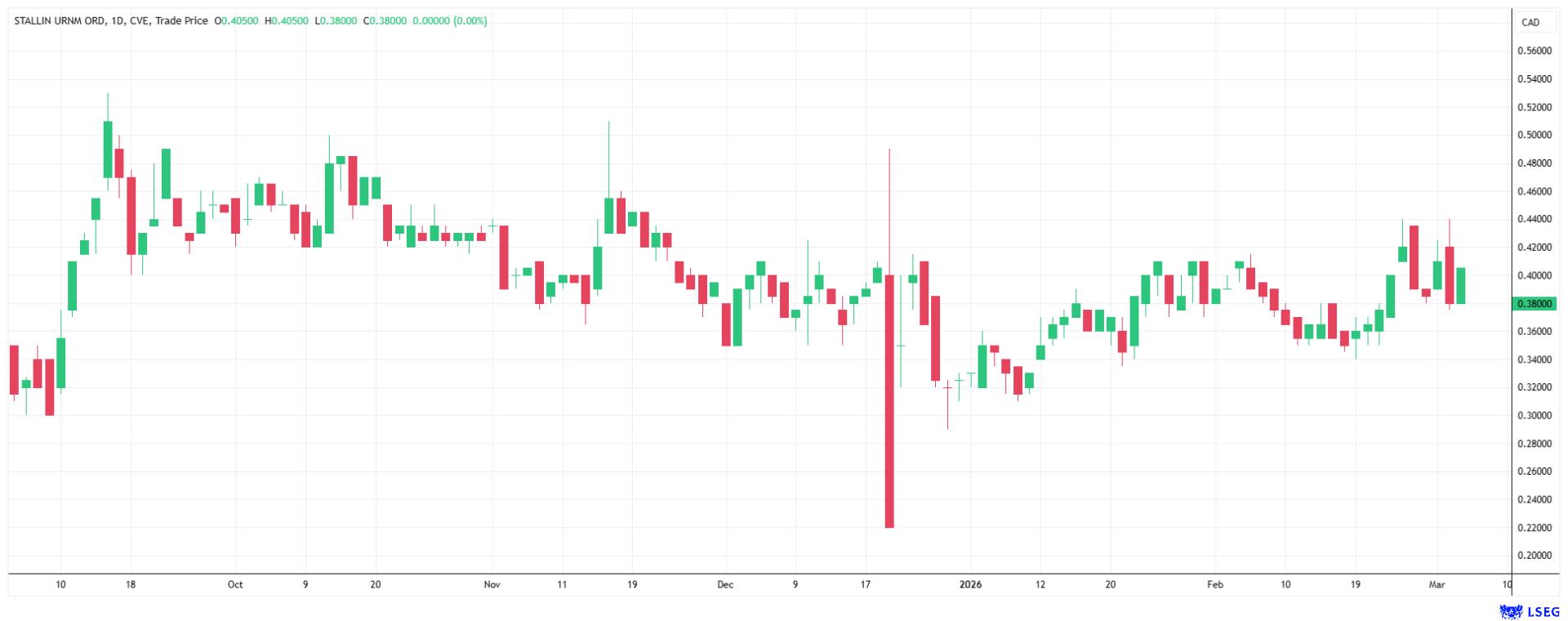
The current priority target is the Coyote Corridor on the Moonlite Project. This area is located just 12 km east of the well-known Arrow deposit and exhibits geophysical anomalies that experts consider promising. Under the leadership of CEO Matthew Schwab, who was previously involved in the discovery of Arrow as a geologist, Stallion launched a 4,000-meter winter drilling program in February to directly test this corridor. Analysts at Red Cloud Securities emphasize the stock's leverage potential, as Stallion operates in the shadow of industry giants. If Stallion Uranium succeeds in identifying the next significant resource in close proximity to existing deposits, the stock offers investors the opportunity to specifically focus on securing the western energy chain in the long term. With a market capitalization of only CAD 56 million, the company still offers sufficient upside on the stock market. The stock has been trading sideways in recent months, but events such as a long-term energy blockade in the Middle East could draw more investors' attention to the opportunities in the Athabasca Basin. The stock is an exciting candidate for anyone who wants to benefit from such a development. Compared to NexGen Energy, Stallion is at an earlier stage. This is not necessarily a disadvantage – mining projects in particular are often subject to delays or operational challenges during development. By investing at an earlier stage, investors effectively avoid the risks associated with mine construction.
Conflict of interest
Pursuant to §85 of the German Securities Trading Act (WpHG), we point out that Apaton Finance GmbH as well as partners, authors or employees of Apaton Finance GmbH (hereinafter referred to as "Relevant Persons") may hold shares or other financial instruments of the aforementioned companies in the future or may bet on rising or falling prices and thus a conflict of interest may arise in the future. The Relevant Persons reserve the right to buy or sell shares or other financial instruments of the Company at any time (hereinafter each a "Transaction"). Transactions may, under certain circumstances, influence the respective price of the shares or other financial instruments of the Company.
In addition, Apaton Finance GmbH is active in the context of the preparation and publication of the reporting in paid contractual relationships.
For this reason, there is a concrete conflict of interest.
The above information on existing conflicts of interest applies to all types and forms of publication used by Apaton Finance GmbH for publications on companies.
Risk notice
Apaton Finance GmbH offers editors, agencies and companies the opportunity to publish commentaries, interviews, summaries, news and the like on news.financial. These contents are exclusively for the information of the readers and do not represent any call to action or recommendations, neither explicitly nor implicitly they are to be understood as an assurance of possible price developments. The contents do not replace individual expert investment advice and do not constitute an offer to sell the discussed share(s) or other financial instruments, nor an invitation to buy or sell such.
The content is expressly not a financial analysis, but a journalistic or advertising text. Readers or users who make investment decisions or carry out transactions on the basis of the information provided here do so entirely at their own risk. No contractual relationship is established between Apaton Finance GmbH and its readers or the users of its offers, as our information only refers to the company and not to the investment decision of the reader or user.
The acquisition of financial instruments involves high risks, which can lead to the total loss of the invested capital. The information published by Apaton Finance GmbH and its authors is based on careful research. Nevertheless, no liability is assumed for financial losses or a content-related guarantee for the topicality, correctness, appropriateness and completeness of the content provided here. Please also note our Terms of use.