March 4th, 2026 | 07:05 CET
Uranium as a geopolitical bargaining chip after the Hormuz shock - Standard Uranium, Kazatomprom, and F3 Uranium in focus
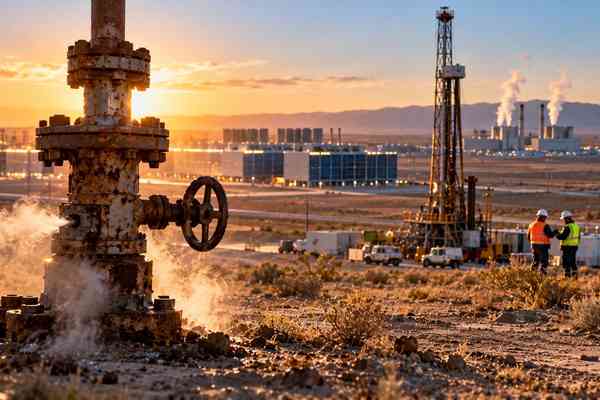
The escalation in the Middle East, which culminated in a de facto blockade of the Strait of Hormuz following the death of Iranian leader Ayatollah Ali Khamenei, has triggered a global energy shock. With around one-fifth of global oil consumption passing through this bottleneck, oil prices have skyrocketed. In their latest market forecasts, analysts at JPMorgan warn of scenarios in which the price could rise to USD 130 or, in extreme cases, up to USD 300 per barrel. This is hitting Asian industrial nations particularly hard and has ruthlessly exposed the vulnerability of international supply chains for fossil fuels. In this environment, uranium is becoming a decisive geopolitical bargaining chip, as nuclear power, at least since the recent conflagration in the Middle East, must no longer be seen merely as a measure of climate protection, but as an instrument of national security and energy sovereignty. We present three uranium companies and highlight which stocks are most interesting for investors.
time to read: 3 minutes | Author: Nico Popp
ISIN: STANDARD URANIUM LTD. | CA85422Q1037 , KAZATOMPROM GDR REGS 1/1 | US63253R2013 , F3 URANIUM CORP | CA30336Y1079 | TSXV: FUU , OTCQB: FUUFF
Table of contents:
Author

Nico Popp
At home in Southern Germany, the passionate stock exchange expert has been accompanying the capital markets for about twenty years. With a soft spot for smaller companies, he is constantly on the lookout for exciting investment stories.
Tag cloud
Shares cloud
The logistical vulnerability of Kazatomprom
The uranium market has entered a multi-year structural bull market characterized by a supply deficit. The International Energy Agency (IEA) states that global uranium production can no longer meet the demand of reactors. In addition, demand is being driven by the rapid expansion of data centers for artificial intelligence, for which tech giants such as Microsoft are increasingly relying on base-load capable nuclear power. Although the Kazakh state-owned company Kazatomprom is the market leader with a market share of around 20%, it is struggling with massive logistical hurdles and the vulnerability of its export routes. Its geographical proximity to conflict zones and its dependence on the so-called "Middle Corridor" across the Caspian Sea lead to high costs and infrastructure bottlenecks. In addition, a shortage of sulfuric acid is limiting Kazatomprom's production targets for the current year, which is weakening Western energy suppliers' confidence in Central Asian supply chains.
The Athabasca Basin as a safe haven
Due to these increasing uncertainties, Canada's Athabasca Basin in the province of Saskatchewan is becoming a safe haven for Western energy suppliers. The region is home to the highest-grade uranium deposits and is characterized by political stability and maximum legal certainty. As the US seeks to drastically reduce its dependence on imports but cannot meet domestic demand with its own production, Canada is establishing itself as an obvious and reliable alternative. Western suppliers are now specifically looking for long-term projects in jurisdictions that score highly in terms of established framework conditions and first-class infrastructure.
F3 Uranium proves the discovery potential
The exploration company F3 Uranium demonstrates the enormous potential of this Canadian region. With the consistent delineation of the JR Zone on the Patterson Lake North Project, F3 Uranium has impressively proven that completely undiscovered world-class deposits still lie hidden in the southwest of the basin. In the JR Zone, F3 Uranium reported several high-grade intervals, including meter sections with double-digit U3O8 grades. This underscores the exceptional quality of the rock in this area. Most recently, management made a strategic shift to the newly discovered Tetra Zone, which, with a mineralization width of 60 m, promises even greater scalability for potential production. These strong discoveries confirm the fundamental assumption that the use of state-of-the-art geophysical methods in this area can create massive added value for its shareholders.
Standard Uranium as an agile project generator
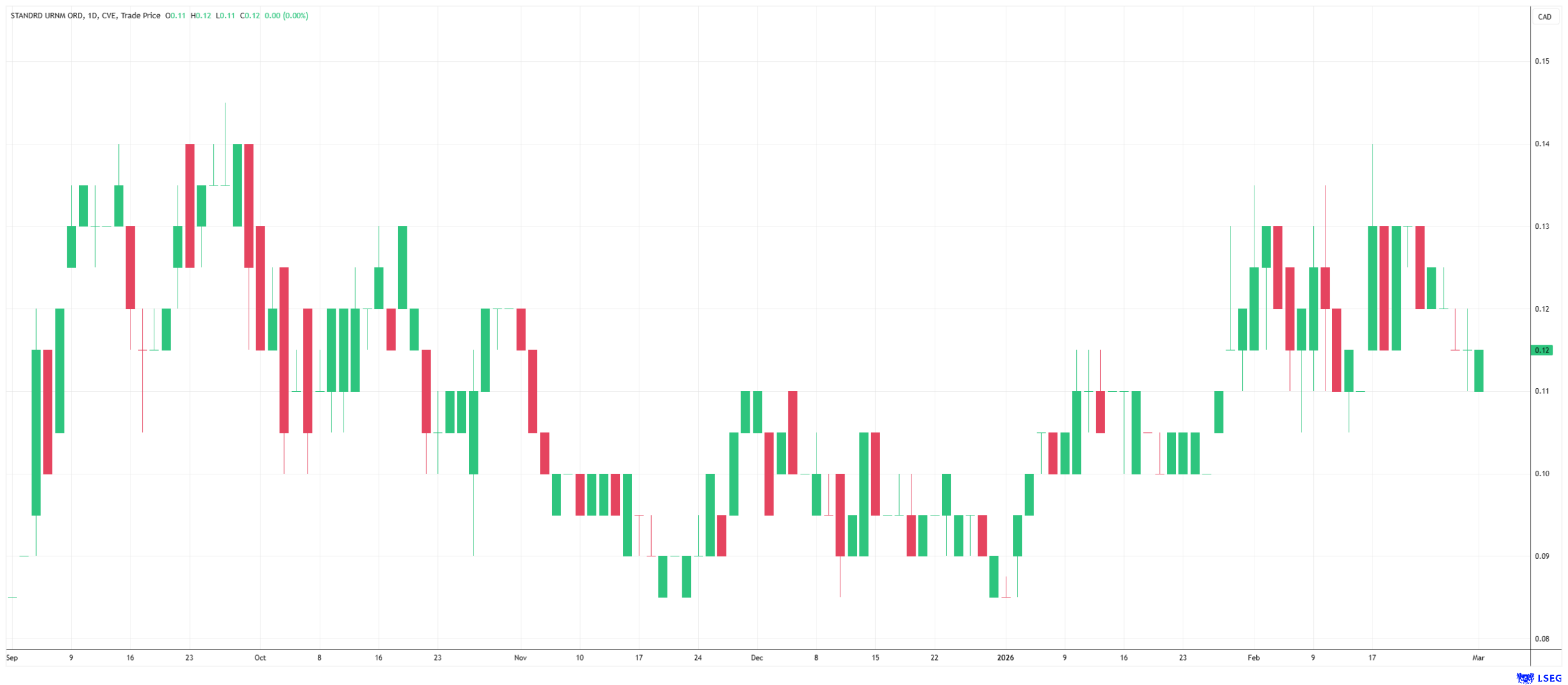
This is precisely the area that Standard Uranium is now entering as a highly specialized project generator. The company's business model aims to identify first-class properties in the Athabasca Basin, reduce financial exploration risk through cutting-edge technologies such as ExoSphere surveying, and then further develop the areas through joint venture partnerships. Through these strategic earn-in partnerships, Standard Uranium minimizes the dilution of its equity and generates cash payments while focusing its own resources entirely on its flagship Davidson River project. With an estimated cash position of approximately CAD 4.0 million and a total of 13 projects in its broad portfolio, the company is excellently positioned and crisis-proof for the current exploration season.
Standard Uranium and the drilling program at Davidson River
The Davidson River project is located in the sought-after southwest of the basin, directly in line with extensive historical discoveries. In May 2026, Standard Uranium plans to commence an extensive drilling program here, which has been developed based on precise 3D density inversion models. To guarantee security of supply in a blocked energy market, Standard Uranium is specifically searching for new, politically unassailable uranium deposits with its 8,000 to 10,000 m drilling program. Drilling will focus primarily on the Warrior and Bronco corridors, where structural anomalies have been identified that indicate high-grade deposits. The current market situation makes it clear that securing Western energy sovereignty is inextricably linked to the search for uranium in politically stable jurisdictions, with explorers such as Standard Uranium being particularly interesting. Unlike other exploration companies, Standard Uranium has several irons in the fire without exposing shareholders to the risk of excessive dilution. The company and its stock are interesting not only in light of current developments.
Conflict of interest
Pursuant to §85 of the German Securities Trading Act (WpHG), we point out that Apaton Finance GmbH as well as partners, authors or employees of Apaton Finance GmbH (hereinafter referred to as "Relevant Persons") may hold shares or other financial instruments of the aforementioned companies in the future or may bet on rising or falling prices and thus a conflict of interest may arise in the future. The Relevant Persons reserve the right to buy or sell shares or other financial instruments of the Company at any time (hereinafter each a "Transaction"). Transactions may, under certain circumstances, influence the respective price of the shares or other financial instruments of the Company.
In addition, Apaton Finance GmbH is active in the context of the preparation and publication of the reporting in paid contractual relationships.
For this reason, there is a concrete conflict of interest.
The above information on existing conflicts of interest applies to all types and forms of publication used by Apaton Finance GmbH for publications on companies.
Risk notice
Apaton Finance GmbH offers editors, agencies and companies the opportunity to publish commentaries, interviews, summaries, news and the like on news.financial. These contents are exclusively for the information of the readers and do not represent any call to action or recommendations, neither explicitly nor implicitly they are to be understood as an assurance of possible price developments. The contents do not replace individual expert investment advice and do not constitute an offer to sell the discussed share(s) or other financial instruments, nor an invitation to buy or sell such.
The content is expressly not a financial analysis, but a journalistic or advertising text. Readers or users who make investment decisions or carry out transactions on the basis of the information provided here do so entirely at their own risk. No contractual relationship is established between Apaton Finance GmbH and its readers or the users of its offers, as our information only refers to the company and not to the investment decision of the reader or user.
The acquisition of financial instruments involves high risks, which can lead to the total loss of the invested capital. The information published by Apaton Finance GmbH and its authors is based on careful research. Nevertheless, no liability is assumed for financial losses or a content-related guarantee for the topicality, correctness, appropriateness and completeness of the content provided here. Please also note our Terms of use.