February 18th, 2026 | 07:05 CET
Unpredictable conflict dynamics turn tungsten into a strategic metal – Almonty moves into focus
The capital markets currently appear paradoxical: record highs for indices, unusually high volatility, and above all, a world order that is shifting faster than any valuation metric. Wars are back and here to stay, trade routes are becoming political and fragile, and sanctions are replacing diplomacy. In this environment, raw materials are once again becoming strategic weapons. While algorithms are still extrapolating growth rates, governments are already thinking about supply scenarios after the crash. In this tense environment, the logic of investing is changing. It is no longer just about supply and demand, but about access, control, and reliability. Who will deliver when the going gets tough? Who will decide who gets what and how much, and who might even be excluded? This is precisely where the major capital movements of the coming years will arise, often away from the familiar mega-caps. A metal that hardly anyone has paid attention to for years is suddenly becoming the focus of technological and military interest. And a company that has long flown under the radar is quietly becoming a strategic factor. Almonty Industries is an example of how geopolitics and capital markets are currently intertwining in new ways and creating dream returns for visionary investors.
time to read: 5 minutes | Author: André Will-Laudien
ISIN: ALMONTY INDUSTRIES INC. | CA0203987072
Table of contents:
Author

André Will-Laudien
Born in Munich, he first studied economics and graduated in business administration at the Ludwig-Maximilians-University in 1995. As he was involved with the stock market at a very early stage, he now has more than 30 years of experience in the capital markets.
Tag cloud
Shares cloud
Tungsten becomes political, and Almonty moves into the center of power
There are phases in the capital markets when prices rise arbitrarily without much change in substance. And there are moments when the substance itself changes. Tungsten is clearly in the second phase. What was a little-noticed specialty raw material for decades has now become a security policy factor. The explosive nature of this development lies not in the metal itself but in geopolitical power projections. Who reacts faster at the control panel? Who is the aggressor, and who is the appeaser? Donald Trump created new realities in Venezuela within 24 hours, and it could happen again any day, anywhere in the world. It is precisely in this environment that Almonty Industries Inc. is moving into the spotlight.
Politics acts as a catalyst for industrial constraints
The global political situation is currently acting as an accelerant. The smoldering conflict between the US and Iran, the ongoing tensions in Eastern Europe, and, above all, the latent risk of escalation between China and Taiwan have one thing in common: they are making strategic raw materials a matter of national interest again. China controls over 80% of global tungsten production, an almost unbearable cluster risk that is putting Western governments under increasing pressure. Unexpected or controlled export restrictions, environmental regulations, and politically motivated contract management further exacerbate the situation. This is particularly critical for tungsten because it cannot be substituted and is used directly in armaments, aviation, semiconductor manufacturing, and high-precision technology. What many investors have overlooked so far is that in a geopolitical stress scenario, tungsten is no longer "traded" but hoarded. How is a market supposed to function when one side is no longer able to trade?
From theory to reality: Operational progress with strategic depth
While political decision-makers are still formulating strategy papers, Almonty is already delivering operational facts. The first ore transport from the Sangdong mine in South Korea in early February 2026 was more than a technical milestone. It marked the transition from the planning and construction phase to direct production expansion and thus also the entry into a completely different valuation category. Sangdong is one of the largest tungsten deposits outside China and has existing infrastructure, which significantly reduces start-up risks. With the ramp-up of production, Almonty will be in a position to serve around 40% of non-Chinese tungsten demand. Then there is Montana, a project that has not yet been taken into account financially by the market.
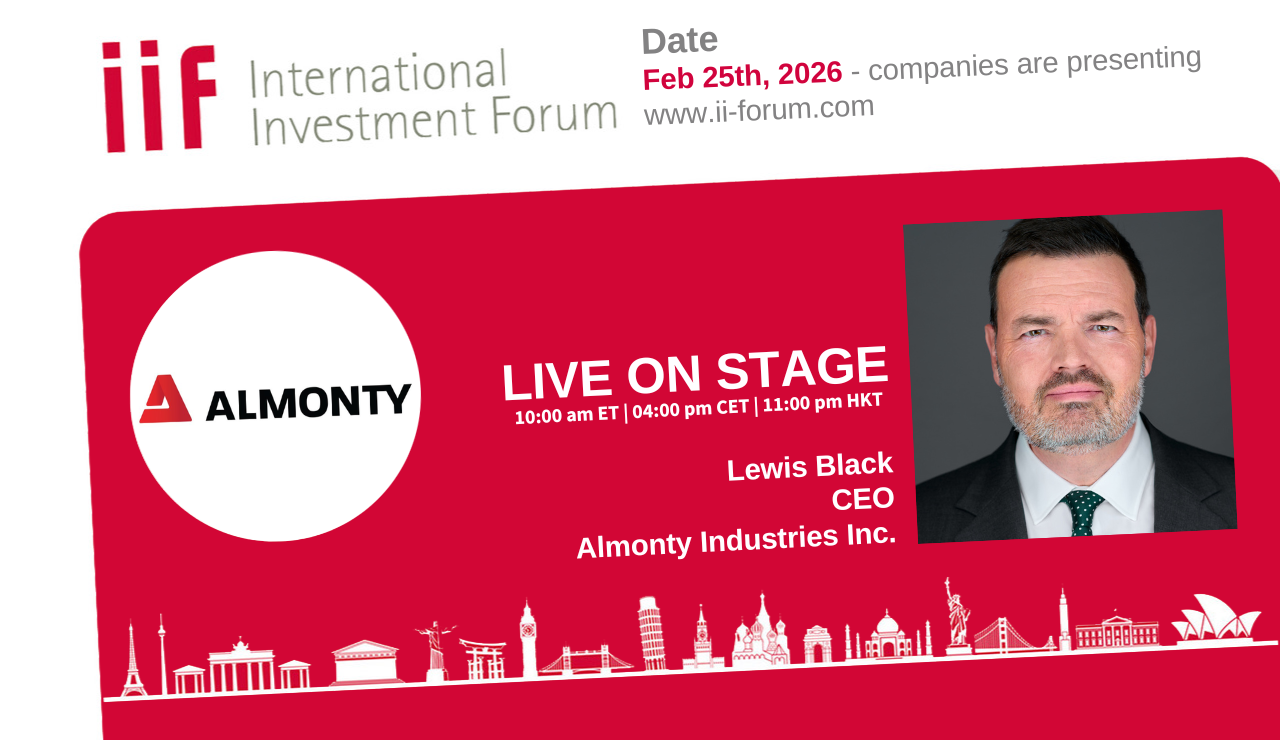
CEO Lewis Black will soon be back in front of the camera to provide an update on Sangdong and Montana. The 18th IIF will take place on February 25 with Lewis Black presenting at 4:00 pm CET. Click here to register.
Combining all production sites in Europe, Asia, and the US creates a geographically diversified supplier in precisely those regions where security of supply is a political priority. The combination of speed, location quality, and political relevance is rare in the raw materials sector and has so far only been partially priced in by the market. However, with more than 1 million shares traded daily, Almonty shares show where the action is.
Management, military, and markets: A logical interplay
One detail that many investors may not yet be aware of concerns the company's personnel orientation. Almonty has specifically recruited former high-ranking military personnel for key positions. This is not a PR maneuver, but rather an expression of a deep understanding of the new reality of raw materials. Critical metals are increasingly seen as security goods, not just as inputs for industry. Those who want to secure long-term supply contracts, government purchase guarantees, and political support in this environment must speak the language of security policy. Almonty does just that, strategically positioning itself far beyond the classic profile of a mining operator.
The price as a signal: Why USD 1,200 per MTU could be just the beginning
The price of tungsten, measured in terms of the base material APT, has risen from around USD 300 to around USD 1,200 per metric ton unit (MTU) over the past twelve months. This development is not speculative exaggeration, but rather an expression of a structural shortage. Spot stocks are low, Chinese exports are declining, and demand from the defense and high-tech industries continues to grow steadily. Tungsten is extremely inelastic, meaning there are no alternatives, no rapid capacity expansions, and hardly any new projects worldwide. For Almonty, this price situation is a massive margin lever. The key point: while significantly lower price assumptions were made during project development, completely new earnings prospects are now opening up. Forecasts by research firms such as Sphene Capital already assume net margins of up to 60% in the coming years. These figures are exceptional in the mining sector and are more reminiscent of software companies. And then there is molybdenum, which could trigger the next witch hunt in the foreseeable future.
Conclusion: Analyst targets as a stopover, not a final destination
The latest price target increases speak for themselves. DA Davidson now sees the stock at around USD 18, Oppenheimer at around CAD 22, and Sphene Capital at over CAD 20. However, all these valuations are based on models that cannot adequately reflect geopolitical escalations, government intervention, and strategic stockpiling logic. Historically, analysts tend to lag behind such structural upheavals. This is also likely the case here!
Almonty Industries has long been more than just a small-cap with commodity potential à la 2022. The company is currently developing into a strategic cornerstone of Western commodity sovereignty. With operational substance, political tailwinds, and a market environment characterized more by scarcity than cyclicality. Against this backdrop, the current price targets appear less ambitious and more like a snapshot of a market in the process of reorganizing itself. Anyone who still views tungsten purely from a business perspective today could overlook its real leverage: power, security, and availability.
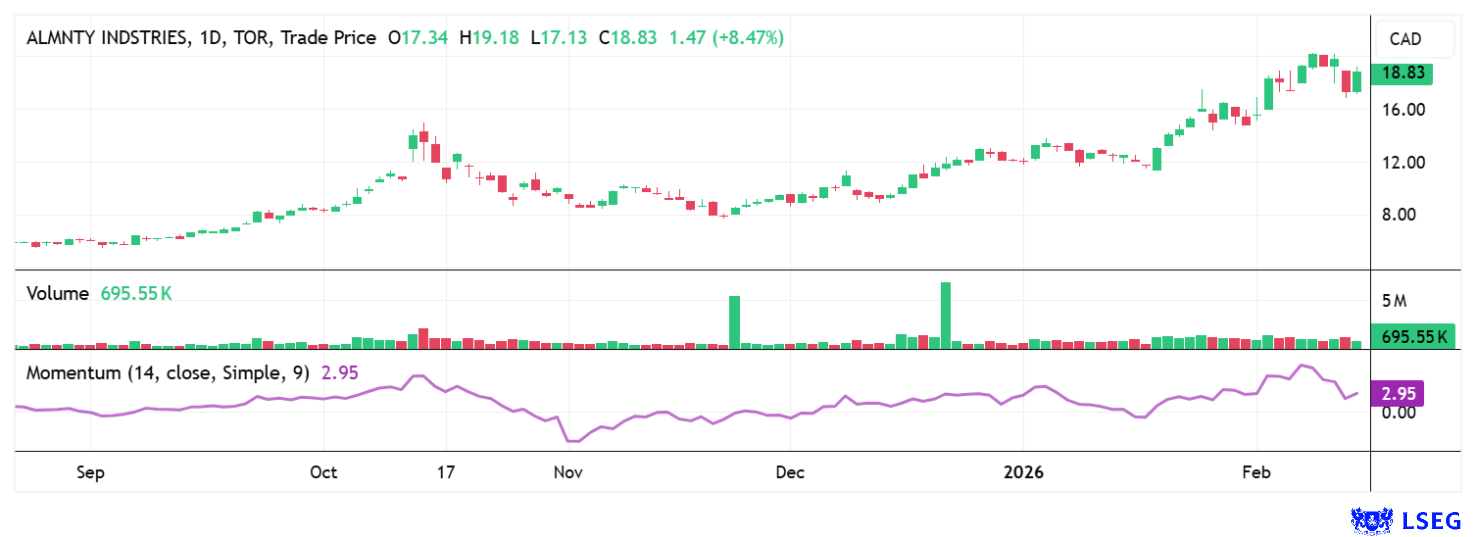
In retrospect, the last consolidation at the beginning of 2026 proved to be the perfect re-entry point for Almonty shares. Demand for this stock is now exuberant. Due to its extreme focus on critical parts of military supply chains, potential interest from the highest levels can no longer be ruled out entirely.
Conflict of interest
Pursuant to §85 of the German Securities Trading Act (WpHG), we point out that Apaton Finance GmbH as well as partners, authors or employees of Apaton Finance GmbH (hereinafter referred to as "Relevant Persons") currently hold or hold shares or other financial instruments of the aforementioned companies and speculate on their price developments. In this respect, they intend to sell or acquire shares or other financial instruments of the companies (hereinafter each referred to as a "Transaction"). Transactions may thereby influence the respective price of the shares or other financial instruments of the Company.
In this respect, there is a concrete conflict of interest in the reporting on the companies.
In addition, Apaton Finance GmbH is active in the context of the preparation and publication of the reporting in paid contractual relationships.
For this reason, there is also a concrete conflict of interest.
The above information on existing conflicts of interest applies to all types and forms of publication used by Apaton Finance GmbH for publications on companies.
Risk notice
Apaton Finance GmbH offers editors, agencies and companies the opportunity to publish commentaries, interviews, summaries, news and the like on news.financial. These contents are exclusively for the information of the readers and do not represent any call to action or recommendations, neither explicitly nor implicitly they are to be understood as an assurance of possible price developments. The contents do not replace individual expert investment advice and do not constitute an offer to sell the discussed share(s) or other financial instruments, nor an invitation to buy or sell such.
The content is expressly not a financial analysis, but a journalistic or advertising text. Readers or users who make investment decisions or carry out transactions on the basis of the information provided here do so entirely at their own risk. No contractual relationship is established between Apaton Finance GmbH and its readers or the users of its offers, as our information only refers to the company and not to the investment decision of the reader or user.
The acquisition of financial instruments involves high risks, which can lead to the total loss of the invested capital. The information published by Apaton Finance GmbH and its authors is based on careful research. Nevertheless, no liability is assumed for financial losses or a content-related guarantee for the topicality, correctness, appropriateness and completeness of the content provided here. Please also note our Terms of use.