July 23rd, 2026 | 07:40 CEST
The Patent Cliff Could Cost Billions: How Bayer and Merck & Co. Respond—and How Vidac Pharma Is Gaining Momentum
Leading oncology centers have long recognized that the fight against cancer cannot be won with just one active ingredient. It is increasingly clear that lasting treatment success depends on combining multiple therapeutic approaches. For years, oncologists relied heavily on conventional chemotherapy. Yet tumours consistently prove resilient and demand more complex therapies. Since patents on many active ingredients are expiring anyway, new, complementary forms of therapy are gaining prominence. One of these therapies targets the disrupted energy metabolism of cancer cells and shows promise. We examine the market and introduce an exciting biotech company that few experts are familiar with.
time to read: 3 minutes | Author: Nico Popp
ISIN: VIDAC PHARMA HOLDING PLC | GB00BM9XQ619 , BAYER AG NA O.N. | DE000BAY0017 , MERCK KGAA O.N. | DE0006599905
Table of contents:
Author

Nico Popp
At home in Southern Germany, the passionate stock exchange expert has been accompanying the capital markets for about twenty years. With a soft spot for smaller companies, he is constantly on the lookout for exciting investment stories.
Tag cloud
Shares cloud
Bayer Fights on Several Fronts
Under the leadership of Bill Anderson, the Leverkusen-based Bayer Group is facing a challenging environment. In fiscal year 2025, the company generated consolidated revenue of EUR 45.575 billion, representing a slight increase of 1.1% after adjusting for currency and portfolio effects. However, legal costs of EUR 6.185 billion related to the US glyphosate litigation pushed operating income deep into the red, resulting in a consolidated net loss of EUR 3.620 billion. For the full year 2026, management is projecting revenue between EUR 45.0 and 47.0 billion and adjusted EBITDA between EUR 9.6 and 10.1 billion. There are glimmers of hope from the pharmaceuticals division, where the cancer drug Nubeqa generated an impressive 62.4% revenue increase last year (2025). Furthermore, the novel alpha therapy BAY 3563254 demonstrated promising results in a Phase I trial for advanced prostate cancer across all dosages, achieving a disease control rate of 83%.
Merck & Co. Builds a Protective Wall Against the Patent Cliff
At US pharmaceutical giant Merck & Co., the patent expiration of the immuno-oncology blockbuster Keytruda is driving strategic planning. The drug alone generated USD 29.5 billion in revenue in 2024, accounting for approximately 46% of the company's total pharmaceutical revenue. Since patent protection in the US expires at the end of 2028, a slump in sales is looming starting in 2029 due to the arrival of biosimilars. Estimates point to a potential decline of 19%. To counter this, management is banking on the subcutaneous version, Keytruda Qlex, which already generated USD 128 million in the first quarter of 2026 and reduces administration time from 30 minutes to just 1 to 2 minutes. At the same time, the pulmonary hypertension drug Winrevair emerged as a growth driver, with its quarterly revenue also surging by a whopping 88% to USD 525 million in the first quarter. Merck also has encouraging news from its research division. In a Phase III study, the novel antibody-drug conjugate Sac-TMT, when combined with pembrolizumab, reduced the risk of disease progression in lung cancer by an impressive 65% compared to the previous monotherapy. This shows that complementary therapies make sense and promote the cure of cancer.
Vidac Pharma Cracks the Energy Code of Tumours
Vidac Pharma is driving one of these promising complementary therapies forward. The company occupies the niche of metabolic oncology. The company's technology is based on reversing the so-called Warburg effect. Cancer cells primarily meet their energy needs through accelerated glucose fermentation and, to do so, abnormally bind the enzyme hexokinase 2 to the mitochondria. This binding blocks the natural cell death signal and allows the tumour to grow unchecked. Vidac Pharma addresses this with novel active ingredients that selectively detach the enzyme from the mitochondria, thereby reactivating the cancer cell's programmed cell death. In addition, Vidac focuses on dosage forms that are comfortable for patients. The active ingredient VDA-1102 is administered as an ointment and, in a Phase 2b study involving patients with Actinic Keratosis, achieved a 40% complete healing rate of skin lesions as well as an 80% reduction in the total number of lesions.
In the treatment of cutaneous T-cell lymphoma, physicians documented an objective response rate of 56% and complete remission in 22% of subjects within 8 to 12 weeks as part of an interim Phase 2a analysis. In laboratory tests with human hepatocellular carcinoma, the drug candidate VDA-1275 demonstrated a synergistic cell inhibition rate of 74.4% in combination with the active ingredient cisplatin. In contrast, monotherapy with the chemotherapeutic agent resulted in only 3.5% inhibition. Vidac's approach to cellular metabolism thus enhances existing therapies.
Vidac Pharma: Approaches for Psoriasis as Well
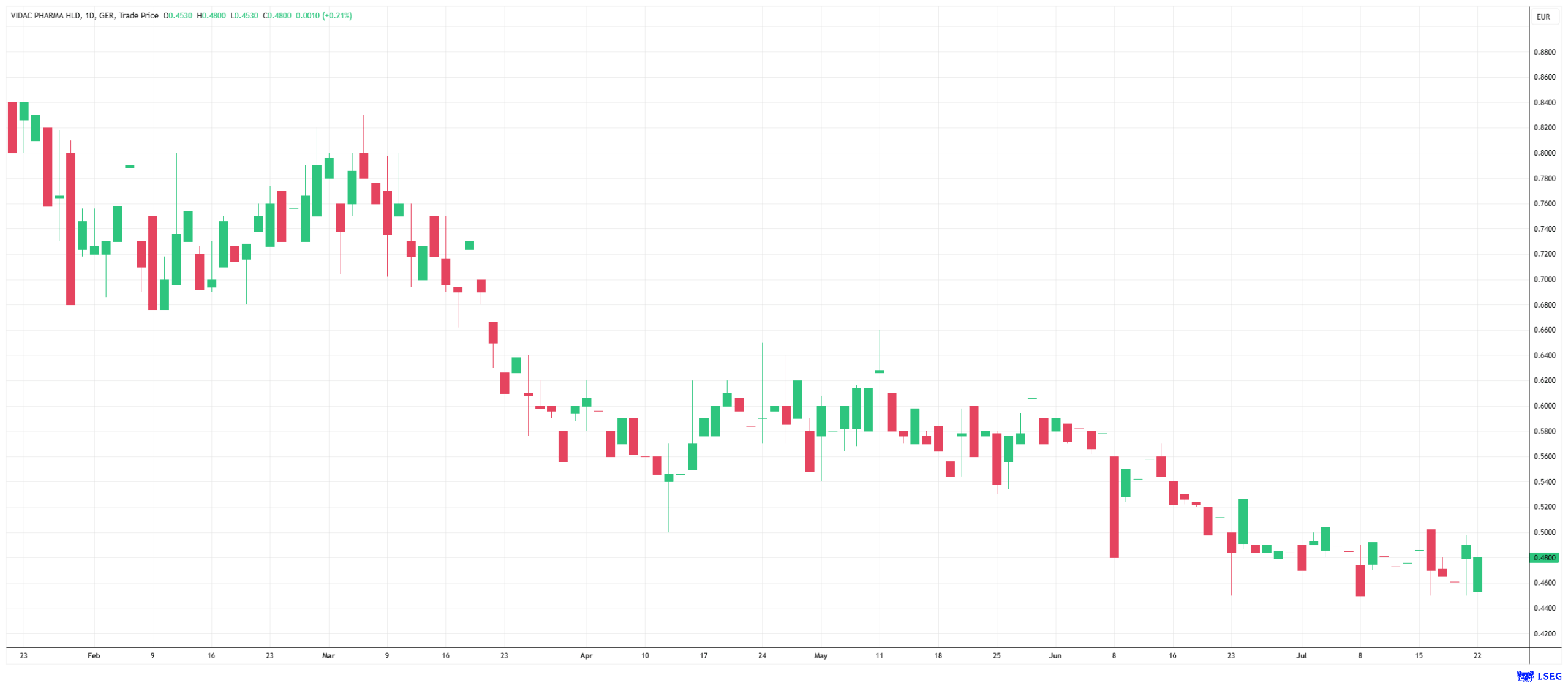
Vidac Pharma also sees potential applications for its platform beyond oncology and is expanding its scope. In February of this year, the biotech pioneer launched a preclinical program for the chronic skin disease psoriasis, as misregulated skin cells in this condition also exhibit runaway glucose metabolism. With its business model, Vidac Pharma offers an exciting profile at the intersection of metabolic research and cancer treatment. Key drivers of the share price are likely to include rapid progress in Phase 2 clinical trials for skin cancer, as well as potential partnerships with major pharmaceutical companies. In November 2025, analysts at Sphene Capital set a price target of EUR 4.10 for Vidac Pharma's stock.
Watch YouTube videoConflict of interest
Pursuant to §85 of the German Securities Trading Act (WpHG), we point out that Apaton Finance GmbH as well as partners, authors or employees of Apaton Finance GmbH (hereinafter referred to as "Relevant Persons") may hold shares or other financial instruments of the aforementioned companies in the future or may bet on rising or falling prices and thus a conflict of interest may arise in the future. The Relevant Persons reserve the right to buy or sell shares or other financial instruments of the Company at any time (hereinafter each a "Transaction"). Transactions may, under certain circumstances, influence the respective price of the shares or other financial instruments of the Company.
In addition, Apaton Finance GmbH is active in the context of the preparation and publication of the reporting in paid contractual relationships.
For this reason, there is a concrete conflict of interest.
The above information on existing conflicts of interest applies to all types and forms of publication used by Apaton Finance GmbH for publications on companies.
Risk notice
Apaton Finance GmbH offers editors, agencies and companies the opportunity to publish commentaries, interviews, summaries, news and the like on news.financial. These contents are exclusively for the information of the readers and do not represent any call to action or recommendations, neither explicitly nor implicitly they are to be understood as an assurance of possible price developments. The contents do not replace individual expert investment advice and do not constitute an offer to sell the discussed share(s) or other financial instruments, nor an invitation to buy or sell such.
The content is expressly not a financial analysis, but a journalistic or advertising text. Readers or users who make investment decisions or carry out transactions on the basis of the information provided here do so entirely at their own risk. No contractual relationship is established between Apaton Finance GmbH and its readers or the users of its offers, as our information only refers to the company and not to the investment decision of the reader or user.
The acquisition of financial instruments involves high risks, which can lead to the total loss of the invested capital. The information published by Apaton Finance GmbH and its authors is based on careful research. Nevertheless, no liability is assumed for financial losses or a content-related guarantee for the topicality, correctness, appropriateness and completeness of the content provided here. Please also note our Terms of use.