May 12th, 2026 | 07:05 CEST
The Gold Supercycle Is Underway. Lahontan Gold Aims to Deliver by 2028 at the Latest. Three Deposits, One Processing Facility — A Story Worth a Closer Look!
Three gold deposits, a single processing facility, and a logistics setup so simple it almost seems trivial. That is precisely what currently makes the Canadian development company Lahontan Gold an interesting case for investors looking to position themselves ahead of the next potential gold producer. While many mining projects struggle with inadequate infrastructure or complex permitting processes, Lahontan is relying on a former producing mine with historical infrastructure, a nearby satellite project, and legacy heap-leach piles that others once considered worthless. The concept is straightforward — and the execution appears carefully thought out.
time to read: 5 minutes | Author: Armin Schulz
ISIN: LAHONTAN GOLD CORP | CA50732M1014 | TSXV: LG , OTCQB: LGCXF
Table of contents:
Author

Armin Schulz
Born in Mönchengladbach, he studied business administration in the Netherlands. In the course of his studies he came into contact with the stock exchange for the first time. He has more than 25 years of experience in stock market business.
Tag cloud
Shares cloud
The Heart of Santa Fe
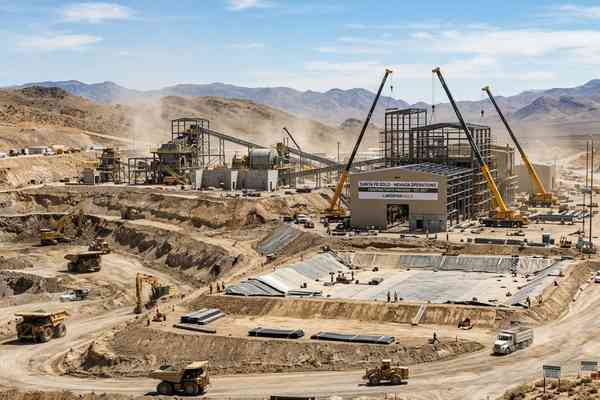
The entire project revolves around the Santa Fe Mine, a site with a turbulent past. Between 1988 and 1994, the operators at the time produced more than 359,000 ounces of gold and over 700,000 ounces of silver there. Then prices fell, and the mine closed. What remained was a complete infrastructure of roads, water wells with all rights, and its own substation. The processing facilities were dismantled at the time, which is proving to be an advantage today. Renovating piecemeal would hardly have been cheaper. Instead, management can now install completely new, efficient technology.
The current resource figures look promising. According to a technical report, the company indicates approximately 1.54 million ounces of gold equivalent for Santa Fe, plus 411,000 ounces inferred. This points to a solid drilling density. An updated estimate is scheduled for May or June. In addition, there are fresh drilling results from the southern part of the deposit, suggesting potential for deeper pits. One drill hole intersected 0.45 g/t gold equivalent over 68 m, while another returned 0.32 g/t over 41 m. These may seem like moderate grades, but given the scale of the deposit and low operating costs, it becomes economically viable.
The West Santa Fe Satellite Project
The real key to the story, however, does not lie solely in the main mine. It is the interaction with a second asset that is attracting growing investor attention. West Santa Fe is located just 15 km down the road. The significance of this short distance can hardly be overstated. Every additional ounce discovered there can be easily hauled by truck to the existing infrastructure at the Santa Fe Mine. No new processing facility, no separate permitting process for a standalone plant, and no duplicate management structure are required. As a result, the incremental costs of processing additional material from the satellite project are exceptionally low.
The West Santa Fe drill results reinforce this approach. One drill hole in the North Zone intersected 1 g/t gold equivalent over nearly 55 m, including a section with 1.75 g/t over just under 17 m. Another drill hole in the South Zone returned 41 m at 1.94 g/t gold equivalent, including 9 m at over 4 g/t. These grades are thus in some cases higher than those known from the main mine. And the rock consists of oxidized, near-surface deposits. Perfect for cost-effective heap leaching.
The previous operators had already explored West Santa Fe in the 1980s. Their metallurgical tests at the time yielded a 70% gold recovery rate and 50% for silver. Recent cyanide leaching tests by the current management confirmed these values and even exceeded them, achieving 81% for gold and 60% for silver.
The company has now planned further drilling to test the system's extension to the east and at depth.
The Silent Treasure of the Legacy Heap-Leach Piles
The third asset is a hidden treasure that many investors overlook. On the grounds of the Santa Fe Mine, four old heap-leach towers from the mine's operational period stand. Back then, the economic cut-off grade was high. What looks like waste today could, in fact, represent a hidden resource. According to internal estimates, the piles may contain more than 200,000 ounces of gold equivalent. The expected average grade is estimated at approximately 0.34 g/t gold equivalent.
As soon as the permits are in place, a special drilling rig will be brought in—a sonic rig that uses high-frequency vibrational energy rather than standard percussive striking. This technique is crucial to avoid damaging the existing tower seals. 95 short holes with a total length of 1,740 m are planned. The key advantage is that the material is already crushed. It would simply need to be collected and transported to a new heap-leach pad. No blasting, no additional crushing, and no major extra energy input would be required. The process is essentially limited to transport and re-leaching. Initial samples taken from waste material at the nearby York open pit have also returned encouraging gold values, further highlighting the potential of these previously overlooked materials.

The Economics of Simple Logistics
The economic logistics of these three assets are strikingly simple. The Santa Fe main mine provides the critical mass and existing infrastructure. West Santa Fe supplies high-grade oxide material at marginal cost. The old tailings piles provide pre-crushed material that essentially just needs to be run through the processing plant once more. All three streams feed into the same planned processing facility. This significantly reduces the investment risk.
The company recently closed a financing round of approximately CAD 13.6 million. According to the company, it holds the equivalent of CAD 11 to 12 million in cash. Additional funds will be generated through the conversion of warrants. Lahontan has brought forward the maturity of the warrants. The funds are expected to last well into 2027, when a production decision is due. The plan is to finance construction with a mix of 80% debt and 20% equity. Four different financing groups have already signalled interest in a loan facility. The estimated repayment period is only 15 to 18 months.
The operating permit is expected in the first quarter of 2027. Contract miners estimate the construction period alone at 4–6 months. This means the company should be ready for production during the fourth quarter of 2027 or early 2028. This is a clear roadmap based on an already approved exploration permit and a historic production facility.
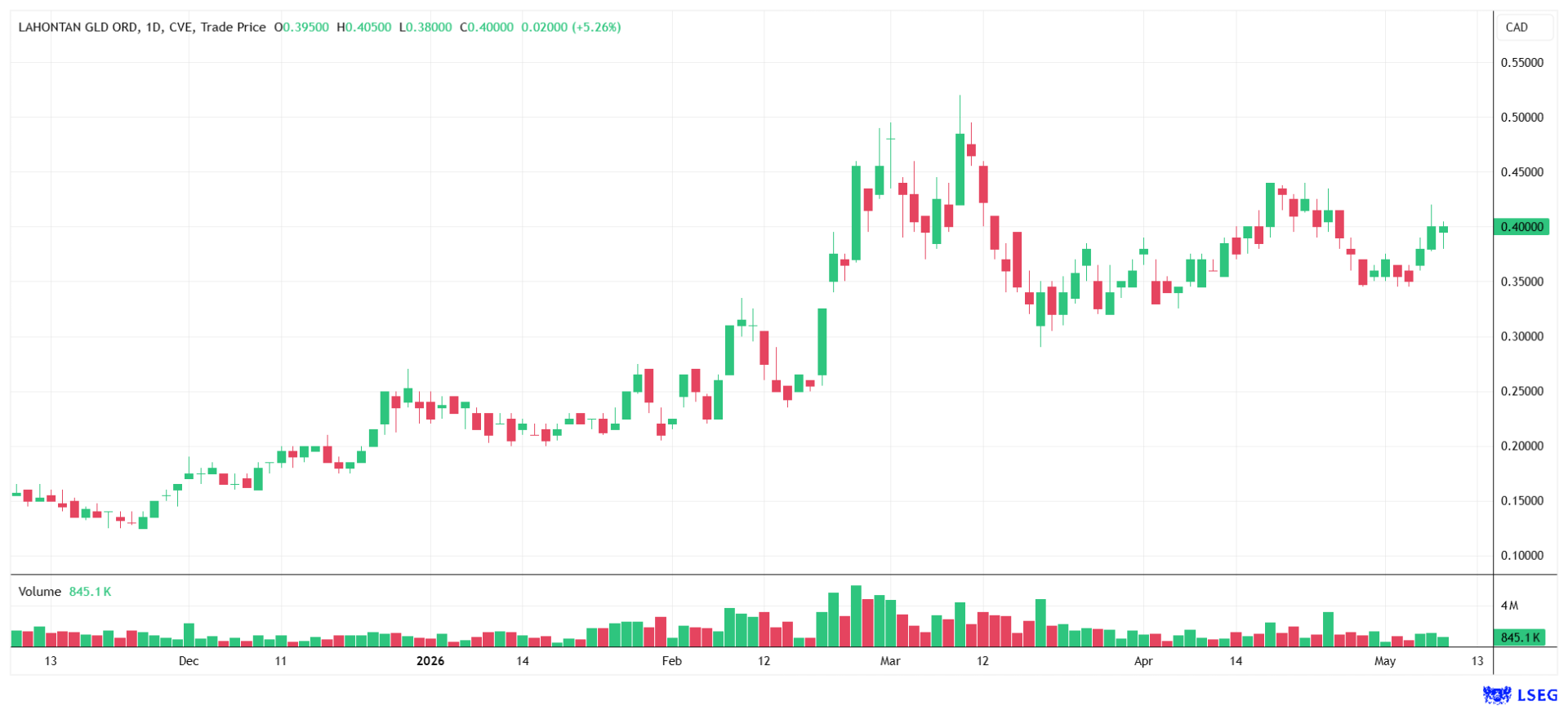
The stock is currently trading at CAD 0.40.
Three assets, one processing plant, one logistics operation. This combination sets Lahontan Gold apart from most exploration stories. While other companies still have to prove whether a mine is even viable, the infrastructure is already in place here. The satellite project delivers better grades than the main mine. The tailings provide material for free. Anyone betting on the next gold cycle gets a project with built-in leverage in Lahontan Gold. The coming months will bring the decisive updates. The timeline is ambitious, but the foundation is solid.
Conflict of interest
Pursuant to §85 of the German Securities Trading Act (WpHG), we point out that Apaton Finance GmbH as well as partners, authors or employees of Apaton Finance GmbH (hereinafter referred to as "Relevant Persons") currently hold or hold shares or other financial instruments of the aforementioned companies and speculate on their price developments. In this respect, they intend to sell or acquire shares or other financial instruments of the companies (hereinafter each referred to as a "Transaction"). Transactions may thereby influence the respective price of the shares or other financial instruments of the Company.
In this respect, there is a concrete conflict of interest in the reporting on the companies.
In addition, Apaton Finance GmbH is active in the context of the preparation and publication of the reporting in paid contractual relationships.
For this reason, there is also a concrete conflict of interest.
The above information on existing conflicts of interest applies to all types and forms of publication used by Apaton Finance GmbH for publications on companies.
Risk notice
Apaton Finance GmbH offers editors, agencies and companies the opportunity to publish commentaries, interviews, summaries, news and the like on news.financial. These contents are exclusively for the information of the readers and do not represent any call to action or recommendations, neither explicitly nor implicitly they are to be understood as an assurance of possible price developments. The contents do not replace individual expert investment advice and do not constitute an offer to sell the discussed share(s) or other financial instruments, nor an invitation to buy or sell such.
The content is expressly not a financial analysis, but a journalistic or advertising text. Readers or users who make investment decisions or carry out transactions on the basis of the information provided here do so entirely at their own risk. No contractual relationship is established between Apaton Finance GmbH and its readers or the users of its offers, as our information only refers to the company and not to the investment decision of the reader or user.
The acquisition of financial instruments involves high risks, which can lead to the total loss of the invested capital. The information published by Apaton Finance GmbH and its authors is based on careful research. Nevertheless, no liability is assumed for financial losses or a content-related guarantee for the topicality, correctness, appropriateness and completeness of the content provided here. Please also note our Terms of use.