February 3rd, 2026 | 07:20 CET
The gold correction is irrelevant here: Why Desert Gold is the missing piece of the puzzle for B2Gold and Allied Gold
The gold market is in a phase that analysts now refer to as a supercycle. With prices breaking historical records, smart capital is turning its attention to the world's most productive regions – even after the recent correction in precious metals. West Africa, and specifically the Senegal-Mali Shear Zone (SMSZ), is considered the geological heartland. This is where some of the largest and richest mines on the planet are located. But the business follows an inexorable logic: even the largest mines are emptying, and the processing plants need to be kept busy. This is true in the south of the zone for Canadian giant B2Gold with its world-class Fekola mine and in the north for Allied Gold, which is revitalizing the historic Sadiola asset. Desert Gold is considered a potential supporter of both companies. The company controls the largest non-producing land parcel in the entire region, located precisely between the two giants. This makes Desert Gold extremely interesting for investors.
time to read: 3 minutes | Author: Nico Popp
ISIN: DESERT GOLD VENTURES | CA25039N4084 , B2GOLD CORP. | CA11777Q2099 , ALLIED GOLD CORPORATION | CA01921D1050
Table of contents:
Author

Nico Popp
At home in Southern Germany, the passionate stock exchange expert has been accompanying the capital markets for about twenty years. With a soft spot for smaller companies, he is constantly on the lookout for exciting investment stories.
Tag cloud
Shares cloud
The neighbors: Hunger for oxide ore at B2Gold and Allied
To understand the value of Desert Gold, one must know the needs of its neighbors. Processing gold ore is expensive, especially when it comes to hard rock from deep deposits. The operators of large mills, such as B2Gold at the Fekola mine or Allied Gold at the Sadiola complex, are therefore constantly on the lookout for so-called oxide ores. These are close to surface, soft, and extremely inexpensive to process. They are the turbochargers for any mining operation and, therefore, in high demand.
As industry analyses show, transport routes in the region are crucial. Allied Gold is investing heavily in the expansion of Sadiola, but every ounce that they do not have to explore at great expense, but can instead transport by truck to the mill from a direct neighbor, increases their margin. Desert Gold is within striking distance with its SMSZ project. The logic is simple: why drill yourself when your neighbor has already defined the ore?
Desert Gold: Controller of 440 km² in the SMSZ
Desert Gold Ventures' core asset is gigantic. The SMSZ project covers around 440 km², making it one of the largest exploration areas in West Africa. But size alone is not enough; quality counts. The company has already defined several deposits in this area, including Barani East and Gourbassi West.
A recently published preliminary economic assessment (PEA) update underscores the project's profitability: even at a conservative gold price of USD 2,850 per ounce – well below current market prices – the project has an internal rate of return (IRR) of 57%. According to the company, the net present value (NPV 10%) after taxes is over USD 61 million. These figures prove that Desert Gold is not just a geological hope, but has an economically robust project that could go into production at any time.
Strategic option: Standalone or takeover?
Desert Gold's management is pursuing a dual strategy that increases pressure on potential buyers. On the one hand, the company is pushing ahead with the development of its own production. The goal is heap leaching, which generates cash flow quickly and with low capital expenditure. The PEA shows that this would be highly profitable.
On the other hand, the strategic location is so obvious that an acquisition or partnership is in the air for many in the industry. Desert Gold's land package borders directly on Allied Gold's properties. Geological structures do not stop at license boundaries – Allied's gold-bearing zones continue on Desert Gold's land. Anyone who wants to secure the long-term supply of Sadiola or Fekola can hardly ignore Desert Gold. Desert thus controls almost all of the region's future reserves.
Diversification into Côte d'Ivoire: The Tiegba Project
Developments in recent months show that Desert Gold is not putting all its eggs in one basket. The company has secured another option in a top jurisdiction with the Tiegba Gold project in Côte d'Ivoire. Côte d'Ivoire is considered politically extremely stable and mining-friendly. This acquisition diversifies the country risk in Mali and shows that management is able to identify promising assets at an early stage. Here, too, the strategy is to acquire projects with a historical database in order to minimize exploration risks. Tiegba offers similar potential to the projects in Mali, but is still in the early stages of development.
Desert Gold shares are exciting for several reasons
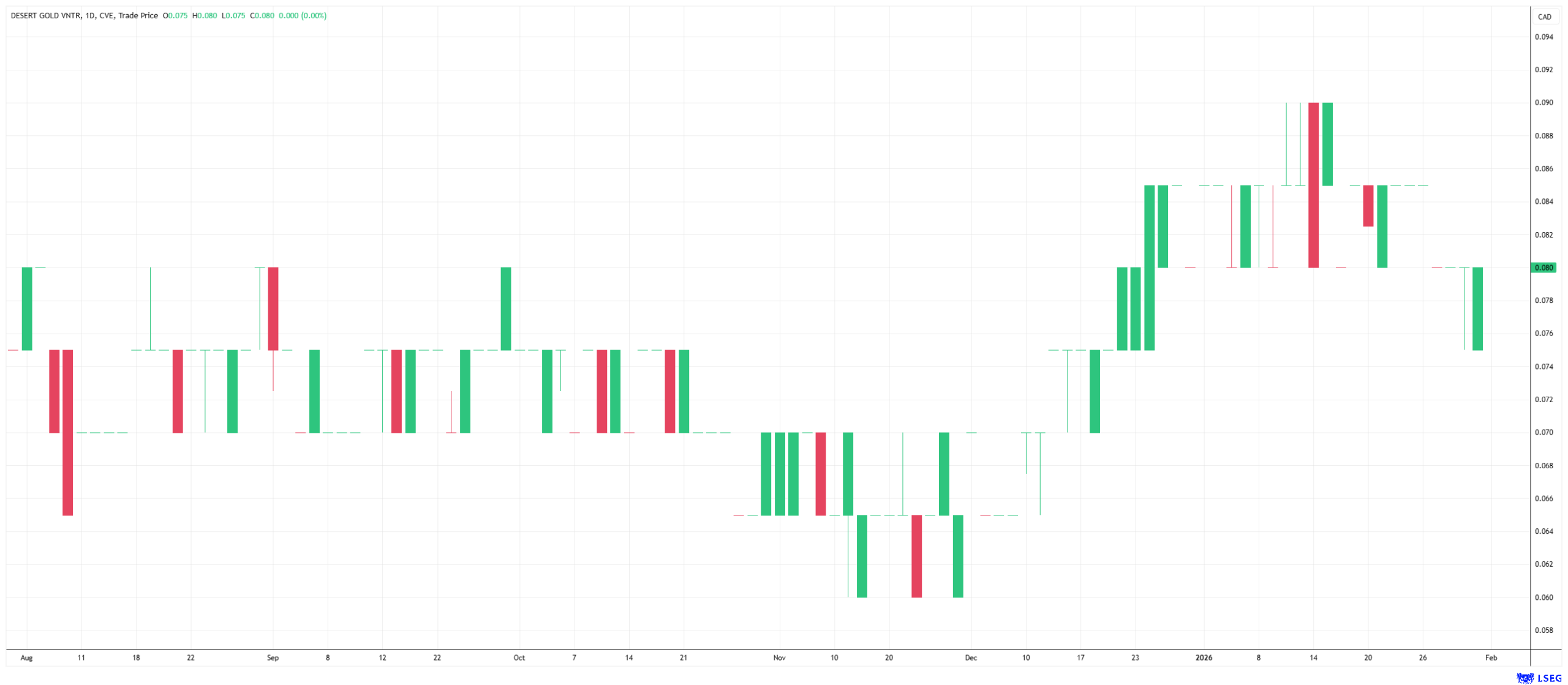
Desert Gold Ventures offers a rare constellation in the mining sector. The company's valuation currently hardly reflects the strategic value of its vast land package in Mali, let alone the potential of the PEA. While B2Gold and Allied Gold are worth billions, Desert Gold is trading at a fraction of that, even though it could play a crucial role in the future of the entire region.
Although geopolitical risk remains a factor in West Africa, mines in this region have been producing reliably for decades, regardless of the political climate, as they are essential to national budgets.** For speculative investors betting on a wave of takeovers in the sector, Desert Gold is the logical candidate. Either the company will become a producer and generate its own cash flow, or it will fall prey to one of its hungry neighbors. In either scenario, the current share price is likely to have plenty of upside potential.
Watch YouTube videoConflict of interest
Pursuant to §85 of the German Securities Trading Act (WpHG), we point out that Apaton Finance GmbH as well as partners, authors or employees of Apaton Finance GmbH (hereinafter referred to as "Relevant Persons") currently hold or hold shares or other financial instruments of the aforementioned companies and speculate on their price developments. In this respect, they intend to sell or acquire shares or other financial instruments of the companies (hereinafter each referred to as a "Transaction"). Transactions may thereby influence the respective price of the shares or other financial instruments of the Company.
In this respect, there is a concrete conflict of interest in the reporting on the companies.
In addition, Apaton Finance GmbH is active in the context of the preparation and publication of the reporting in paid contractual relationships.
For this reason, there is also a concrete conflict of interest.
The above information on existing conflicts of interest applies to all types and forms of publication used by Apaton Finance GmbH for publications on companies.
Risk notice
Apaton Finance GmbH offers editors, agencies and companies the opportunity to publish commentaries, interviews, summaries, news and the like on news.financial. These contents are exclusively for the information of the readers and do not represent any call to action or recommendations, neither explicitly nor implicitly they are to be understood as an assurance of possible price developments. The contents do not replace individual expert investment advice and do not constitute an offer to sell the discussed share(s) or other financial instruments, nor an invitation to buy or sell such.
The content is expressly not a financial analysis, but a journalistic or advertising text. Readers or users who make investment decisions or carry out transactions on the basis of the information provided here do so entirely at their own risk. No contractual relationship is established between Apaton Finance GmbH and its readers or the users of its offers, as our information only refers to the company and not to the investment decision of the reader or user.
The acquisition of financial instruments involves high risks, which can lead to the total loss of the invested capital. The information published by Apaton Finance GmbH and its authors is based on careful research. Nevertheless, no liability is assumed for financial losses or a content-related guarantee for the topicality, correctness, appropriateness and completeness of the content provided here. Please also note our Terms of use.