December 2nd, 2025 | 07:00 CET
The demographic clock is ticking: How Bayer, Vidac Pharma, and Novo Nordisk are positioning themselves in the billion-dollar battle for our health
The demographic clock is ticking inexorably. An aging society brings with it a flood of widespread diseases such as heart disease, cancer, and diabetes. Each one is a billion-dollar market that is pushing healthcare systems to their limits. As costs explode, brutal, cut-throat competition is emerging. The winner will not be the one with the most pills, but the one with the most effective solutions to the greatest medical and economic challenges of our time. Today, we take a look at how Bayer, Vidac Pharma, and Novo Nordisk plan to shape the future.
time to read: 5 minutes | Author: Armin Schulz
ISIN: BAYER AG NA O.N. | DE000BAY0017 , VIDAC PHARMA HOLDING PLC | GB00BM9XQ619 , NOVO NORDISK A/S | DK0062498333
Table of contents:
Author

Armin Schulz
Born in Mönchengladbach, he studied business administration in the Netherlands. In the course of his studies he came into contact with the stock exchange for the first time. He has more than 25 years of experience in stock market business.
Tag cloud
Shares cloud
Bayer – Focusing on innovations beyond patent cliffs
The latest news from Bayer reads like a success story for the research department. Several active ingredients from its own pipeline are making a name for themselves. Particularly noteworthy is Asundexian, a novel anticoagulant that has proven itself in an extensive registration study. The new data sounds promising. The active ingredient significantly reduces the risk of further strokes without increasing the risk of serious bleeding compared to the current standard. These results could herald a real turning point in stroke prevention. For Bayer, this success comes at just the right time to offset the impending decline in sales due to the loss of the Xarelto patent. The Company is thus positioning itself specifically in a large, unmet medical need.
In the field of personalized oncology, Bayer scores with the accelerated US approval of sevabertinib. The active ingredient targets a specific HER2 mutation in lung cancer, a patient group with limited options to date. In studies, over 70% of treated patients responded, a remarkable figure. This development underscores the strategy of occupying niches with high medical needs rather than focusing solely on broad effectiveness. In addition, the EU approval of elinzanetant for menopausal symptoms strengthens the portfolio and opens up another high-revenue field outside of cancer therapy.
The future of the Company will depend largely on how successfully these new active ingredients can be placed on the market. The pipeline is well filled, but competition is fierce. The challenge now lies in commercial implementation. Bayer must prove that it can convert its innovative strength into sustainable revenue not only in the laboratory, but also in sales. For investors, this is a key indicator of whether the Company can return to its former strengths in the long term and break away from its legacy issues. The focus on precision medicine appears to be the right path forward. The share is currently available for EUR 30.48.
Vidac Pharma – With an innovative approach to cancer
Vidac Pharma is pursuing a promising approach in oncology that differs fundamentally from traditional therapies. The Company is targeting the so-called Warburg effect, a metabolic disorder that enables cancer cells to grow aggressively. The drug candidate VDA-1102 was developed to reverse this mechanism by blocking a key enzyme. This could not only stop tumor growth, but also reactivate the body's own immune defenses. The focus is on oncological skin diseases such as actinic keratosis.
The Company recently reached a significant regulatory milestone: approval of a new Phase 2 study in Germany for highly proliferative actinic keratosis. This approval by the authorities confirms the scientific basis of the approach and paves the way for clinical data generation. At the same time, Vidac is strengthening its presence on the European capital market with a listing on the Düsseldorf Stock Exchange's open market as of December 1. This step is intended to improve the tradability of the stock for German investors and broaden the long-term financing base.
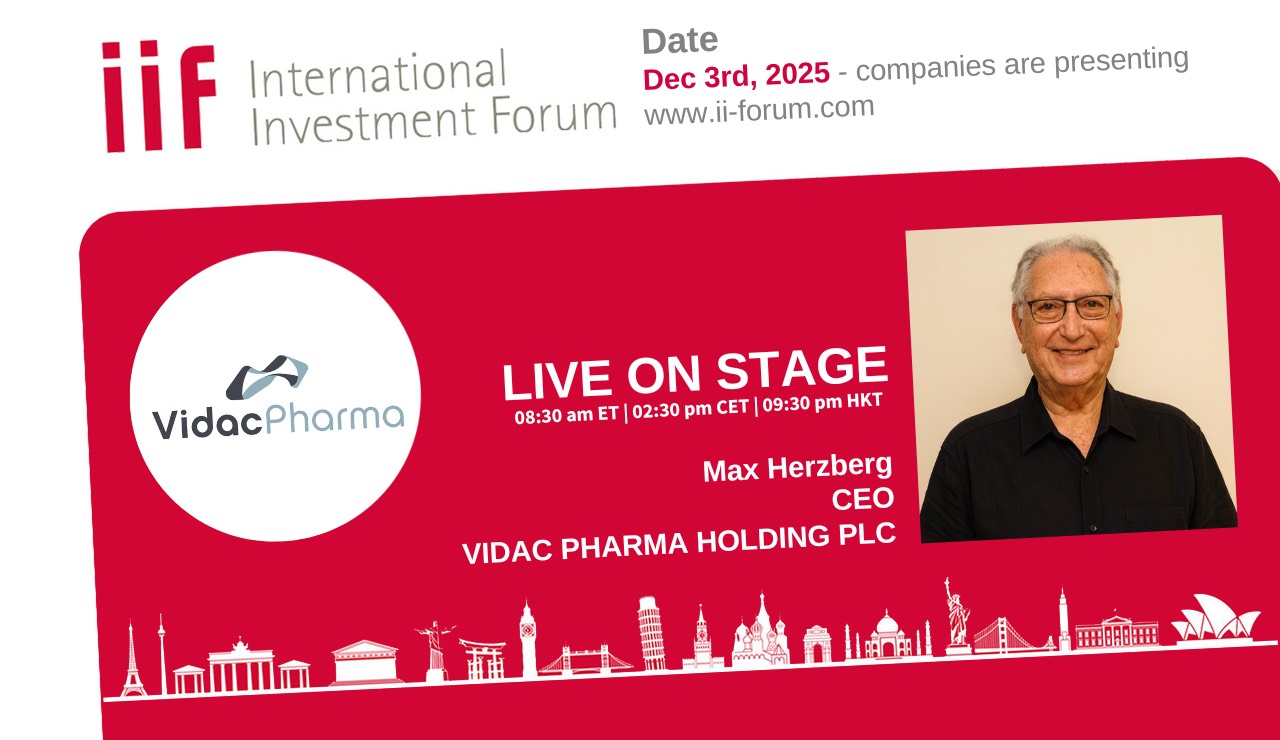
This promising development has also been recognized by analysts. The research firm Sphene Capital recently reaffirmed its "Buy" recommendation for Vidac. After a currency-related adjustment, the price target is EUR 4.20 per share, which represents significant potential compared to the current price of EUR 0.548. Sphene Capital highlights the novel mode of action and differentiated pipeline. With the clinical trial now starting and growing visibility in the capital market, Vidac is positioning itself as an interesting investment in a promising therapeutic area. The Company will be presenting at the International Investment Forum on December 3 - registration is open!
Novo Nordisk - Ways out of the crisis
While investor sentiment around Novo Nordisk is currently at a low point, the Company is strategically working on its future. A key component of this is the expansion of its portfolio around the active ingredient semaglutide. The Company recently applied for approval of a higher 7.2 mg dose of its weight loss drug Wegovy in the US. This new dosage has shown an average weight reduction of over 20% in studies and could therefore improve treatment outcomes for many patients. At the same time, Novo is pushing ahead with the development of follow-up drugs such as Amycretin, which demonstrated impressive weight loss and improved blood sugar levels in Phase 2 studies. The pipeline is therefore well stocked to defend market leadership in the field of metabolic diseases in the long term.
The focus is also on simplifying application. A potential game changer for the mass market is the oral version of Wegovy, which is expected to be approved this year. The ease of taking it as a tablet should not be underestimated either. It could lower the inhibition threshold for many patients who shy away from injections. It is precisely these strategic levers that are crucial to surviving fierce competition from rivals such as Eli Lilly. Even though Novo Nordisk is currently under some pressure and losing market share, the GLP-1 market is growing so rapidly overall that there should be enough room for several major players in the long term. The current restructuring measures are also aimed at making the Company more agile and cost-efficient.
Another key to the future lies in improving the affordability and accessibility of medicines. The latest price agreements with the US government, which drastically reduce costs for Medicare patients, are a short-term shock to margins. In the long term, however, they open up access to a vast, previously untapped patient pool. Through this expanded coverage and planned local production expansions, Novo Nordisk aims to more than compensate for the loss of revenue due to lower prices. Through innovation, more user-friendly products, and broader access, the Company aims to increase its growth over the next decade. Currently, one share costs EUR 42.00.
In the fight against the consequences of demographic change, companies are relying on different but equally forward-looking strategies. Bayer is countering the threat of declining sales due to patent expiries with promising precision medicines such as Asundexian. Vidac Pharma is impressing with a novel, metabolic cancer therapy approach and is aiming for a broader financing base through its new stock market listing. Novo Nordisk is defending its leading position in the GLP-1 market with higher dosages, oral formulations, and strategic pricing models for broader accessibility. The winner will not be the one with the most solutions, but the one with the most effective and economical ones.
Conflict of interest
Pursuant to §85 of the German Securities Trading Act (WpHG), we point out that Apaton Finance GmbH as well as partners, authors or employees of Apaton Finance GmbH (hereinafter referred to as "Relevant Persons") may hold shares or other financial instruments of the aforementioned companies in the future or may bet on rising or falling prices and thus a conflict of interest may arise in the future. The Relevant Persons reserve the right to buy or sell shares or other financial instruments of the Company at any time (hereinafter each a "Transaction"). Transactions may, under certain circumstances, influence the respective price of the shares or other financial instruments of the Company.
In addition, Apaton Finance GmbH is active in the context of the preparation and publication of the reporting in paid contractual relationships.
For this reason, there is a concrete conflict of interest.
The above information on existing conflicts of interest applies to all types and forms of publication used by Apaton Finance GmbH for publications on companies.
Risk notice
Apaton Finance GmbH offers editors, agencies and companies the opportunity to publish commentaries, interviews, summaries, news and the like on news.financial. These contents are exclusively for the information of the readers and do not represent any call to action or recommendations, neither explicitly nor implicitly they are to be understood as an assurance of possible price developments. The contents do not replace individual expert investment advice and do not constitute an offer to sell the discussed share(s) or other financial instruments, nor an invitation to buy or sell such.
The content is expressly not a financial analysis, but a journalistic or advertising text. Readers or users who make investment decisions or carry out transactions on the basis of the information provided here do so entirely at their own risk. No contractual relationship is established between Apaton Finance GmbH and its readers or the users of its offers, as our information only refers to the company and not to the investment decision of the reader or user.
The acquisition of financial instruments involves high risks, which can lead to the total loss of the invested capital. The information published by Apaton Finance GmbH and its authors is based on careful research. Nevertheless, no liability is assumed for financial losses or a content-related guarantee for the topicality, correctness, appropriateness and completeness of the content provided here. Please also note our Terms of use.