February 18th, 2026 | 07:25 CET
The Transaction Era: Why Desert Gold Ventures Emerges as the Clear Winner in West Africa – B2Gold Watches, Robex Resources as a Blueprint
The spotlight at Mining Indaba 2026 in Cape Town in early February illuminated a new reality that goes far beyond production quotas and drilling results. A term emerged from the panel discussions that defines future commodity policy: "transactional." The era of purely ideological alliances is giving way to a pragmatic age in which security of supply and access to resources are the currency of geopolitics. In this new global structure, in which the West, China, and the Global South are vying for influence, Africa is no longer positioning itself as a supplicant but as a strategic partner on an equal footing. Capital follows this logic. However, it does not flow indiscriminately, but rather targets the most geologically productive regions. In the gold sector, this means that all eyes are on the Senegal-Mali Shear Zone (SMSZ). In this world-class district, a small explorer controls the key to the longevity of the giants there: Desert Gold Ventures. While B2Gold and Robex Resources manage their billion-dollar assets, Desert Gold sits on strategic reserves that are likely to become very expensive in a transactional world.
time to read: 3 minutes | Author: Nico Popp
ISIN: DESERT GOLD VENTURES | CA25039N4084 , B2GOLD CORP. | CA11777Q2099 , ROBEX RESOURCES INC. | CA76125Y1051
Table of contents:
Author

Nico Popp
At home in Southern Germany, the passionate stock exchange expert has been accompanying the capital markets for about twenty years. With a soft spot for smaller companies, he is constantly on the lookout for exciting investment stories.
Tag cloud
Shares cloud
Robex and B2Gold as blueprints for success and demand
Robex Resources has demonstrated how to create value in West Africa through operational excellence with the development of the Kiniero Gold project in Guinea. The company proves that the market rewards functioning business models in this region with significant valuations, as long as production is on track. Even more important for the investment story, however, is its neighbor in Mali: B2Gold. The Canadian major operates one of the flagships of the global gold industry, the Fekola mine. But mines are finite assets. As industry analysts point out, B2Gold needs a continuous supply of new, easily processable ore to extend the life of its expensive infrastructure and keep margins high. In a world dominated by "transactional relationships," purchasing resources from a direct neighbor is often the most efficient way to secure one's own future.
Desert Gold: Lord of the strategic land package
This is precisely where the immeasurable value of Desert Gold Ventures lies. The company is not a speculator drilling in the middle of nowhere, but one of the largest landowners without its own production in the entire SMSZ. With an area of around 440 sq km, Desert Gold controls a contiguous land package along the Senegal-Mali Shear Zone, stretching between B2Gold's Fekola mine in the south and Allied Gold's Sadiola complex in the north.
The geological logic is compelling: the gold-bearing structures that have made Fekola and Sadiola multi-billion dollar assets do not end at the license boundaries. They run right through the middle of Desert Gold's territory. The company has already proven that gold is present there with the Barani East and Gourbassi West deposits. However, in the new transactional era, it is not only geology that counts, but also economics.
The PEA as proof of economic viability
Desert Gold's management has reinforced the fact that the company is more than just an acquisition option with its latest update of the preliminary economic assessment (PEA). The figures, measured in terms of market capitalization, are a wake-up call for investors. Even under conservative assumptions, the project has an internal rate of return (IRR) of 57%. The net present value (NPV 10%) after taxes is over USD 61 million – based on a base gold price of USD 2,850 per ounce, which is significantly below the spot prices of USD 4,000 per ounce additionally considered in the study.
Desert's strategic focus is on a manageable open-pit oxide mine with a simple gravity and CIL process, as described in the updated PEA. This is promising for investors: such a flowsheet is low in capital, quick to ramp up, and technically much less risky than complex sulfide projects. For a potential buyer such as B2Gold or Allied Gold, this is exactly the ideal scenario: you are not buying an expensive adventure, but oxidized ore that can be processed immediately using existing CIL technology.
Conclusion: Desert Gold in the sights of the giants
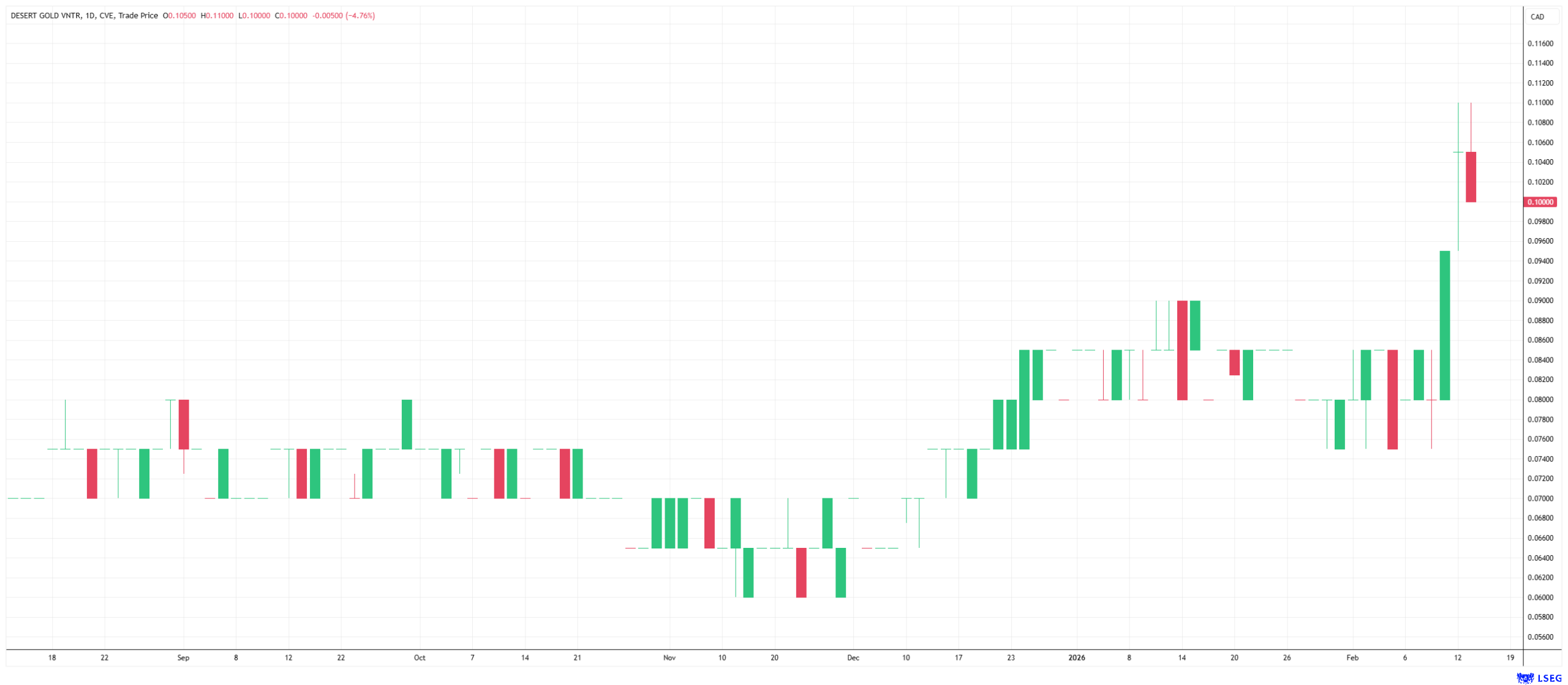
The message from Mining Indaba 2026 was clear: whoever has the resources makes the rules. Desert Gold Ventures owns the strategic reserve in West Africa's most important gold region. While Robex goes its own way and B2Gold looks for fodder for its mills, Desert Gold becomes an indispensable variable in the equation. The company offers investors an attractive starting position. Its valuation of just over CAD 30 million currently hardly reflects the value of its resources, let alone the strategic premium paid for secure assets in a transactional world. Whether Desert Gold goes into production itself and takes advantage of high gold prices or is swallowed up by one of its neighbors is almost irrelevant to investors: the stock is undervalued amid the gold boom and is likely to be the focus of several major players. Those who can take on the country risk in Mali will find a promising opportunity here – the conditions for a revaluation appear to be in place.
Watch YouTube videoConflict of interest
Pursuant to §85 of the German Securities Trading Act (WpHG), we point out that Apaton Finance GmbH as well as partners, authors or employees of Apaton Finance GmbH (hereinafter referred to as "Relevant Persons") currently hold or hold shares or other financial instruments of the aforementioned companies and speculate on their price developments. In this respect, they intend to sell or acquire shares or other financial instruments of the companies (hereinafter each referred to as a "Transaction"). Transactions may thereby influence the respective price of the shares or other financial instruments of the Company.
In this respect, there is a concrete conflict of interest in the reporting on the companies.
In addition, Apaton Finance GmbH is active in the context of the preparation and publication of the reporting in paid contractual relationships.
For this reason, there is also a concrete conflict of interest.
The above information on existing conflicts of interest applies to all types and forms of publication used by Apaton Finance GmbH for publications on companies.
Risk notice
Apaton Finance GmbH offers editors, agencies and companies the opportunity to publish commentaries, interviews, summaries, news and the like on news.financial. These contents are exclusively for the information of the readers and do not represent any call to action or recommendations, neither explicitly nor implicitly they are to be understood as an assurance of possible price developments. The contents do not replace individual expert investment advice and do not constitute an offer to sell the discussed share(s) or other financial instruments, nor an invitation to buy or sell such.
The content is expressly not a financial analysis, but a journalistic or advertising text. Readers or users who make investment decisions or carry out transactions on the basis of the information provided here do so entirely at their own risk. No contractual relationship is established between Apaton Finance GmbH and its readers or the users of its offers, as our information only refers to the company and not to the investment decision of the reader or user.
The acquisition of financial instruments involves high risks, which can lead to the total loss of the invested capital. The information published by Apaton Finance GmbH and its authors is based on careful research. Nevertheless, no liability is assumed for financial losses or a content-related guarantee for the topicality, correctness, appropriateness and completeness of the content provided here. Please also note our Terms of use.