
Comments

Commented by Nico Popp on October 7th, 2026 | 09:15 CEST
Aspermont, S&P Global and Alphabet: Specialized Data Poses a Challenge Even for Tech Giants
Generative artificial intelligence is fundamentally changing how information is obtained and siphoning organic web traffic away from traditional media platforms. As search engines utilize AI-generated answers, such as AI Overviews, the traditional advertising business of websites is losing its foundation. Publishers are becoming increasingly dependent on others, but specialized B2B information providers are carving out a lucrative niche. Deep industry knowledge built up over time still offers added value, as it is indispensable for reliable industrial applications and not easily replaceable. We shed light on this trend and highlight some exciting companies.
Read
Commented by André Will-Laudien on October 7th, 2026 | 09:10 CEST
Bridging the Skies: The European-Canadian Drone Offensive with Volatus Aerospace, Boeing, RTX and DroneShield
"If Russia is not stopped, its war machine will sooner or later turn against us," German Chancellor Friedrich Merz has warned. The current security situation is very serious, and it would certainly be preferable to avoid being drawn into such a conflict. As modern warfare is no longer fought exclusively on the ground, the global aerospace and defence industry is undergoing one of the biggest transformations in its history. Relations between Germany and Canada are also developing in a remarkably positive direction, a testament to the inner strength of the NATO alliance. The new strategic alliance aims to break through existing technological barriers and set new standards for the defence sector. At the heart of this initiative is the integration of cutting-edge sensor technology, artificial intelligence, and state-of-the-art platforms. Innovative systems for airspace surveillance and threat detection are becoming increasingly important for securing critical infrastructure. For investors, this development creates opportunities to gain exposure to a highly dynamic, rapidly evolving growth market.
Read
Commented by Matthias Schomber on October 7th, 2026 | 09:05 CEST
Banking Power Struggles, Takeover Battles & Tungsten Boom: Time For Bold Moves in Commerzbank, Deutsche Bank and Almonty Industries
Financial markets are currently on edge! Yields on 10-year bonds are climbing to extreme levels in several European countries as well as in the US, creating turbulence across a wide range of asset classes. Ongoing geopolitical conflicts are adding to the uncertainty. While Germany's banking sector is caught between takeover battles and significant interest-rate risks, investors are looking for fresh catalysts. At Commerzbank, Italian major shareholder UniCredit is shaking up the status quo, while Deutsche Bank is grappling with pressured bond portfolios despite completing its share buyback program. Meanwhile, the commodities sector is presenting a very different, but equally compelling, setup. Here, Almonty Industries' stock has undergone a sharp, rapid consolidation following a spectacular rally and is now hovering near a critical chart level. In this analysis, we examine the potential risks involved and where attractive opportunities are now opening up for savvy investors.
Read
Commented by André Will-Laudien on October 7th, 2026 | 09:00 CEST
Droughts, Floods, Wars! Crisis-Resilient Returns with Global Food Stocks Like Unilever, MustGrow, Bayer and Kraft Heinz
Created and Published on Behalf of MustGrow Biologics Corp.
In times of heightened geopolitical and climate-related crises, the food and agriculture sector is emerging as an increasingly critical industry. Droughts, storms, and devastating floods are presenting the global food industry with ever-greater challenges. Companies in this sector are committed to ensuring basic food security and are also driving the adoption of more sustainable farming practices. For investors, Bayer, Unilever, MustGrow, and Kraft Heinz are being put to the test, with their fundamental strength facing increasingly difficult conditions. British consumer-goods giant Unilever, for example, is placing greater emphasis on regenerative agriculture while leveraging its portfolio of global brands. US food giant Kraft Heinz, meanwhile, is seeking to withstand inflation and volatile supply chains with its portfolio of established consumer brands. At the same time, biotech company MustGrow is positioning itself with sustainable agricultural solutions designed to address increasingly extreme weather conditions, while collaborating with crop-science specialist Bayer. Current challenges are pushing food producers' business models to their limits. A closer look at the key metrics reveals who is truly prepared for the future of food.
Read
Commented by Carsten Mainitz on October 7th, 2026 | 08:55 CEST
Pellets, Steel & Wind Power: How Strategic Resources, Salzgitter & Nordex Could Profit from the Billion-Dollar Steel Transformation
Green steel represents a new generation of steel production in which hydrogen and renewable energy replace coal, drastically reducing CO₂ emissions. Behind this green vision lies a market worth billions—though it comes with challenges. Rising CO₂ costs, stricter climate regulations, and the pursuit of resilient supply chains could further accelerate demand for low-carbon steel. However, energy costs, huge investments, and access to high-quality raw materials will ultimately determine who actually benefits from the transformation. Strategic Resources is focusing on high-quality iron ore for modern direct reduction plants. Salzgitter is consistently pursuing the path of transformation. Nordex is benefiting from the expansion of renewable energy and has a record order backlog. Who has the lead?
Read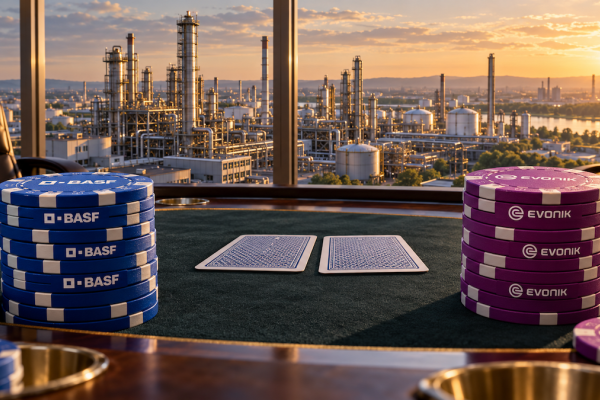
Commented by Fabian Lorenz on October 7th, 2026 | 08:50 CEST
Takeover Battle Intensifies: BASF, Evonik, Gerresheimer and Phenom Resources
The takeover battle surrounding BASF and Evonik is intensifying, and politicians are now getting involved as well. The state government is demanding job guarantees, while the leader of the SPD parliamentary group in North Rhine-Westphalia has voiced criticism and called on Minister President Hendrik Wüst to step up his efforts and provide greater clarity. Phenom Resources is a hot stock with takeover potential. The Canadian company is focused on gold and vanadium projects in the US state of Nevada. Its gold and copper assets are set to be spun off—but could a strategic partner make a move instead? Gerresheimer was already in the crosshairs of financial investors back in 2025. Since the failed takeover attempt, however, things have been relatively quiet. The company is currently restructuring and streamlining its business. That could eventually put it back on potential buyers' radar.
Read
Commented by Stefan Bode on October 7th, 2026 | 08:45 CEST
Stocks Put to the Test: 1&1, BMW, dynaCERT, United Internet
Heavy investment, rising interest rates, shrinking margins, and the restructuring of established business models are currently shaping many stocks. While one company is financing the development of critical infrastructure, another is focusing on technology to make existing fleets more efficient. A third well-known company is struggling with price pressure and weaker demand in its traditional core markets. What matters most to investors is not the next announcement, but rather the resolution of the problem and its operational implementation, which will then be reflected in the order book and future cash flow.
Read
Commented by Carsten Mainitz on October 7th, 2026 | 08:40 CEST
Spot the Next Stock Catalyst Early: Key Milestones for Lahontan Gold, Evotec and Deutz
Get in before the stock takes off! The key is to identify the trigger for the next share-price move early enough. Lahontan Gold is working to restart a historic gold mine in Nevada and recently made an attractive acquisition. Biotech company Evotec is fighting to turn its operations around and rebuild investor confidence. Deutz is expanding its industrial business into energy and defense, taking the company into new dimensions of growth. What does this mean for investors? Where are the most compelling opportunities for stock pickers?
Read
Commented by Fabian Lorenz on October 7th, 2026 | 08:35 CEST
Time to Sell Moderna Stock After a 200% Rally? A Comeback for Standard Lithium and HPQ Silicon?
Moderna's stock has had a spectacular run in recent weeks. Since mid-August, the biotech company's stock has surged from USD 63 to over USD 200. But now analysts are pouring cold water on the price surge. In their view, the stock could more than halve in value. While Moderna has already made a successful comeback, there are good reasons to believe that HPQ Silicon's is still to come. Despite positive news flow, the stock has yet to take off. Following successes in the drone sector, the company recently laid the groundwork to market its technology for producing fumed silica. Investors have been waiting for a comeback from Standard Lithium for quite some time. The stock is trading at a yearly low and approaching penny stock levels. Yet the company recently secured a new customer.
Read
Commented by Tarik Dede on October 7th, 2026 | 08:30 CEST
Two Years of Hormuz Tension? Stocks Like Shell, Zefiro Methane and TotalEnergies Stand to Gain
Created and Published on Behalf of Zefiro Methane Corp.
The energy world turned its attention to London just a few days ago for the Energy Intelligence Forum. The message from the Thames was hardly encouraging for either industry or households. Amin Nasser, CEO of Saudi Aramco, emphasized that even after the Strait of Hormuz is fully reopened, it could take up to two years to rebuild global oil and diesel inventories to normal levels. The fact that global inventories of crude oil and refined products, particularly diesel, are at dangerously low levels is becoming increasingly apparent at the pump. But two years also means that the oil and refining industries could have a prolonged period of strong earnings ahead. This is especially relevant as Ukraine is currently inflicting significant damage on Russian refineries. Against this backdrop, investors should consider how to position themselves for the years ahead. Today, we take a closer look at opportunities across the oil market, from the clean-up specialist Zefiro Methane and refining giant Shell to French energy champion TotalEnergies.
Read