February 26th, 2026 | 07:15 CET
Opportunities thanks to industrial transformation: The closed value chain of CHAR Technologies, PyroGenesis, and BASF
When it comes to the climate-neutral transformation of industry, the current phase marks the transition from strategic planning to operational implementation for many companies. According to recent publications by McKinsey and the International Energy Agency (IEA), about half of the required reduction in CO2 emissions by 2050 depends on the provision of alternative heat sources for the production of basic industrial materials such as steel, cement, and chemicals. The regulatory framework in Europe and North America is defined by the Emissions Trading System (ETS) and stricter standards for the circular economy, which increases the financial pressure on CO2-intensive processes. In this environment, the thermal decomposition of organic materials in the absence of oxygen, known as pyrolysis, is becoming increasingly popular as a means of recovering energy from waste streams and utilizing them as carbon sinks. CHAR Technologies, PyroGenesis, and BASF play an important role in this context, ranging from decentralized waste recovery to specialized plant engineering and industrial applications.
time to read: 3 minutes | Author: Nico Popp
ISIN: CHAR Technologies Ltd. | CA15957L1040 , PYROGENESIS CANADA INC. | CA74734T1049 , BASF SE NA O.N. | DE000BASF111
Table of contents:
Author

Nico Popp
At home in Southern Germany, the passionate stock exchange expert has been accompanying the capital markets for about twenty years. With a soft spot for smaller companies, he is constantly on the lookout for exciting investment stories.
Tag cloud
Shares cloud
CHAR Technologies and decentralized resource recovery
CHAR Technologies focuses on decentralized resource recovery, converting forestry waste, biosolids, and sewage sludge into renewable natural gas, green hydrogen, and solid biochar. The Thorold Renewable Energy Facility in the Canadian province of Ontario recently commenced commercial operations, demonstrating the applicability of the technology. In the first phase, the plant is designed for an annual production of 5,000 tons of biochar, with plans to expand to 10,000 tons and produce renewable natural gas in a second phase. The biochar produced in Thorold serves as a carbon-neutral substitute for fossil coal in the steel industry, which represents a measurable operational cost advantage for industrial customers in view of rising CO2 prices.
The technological basis is high-temperature pyrolysis (HTP), which operates at higher temperatures than slow processes, increases energy yield efficiency, and produces a clean synthesis gas. A completed demonstration project in Baltimore also validated the ability of HTP technology to completely destroy long-chain fluorinated compounds (PFAS), also known as "forever chemicals," in municipal biosolids through heat. Financially, the company recorded a profit of CAD 4.13 million from a joint venture contribution in fiscal year 2025, which was largely driven by the cooperation with the BMI Group. With an initial investment of CAD 8 million in the Thorold project and a further commitment of CAD 10 million for the Espanola project, the BMI Group is strengthening CHAR Technologies' capital base for the upcoming capacity expansion.
PyroGenesis electrifies heavy industry
While CHAR Technologies primarily processes organic waste, PyroGenesis addresses the direct emissions of large-scale industrial processes through the use of plasma technology. Electric plasma burners replace fossil fuels and achieve the temperatures required for energy-intensive processes such as deacidification in cement production or metal production. In the cement industry, where around 40% of total emissions come from the combustion of fossil fuels, the company signed a CAD 1.3 million contract with a European customer in December 2025 to supply a plasma burner for a rotary kiln. At the same time, in January 2026, PyroGenesis delivered a 4.5 MW plasma burner to a customer in the US defense sector, which will serve as the technological basis for the planned scaling up to a 20 MW system.
BASF scales up and integrates global material flows
The world's largest chemical company, BASF, is using the pyrolysis process for large-scale industrial recycling and the production of low-carbon hydrogen. In partnership with ExxonMobil, BASF is driving methane pyrolysis to market maturity, in which natural gas is split directly into hydrogen and solid carbon without generating any process-related CO2 emissions. The demonstration plant at ExxonMobil's Baytown, Texas, site is designed to produce 2,000 tons of low-carbon hydrogen and 6,000 tons of solid carbon annually. Since this process uses existing natural gas infrastructure and requires about five times less energy than conventional water electrolysis, it can be scaled up more quickly and economically on an industrial scale.
Market Dynamics – Focus on CHAR Technologies
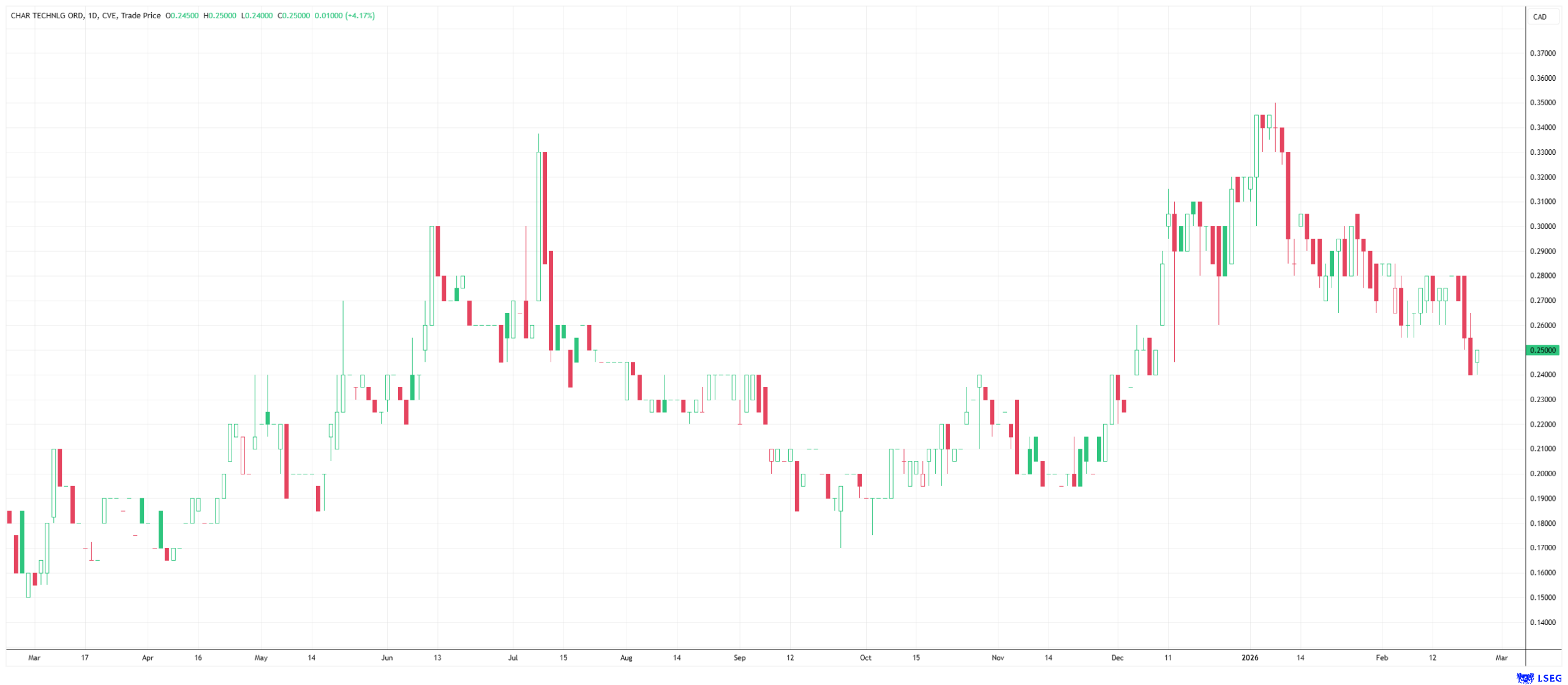
Market observers at Wood Mackenzie characterize 2026 as a consolidation phase for the hydrogen sector, with capital increasingly allocated to projects backed by secured off-take agreements. An analysis by PwC further indicates that 93% of surveyed CEOs are pushing ahead with the regionalization of supply chains, which increases the need for local energy production. CHAR Technologies' decentralized pyrolysis facilities serve this trend toward nearshoring, as they utilize local waste materials to make regional industrial companies less dependent on energy imports. In the hydrogen ecosystem, large industrial players such as BASF act as anchor off-takers, providing the baseline demand required to underpin investment in emerging production technologies. From an investment perspective, CHAR Technologies appears particularly interesting – the company is making operational progress and has secured a strategic partner. Given its market capitalization of just over CAD 30 million, the stock is likely to have further potential if successful.
Conflict of interest
Pursuant to §85 of the German Securities Trading Act (WpHG), we point out that Apaton Finance GmbH as well as partners, authors or employees of Apaton Finance GmbH (hereinafter referred to as "Relevant Persons") may hold shares or other financial instruments of the aforementioned companies in the future or may bet on rising or falling prices and thus a conflict of interest may arise in the future. The Relevant Persons reserve the right to buy or sell shares or other financial instruments of the Company at any time (hereinafter each a "Transaction"). Transactions may, under certain circumstances, influence the respective price of the shares or other financial instruments of the Company.
In addition, Apaton Finance GmbH is active in the context of the preparation and publication of the reporting in paid contractual relationships.
For this reason, there is a concrete conflict of interest.
The above information on existing conflicts of interest applies to all types and forms of publication used by Apaton Finance GmbH for publications on companies.
Risk notice
Apaton Finance GmbH offers editors, agencies and companies the opportunity to publish commentaries, interviews, summaries, news and the like on news.financial. These contents are exclusively for the information of the readers and do not represent any call to action or recommendations, neither explicitly nor implicitly they are to be understood as an assurance of possible price developments. The contents do not replace individual expert investment advice and do not constitute an offer to sell the discussed share(s) or other financial instruments, nor an invitation to buy or sell such.
The content is expressly not a financial analysis, but a journalistic or advertising text. Readers or users who make investment decisions or carry out transactions on the basis of the information provided here do so entirely at their own risk. No contractual relationship is established between Apaton Finance GmbH and its readers or the users of its offers, as our information only refers to the company and not to the investment decision of the reader or user.
The acquisition of financial instruments involves high risks, which can lead to the total loss of the invested capital. The information published by Apaton Finance GmbH and its authors is based on careful research. Nevertheless, no liability is assumed for financial losses or a content-related guarantee for the topicality, correctness, appropriateness and completeness of the content provided here. Please also note our Terms of use.