April 28th, 2026 | 07:05 CEST
Oil and Gas Shock Boosts dynaCERT, ITM, and Nel, but Sparks Panic at Jungheinrich!
The stock market has its ups and downs. While Canadian hydrogen fuel-saving company dynaCERT had been stagnating for months, it is now making a breakthrough in Asia. The Canadians' fuel-saving technology is being welcomed with open arms in Vietnam, raising hopes for a hot summer in other Asian countries as well. While Plug Power already celebrated a stellar first quarter, industry rivals ITM Power and Nel ASA are now quickly following suit. However, the current excitement surrounding hydrogen offers little support for Jungheinrich's stock. Here, the Q1 figures are more of a reason to sell. What happens next? Read for yourself.
time to read: 5 minutes | Author: André Will-Laudien
ISIN: DYNACERT INC. | CA26780A1084 | TSX: DYA , OTCQB: DYFSF , NEL ASA NK-_20 | NO0010081235 , ITM POWER PLC LS-_05 | GB00B0130H42 , JUNGHEINRICH AG O.N.VZO | DE0006219934
Table of contents:
Author

André Will-Laudien
Born in Munich, he first studied economics and graduated in business administration at the Ludwig-Maximilians-University in 1995. As he was involved with the stock market at a very early stage, he now has more than 30 years of experience in the capital markets.
Tag cloud
Shares cloud
dynaCERT – Vietnamese Momentum Boosts Operational Outlook
This is a game changer! Investors have had to endure a long wait, but now the rally is really taking off. 80% in just 2 weeks is significant. What happened? The Canadian cleantech specialist dynaCERT is moving into the spotlight as, after years of intensive development work, a phase of operational scaling is beginning to emerge. Instead of speculating on future infrastructure, it addresses the existing global fleet of diesel vehicles—at a time when geopolitical tensions in regions such as the Strait of Hormuz are already disrupting daily oil and gas flows. With its HydraGEN™ technology, dynaCERT positions itself as a bridging solution in a transitional phase in which increased efficiency and emissions reductions must deliver immediate, measurable economic benefits. The system generates hydrogen on demand during engine operation, thereby optimizing combustion, which leads to a noticeable reduction in fuel consumption as well as lower emissions. Of particular strategic relevance is the integration of the HydraLytica telematics platform, which transparently captures emissions data and forms the basis for monetizing CO₂ savings through internationally recognized certification standards.
A decisive operational impetus is currently coming from Southeast Asia, where market entry in Vietnam, in particular, is emerging as a potential growth driver. The country has a fleet of more than 3.5 million heavy-duty commercial vehicles and construction machines, most of which are diesel-powered, representing enormous sales potential. In this context, dynaCERT has signed two strategically significant letters of intent to ensure both scientific validation and on-site industrial scalability of the technology. Of particular note is the collaboration with the Ho Chi Minh City University of Technology, which involves joint testing programs and technical evaluations under local operating conditions. In parallel, a partnership has been established with a leading state-controlled energy company to implement pilot projects within the national infrastructure, thereby creating reference applications for broader market penetration.
Operationally, the first pilot installations are already in use on heavy-duty trucks and container-handling equipment at logistics centers in Ho Chi Minh City, Hanoi, and Hai Phong. These early applications not only provide technical performance data but also serve as a gateway for further commercial rollouts in a market that is increasingly relying on emissions trading systems from a regulatory perspective. Should Vietnam establish a national CO₂ certificate system as planned, this would significantly enhance the technology's economic appeal, as efficiency gains could be directly converted into tradable emission credits. From a strategic perspective, management therefore explicitly views Vietnam as a regional bridgehead for the entire Southeast Asian market, where millions of diesel-powered commercial vehicles require long-term modernization.
Financially, dynaCERT recently strengthened its operational capacity through a capital raise of approximately CAD 2 million, thereby securing, in particular, its international sales operations and working capital. With an existing production capacity of up to 36,000 units per year, the company already has the industrial infrastructure to scale up quickly as demand rises. From a valuation perspective, the company currently remains at a level below the cumulative investments of the past decade. Against this backdrop, analysts see the combination of market-ready technology, new reference projects in Vietnam, and prospective access to CO₂ certificate markets as a potential catalyst for a revaluation of the share in the coming quarters. Currently, reaching the CAD 0.75 price target would amount to a fourfold increase. Having nearly doubled in just a few days, the momentum is strong! Jump on board!
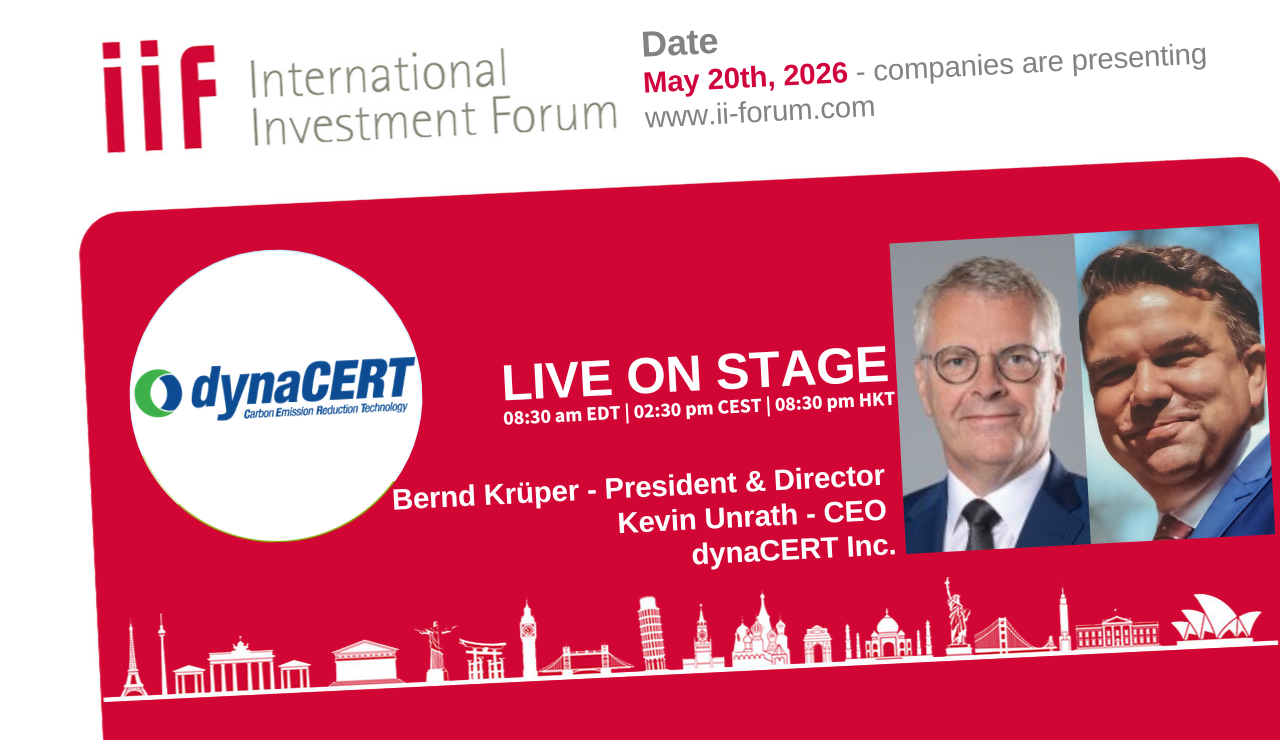
At the next International Investment Forum (IIF) on May 20 at 2:30 pm CET, President Bernd Krüper and COO Kevin Unrath of dynaCERT will present live and discuss current developments.
Jungheinrich – Profits Halved and Share Price Disaster
Although Jungheinrich already operates many of its forklifts on hydrogen, this does not shield the company from losses. The first quarter turned out to be a setback for the Hamburg-based company, as operating profit plummeted by nearly half. While revenue of EUR 1.27 billion was only slightly below the previous year, earnings before interest and taxes (EBIT) fell significantly to EUR 56.5 million from EUR 104 million. The company attributed this to increased price pressure due to intense competition, lower capacity utilization, and the recent strike, which paralyzed the plant in Lüneburg—set to close—for 85 days through the end of February. The withdrawal from Russia also weighed on EBIT by an additional EUR 20 million. The share price fell from around EUR 30 to below EUR 24 and has only begun to stabilize somewhat this week. The British investment bank Barclays lowered its price target from EUR 44 to 41 but maintained its "Overweight" rating. The experts on the LSEG Refinitiv platform remained equally calm and estimate their 12-month average price target at EUR 39.50, a premium of more than 50% over the current price. Well then!
ITM Power and Nel ASA – Finally on the Verge of a Breakout
Two other hydrogen companies are currently in the spotlight: ITM Power and Nel ASA. At ITM Power, signs are mounting that the company is finding its operational footing after a period in which it was perceived more as a turnaround candidate than a growth stock. Stricter cost discipline, a more selective project approach, and a recalibrated production strategy convey to investors the image of a management team that is back at the helm rather than rowing in the engine room. The market rewarded this new order with an impressive price rally in a short time—perhaps too impressive. The share price exploded from EUR 0.80 to over EUR 1.90 but has since dropped around 10% to EUR 1.69 at the start of the week. Experience shows that when a turnaround is priced in before it is visible in the numbers, the risk of a short-term reality check increases.
The situation at Nel ASA is quite different. Here, we see a prime example of just how challenging the industrialization of the hydrogen business actually is. Technologically well-positioned, strategically present, but operationally dependent on investment decisions by major customers who are quick to hit the brakes in times of high financing costs. These delays directly impact the visibility of order intake and keep the stock in a nervous sideways dance. Following the massive price drop since 2022, the current stabilization feels more like a cautious breather than a real sprint. A 15% gain in just one week—speculators are waiting for much more, and momentum is building!
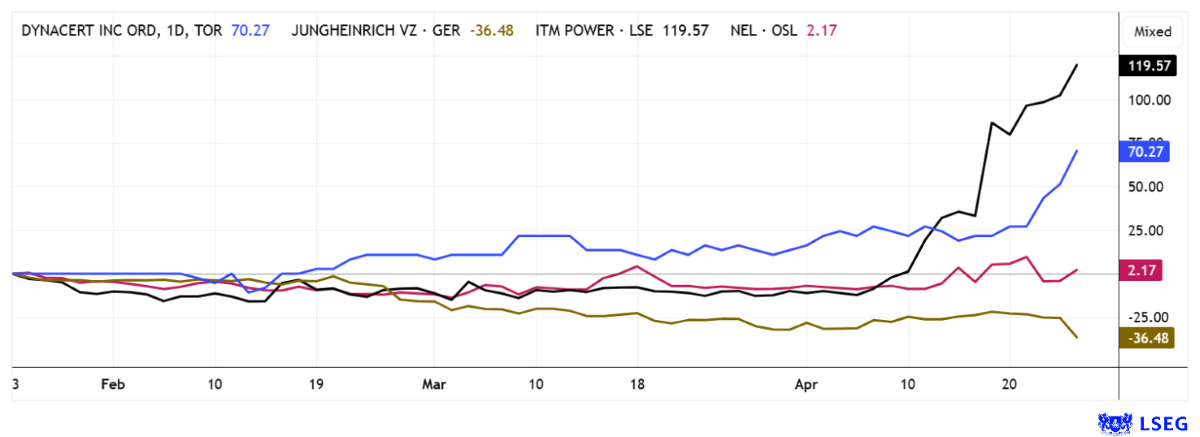
The capital markets are ruthless. With every statement made by US President Donald Trump, the short-term scenario shifts—no one knows how strongly it will move in either direction. Long-term trends are less affected, and in the case of hydrogen technologies, these could now begin to translate into tangible value. Oil and gas are temporarily out of favor, while investors are turning to fuel-saving technologies from dynaCERT or new energy supply concepts from ITM Power and Nel ASA. The long-beaten-down stocks are only just beginning to gain real momentum.
Conflict of interest
Pursuant to §85 of the German Securities Trading Act (WpHG), we point out that Apaton Finance GmbH as well as partners, authors or employees of Apaton Finance GmbH (hereinafter referred to as "Relevant Persons") currently hold or hold shares or other financial instruments of the aforementioned companies and speculate on their price developments. In this respect, they intend to sell or acquire shares or other financial instruments of the companies (hereinafter each referred to as a "Transaction"). Transactions may thereby influence the respective price of the shares or other financial instruments of the Company.
In this respect, there is a concrete conflict of interest in the reporting on the companies.
In addition, Apaton Finance GmbH is active in the context of the preparation and publication of the reporting in paid contractual relationships.
For this reason, there is also a concrete conflict of interest.
The above information on existing conflicts of interest applies to all types and forms of publication used by Apaton Finance GmbH for publications on companies.
Risk notice
Apaton Finance GmbH offers editors, agencies and companies the opportunity to publish commentaries, interviews, summaries, news and the like on news.financial. These contents are exclusively for the information of the readers and do not represent any call to action or recommendations, neither explicitly nor implicitly they are to be understood as an assurance of possible price developments. The contents do not replace individual expert investment advice and do not constitute an offer to sell the discussed share(s) or other financial instruments, nor an invitation to buy or sell such.
The content is expressly not a financial analysis, but a journalistic or advertising text. Readers or users who make investment decisions or carry out transactions on the basis of the information provided here do so entirely at their own risk. No contractual relationship is established between Apaton Finance GmbH and its readers or the users of its offers, as our information only refers to the company and not to the investment decision of the reader or user.
The acquisition of financial instruments involves high risks, which can lead to the total loss of the invested capital. The information published by Apaton Finance GmbH and its authors is based on careful research. Nevertheless, no liability is assumed for financial losses or a content-related guarantee for the topicality, correctness, appropriateness and completeness of the content provided here. Please also note our Terms of use.