July 7th, 2026 | 07:30 CEST
DAX at 30,000—Unrealistic? Keep an Eye on DroneShield, Volatus Aerospace, Airbus, and Hensoldt
It has been a long time since global equity markets experienced such a powerful and broad-based bull run. Investors have once again been reminded that geopolitical conflicts do not necessarily trigger prolonged market declines. Instead, they often reinforce expectations of higher defence spending, accelerated technological innovation, and additional government investment. At the same time, public debt continues to climb. Rather than being meaningfully reduced, maturing obligations are typically refinanced by issuing new debt. In the view of many market participants, this ongoing expansion of public borrowing continues to provide liquidity support for financial markets. This trend has persisted since the global financial crisis of 2008. Meanwhile, the influence of major technology entrepreneurs and capital allocators on politics and industry has become increasingly apparent. Figures such as Elon Musk play a far greater role in shaping industrial policy and technological development than would have seemed conceivable only a decade ago. Valuation, however, remains a growing concern. The cyclically adjusted Shiller P/E ratio for the S&P 500 has averaged roughly 17.4 over the long term. At around 39.5, it currently stands approximately 127% above that historical average. That places the market among the most richly valued periods in modern history, exceeded only by the peak of the dot-com bubble in 1999. Whether traditional valuation metrics remain fully applicable in today's AI-driven and highly liquid market environment has therefore become an increasingly debated question among investors.
time to read: 6 minutes | Author: André Will-Laudien
ISIN: VOLATUS AEROSPACE INC | CA92865M1023 | TSXV: FLT , OTCQB: TAKOF , HENSOLDT AG INH O.N. | DE000HAG0005 , DRONESHIELD LTD | AU000000DRO2 , AIRBUS | NL0000235190
Table of contents:
Author

André Will-Laudien
Born in Munich, he first studied economics and graduated in business administration at the Ludwig-Maximilians-University in 1995. As he was involved with the stock market at a very early stage, he now has more than 30 years of experience in the capital markets.
Tag cloud
Shares cloud
Airbus and Hensoldt: On the Way Back to Old Highs?
The tide has apparently turned in the defence sector! Investors who had hoped for further declines are being proven wrong. Technology-based stocks such as Airbus and Hensoldt are firmly back in focus, because they can supply the needs of organizations like NATO. With its decision to permanently allocate 5% of gross domestic product to defence and security-relevant infrastructure by 2035 at the latest, NATO has launched the largest security-policy investment offensive in its history. For the European member states alone, this means additional defence spending of several hundred billion euros per year. The focus is on air defence, electronic warfare, artificial intelligence and the defence against unmanned aerial objects - capabilities that have gained considerable importance through the experiences of the Ukraine war. In parallel, Europe is giving concrete shape to the build-out of a so-called drone wall along NATO's eastern border, to better protect critical infrastructure and airspace against autonomous threats.
Because investors had expected operational delays here, the front-line stocks first had to accept hefty discounts. Yet now, with the rapid turnaround of the Rheinmetall share, everything seems fine again: buy while the cannons are thundering is the motto - and it is working out. Thus, Hensoldt managed to gain a full 20% in just 2 weeks, while the recovery for the DAX stock Airbus was much stronger. Because in mid-May the stock was still at EUR 165, it is now back at EUR 211, just below its all-time high of EUR 221. At Airbus Defence and Space, the unmanned systems business is increasingly coming to the fore. Only a few months ago, the group successfully demonstrated the autonomous "Bird of Prey" interceptor-drone prototype, which can independently identify and engage kamikaze drones. In addition, Airbus is advancing the build-out of a European counter-UAS architecture together with technology partners, positioning itself in a market segment that is likely to gain considerable momentum in the coming years. At the same time, Airbus is working on the next generation of autonomous combat-aircraft companions, the so-called "Loyal Wingman" systems. These AI-controlled aircraft are intended to accompany manned fighter jets in the future, carry sensors, take over electronic jamming measures or even deploy weapons themselves.
Hensoldt benefits even more directly from the expansion of European air defence. The specialist for radar, sensor and reconnaissance technologies supplies precisely those components without which modern drone defence would hardly be functional. The company is consistently expanding its position in both electronic warfare and drone detection and is now participating in several European initiatives to build area-wide drone defence systems. Fundamentally, much suggests that both companies are only at the beginning of a long-term investment cycle. Analysts on the LSEG Refinitiv platform see a median 12-month price target of EUR 211 for Airbus, which is likely still lagging the strong momentum. For Hensoldt, EUR 89.50 is estimated - and here, too, the room to the upside is already getting somewhat tight at EUR 89.50.
Volatus Aerospace: Next-Generation Autonomous Systems on the Rise
The turning of the times is currently changing not only the defence strategies of numerous states but at the same time creating a billion-dollar market for autonomous systems, artificial intelligence and unmanned aviation. Companies that can offer hardware, software and operational services from a single source are increasingly coming into focus for institutional investors. That the market may only be at the start of its growth cycle is underscored by current industry studies. According to an analysis by Fortune Business Insights, the global market for unmanned aerial systems is expected to grow from USD 47 billion in 2026 to around USD 160 billion by 2034. This corresponds to an average annual growth rate (CAGR) of 16.4%. High momentum can be expected for autonomous systems such as drones and robots, AI-supported mission software and safety-critical applications. They have their own specific usage characteristics for defence, energy supply and critical infrastructure. For companies like Volatus Aerospace, this creates a highly attractive market environment, as hardware, software and recurring service revenues combine into integrated platform solutions. And this is where the Canadians can score particularly well!
CFO Abhinav Singhvi explained the company's strategy and its CAD 500 million pipeline at the recent 19th International Investment Forum.
Having started with delivery and control systems from the air, Volatus Aerospace today positions itself in the critical upper segment of the sector. Because today the demand is for unmanned aerial systems that enable airborne data services and AI-based autonomy solutions. Volatus Aerospace has many patents and software know-how, complemented by corresponding user training. The goal is an integrated platform for civil, industrial and security-relevant applications. With this vertical setup, a business model emerges that benefits from infrastructure inspections just as much as from the global rise in demand for modern defence technologies. A further milestone has now been reached with the commissioning of a roughly 53,000-square-foot production and integration center at the Mirabel aviation site near Montréal. There, the first intelligent drone docking stations for commercial customers are already rolling off the line, while production of the company's own V-Series drones is also set to start soon. The new production base considerably increases industrial capacity and, at the same time, creates the conditions to supply customers in Canada, the USA, and other NATO partner states faster and on a larger scale.
Following a recently completed capital measure, the company received CAD 34.5 million, which is to be invested in production expansion, new RPAS systems and targeted acquisitions. At the same time, according to its own statements, management now has a project pipeline of around CAD 500 million, which is to be gradually converted into concrete orders in the coming quarters. Additional attention was generated by the admission to the second selection round of the US Drone Dominance Program, in which only a few companies were able to qualify for further testing and possible later production orders. Should this give rise to a long-term supplier role within Western defence structures, it would likely considerably strengthen the company's international perception once again. The share price recently consolidated toward CAD 0.60 amid profit-taking across the defence sector. However, with a market capitalization of around CAD 428 million, Volatus Aerospace has reached a size that is attracting the attention of international investors focused on defence and security technologies. The company also remains well-positioned to secure a place in US defence procurement programs—a development that could prove a significant catalyst if it materializes.
DroneShield: The Third Sell-Off Is Underway
Another dazzling stock from the defence space. The topic is the Australian counter-drone company DroneShield. After a high of around EUR 3.80, three downward waves have since occurred, pushing the price back below EUR 1.50. Despite its sought-after products and extensive reports on upcoming collaborations with Western defence alliances, the company's revenue target for 2026 is only around AUD 300 million (up from AUD 216 million in 2025). The mark of over AUD 500 million is one the board is not aiming for until 2028. Here, too, investors had expected a much faster pace of execution and were confronted, alongside operational delays, with management's share sales. Perhaps the weak sentiment reflects this combination of disappointments. From a fundamental perspective, however, one could also argue that a price-to-sales (P/S) ratio of 8.5 is difficult to justify. Even at the current share price, the valuation still appears demanding.
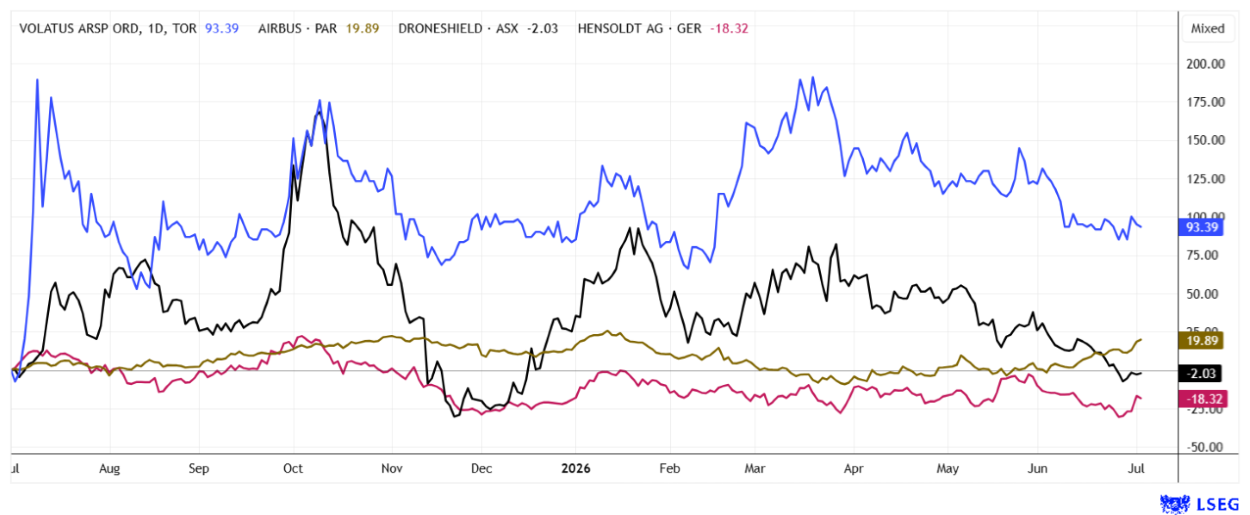
The overall situation smells explosive. Rising interest rates and stubborn inflation are currently likely preventing a continuation of the dramatic stock-market rally of recent weeks. While high-tech and chip stocks celebrated a once-in-a-century bull run, it was above all defence stocks that consolidated considerably. Yet the order situation in the sector argues for further investment by public contracting authorities. That speaks for Airbus and Hensoldt, but in particular for Volatus Aerospace, since here a North American aerial excellence is being built for the coming decades.
Conflict of interest
Pursuant to §85 of the German Securities Trading Act (WpHG), we point out that Apaton Finance GmbH as well as partners, authors or employees of Apaton Finance GmbH (hereinafter referred to as "Relevant Persons") currently hold or hold shares or other financial instruments of the aforementioned companies and speculate on their price developments. In this respect, they intend to sell or acquire shares or other financial instruments of the companies (hereinafter each referred to as a "Transaction"). Transactions may thereby influence the respective price of the shares or other financial instruments of the Company.
In this respect, there is a concrete conflict of interest in the reporting on the companies.
In addition, Apaton Finance GmbH is active in the context of the preparation and publication of the reporting in paid contractual relationships.
For this reason, there is also a concrete conflict of interest.
The above information on existing conflicts of interest applies to all types and forms of publication used by Apaton Finance GmbH for publications on companies.
Risk notice
Apaton Finance GmbH offers editors, agencies and companies the opportunity to publish commentaries, interviews, summaries, news and the like on news.financial. These contents are exclusively for the information of the readers and do not represent any call to action or recommendations, neither explicitly nor implicitly they are to be understood as an assurance of possible price developments. The contents do not replace individual expert investment advice and do not constitute an offer to sell the discussed share(s) or other financial instruments, nor an invitation to buy or sell such.
The content is expressly not a financial analysis, but a journalistic or advertising text. Readers or users who make investment decisions or carry out transactions on the basis of the information provided here do so entirely at their own risk. No contractual relationship is established between Apaton Finance GmbH and its readers or the users of its offers, as our information only refers to the company and not to the investment decision of the reader or user.
The acquisition of financial instruments involves high risks, which can lead to the total loss of the invested capital. The information published by Apaton Finance GmbH and its authors is based on careful research. Nevertheless, no liability is assumed for financial losses or a content-related guarantee for the topicality, correctness, appropriateness and completeness of the content provided here. Please also note our Terms of use.