March 23rd, 2026 | 07:30 CET
Is US Ammunition Capacity at Its Limit? Antimony Resources Delivers What Washington Needs for "Unlimited" Firepower
As geopolitical tensions mount in the Middle East and Washington speaks of "unlimited" ammunition capacity, a critical bottleneck in the supply chain is becoming increasingly apparent: antimony. This unassuming semimetal, essential for modern weapon systems and high-tech industries, is scarcer than ever. China has turned off the export tap. A Canadian company is stepping into this very vacuum. With one of North America's most promising projects, Antimony Resources aims to secure the West's strategic independence.
time to read: 5 minutes | Author: Armin Schulz
ISIN: ANTIMONY RESOURCES CORP | CA0369271014 | CSE: ATMY , OTCQB: ATMYF
Table of contents:
Author

Armin Schulz
Born in Mönchengladbach, he studied business administration in the Netherlands. In the course of his studies he came into contact with the stock exchange for the first time. He has more than 25 years of experience in stock market business.
Tag cloud
Shares cloud
A Strategic Raw Material is Being Reevaluated
The days when antimony languished as a mere byproduct in the shadow of major mines are finally over. The silvery-white metal, typically found in the mineral stibnite, has evolved from a niche raw material to a strategic cornerstone within just a few months. The reason is simple, yet all the more powerful. The global supply structure is fragile. For years, China and Russia dominated the market. This dependence is now coming back to haunt us. With Beijing effectively halting exports at the end of 2024 and Russia remaining under sanctions, a critical supply gap has opened up for Western industries. The price reacted promptly, skyrocketing to dizzying heights in a very short time.
Bald Hill: A Project in the Heart of a Stable Jurisdiction
In this tense environment, a company that has recognized the signs of the times is taking center stage. Vancouver-based Antimony Resources has secured a strategic position with the Bald Hill project in New Brunswick that goes far beyond the usual exploration story. It is not just what is in the ground, but also where it is. The property is located in one of the most stable and resource-friendly jurisdictions in the world, with direct access to deep-water ports and power grids.
Definitional Drilling Delivers Tangible Results
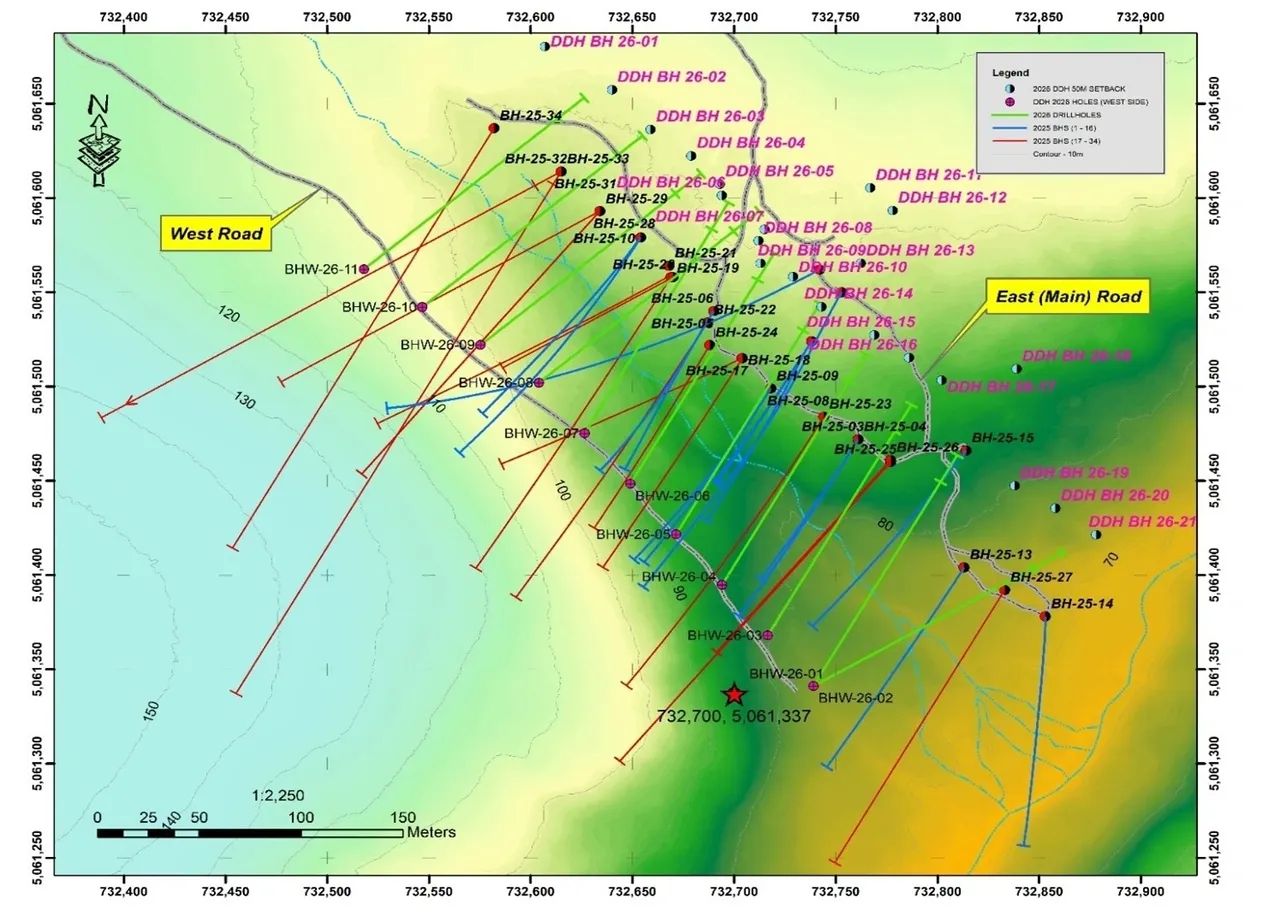
But the real momentum is currently unfolding beneath the surface. The company is pushing ahead full steam with a 10,000-meter definition drilling program. By mid-March, 5,000 m of drilling had already been completed, and the results confirm the high potential. Three drill rigs are in operation simultaneously, two of them in the main zone, while a third rig, internally dubbed "Wanderer," is already exploring the newly discovered areas.
Work is focused on the main zone, which now extends over a strike length of more than 700 m and has been verified to a depth of at least 400 m. The mineralization thickness averages 3–4 m, with average grades ranging from 3–4%, an excellent range for antimony deposits. The most recent drill holes from the western main zone show massive stibnite mineralization within a heavily altered sedimentary rock zone. In drill hole BHW-26-03, the mineralization extends over a range of 80–86 m, and in BHW-26-04 over 113–120 m. Results from previous campaigns, including 2.38% over 9.6 m and 6.79% over 2.3 m, underscore the consistency and quality of the mineralization.
More Than Just One Zone: A Larger System is Emerging
What sets Bald Hill apart from other projects, however, is the growing realization that this is a far larger mineralizing system. CEO Jim Atkinson sums it up in a conversation with analysts: "We are increasingly convinced that the mineralization in the Bald Hill area represents a large and extensive system." This conviction is fueled by concrete discoveries. During construction work on access roads, the field team unexpectedly stumbled upon a completely new zone to the west, which was named the Marcus Zone after the first prospector on site. It is not only visible at surface but is now being explored with shallow drilling at depths between 75 and 100 m.
Added to this is the Central Zone, which lies between the Main Zone and the South Zone. Here, historical trenching samples from 2010 returned grades of 2.90% antimony over 8.18 m, including a section of 5.79% over 1.75 m and another of 8.47% over 1.53 m. The South Zone, in turn, extends over a length of 150 m. In total, stibnite mineralization has already been identified in four separate areas of the property.
CEO Jim Atkinson commented on this progress in March 2026 in clear terms: "We are becoming increasingly convinced that the mineralization in the Bald Hill area represents an extensive system. Antimony-bearing stibnite mineralization has now been identified in four different areas of the property as massive and brecciated bodies. This raises hopes for an expansion of the project's potential resources beyond the main zone."
This diversification of zones is a strong signal of expansion potential. The Bald Hill complex could reach a scale that would make it one of the most significant antimony deposits in North America. A technical report from October 2025 supports this assessment. The exploration potential is estimated at approximately 2.7 million tons with a grade of 3–4% antimony. While this is a conceptual estimate, the ongoing definition program is specifically aimed at converting this potential into an official resource.
The Roadmap: Financed and Scheduled
The course has been set. Definition drilling in the main zone is expected to be completed by the end of April. The final assay results are expected 3–4 weeks later, so around early June. Then, the renowned consulting firm SRK Consultants will evaluate the data and present the first official resource estimate. SRK brings specific experience from the recently completed resource calculation for the formerly producing Beaverbrook deposit in Newfoundland, a geologically comparable antimony deposit.
The path is also clear financially. Following a funding round in December 2025, raising approximately CAD 9.5 million and the recent exercise of warrants, which brought in an additional CAD 1.2 million, the company has a well-funded cash position. The current exploration budget for 2026 amounts to approximately CAD 3 million. The financial security has been clearly communicated: "The planned exploration program is fully funded with over USD 7 million in the bank," said CEO Jim Atkinson in an interview with GBC Research. These funds are thus sufficient not only for the ongoing drilling but also for the next steps, which include discussions with authorities regarding the environmental impact assessment and the technical gap analysis.
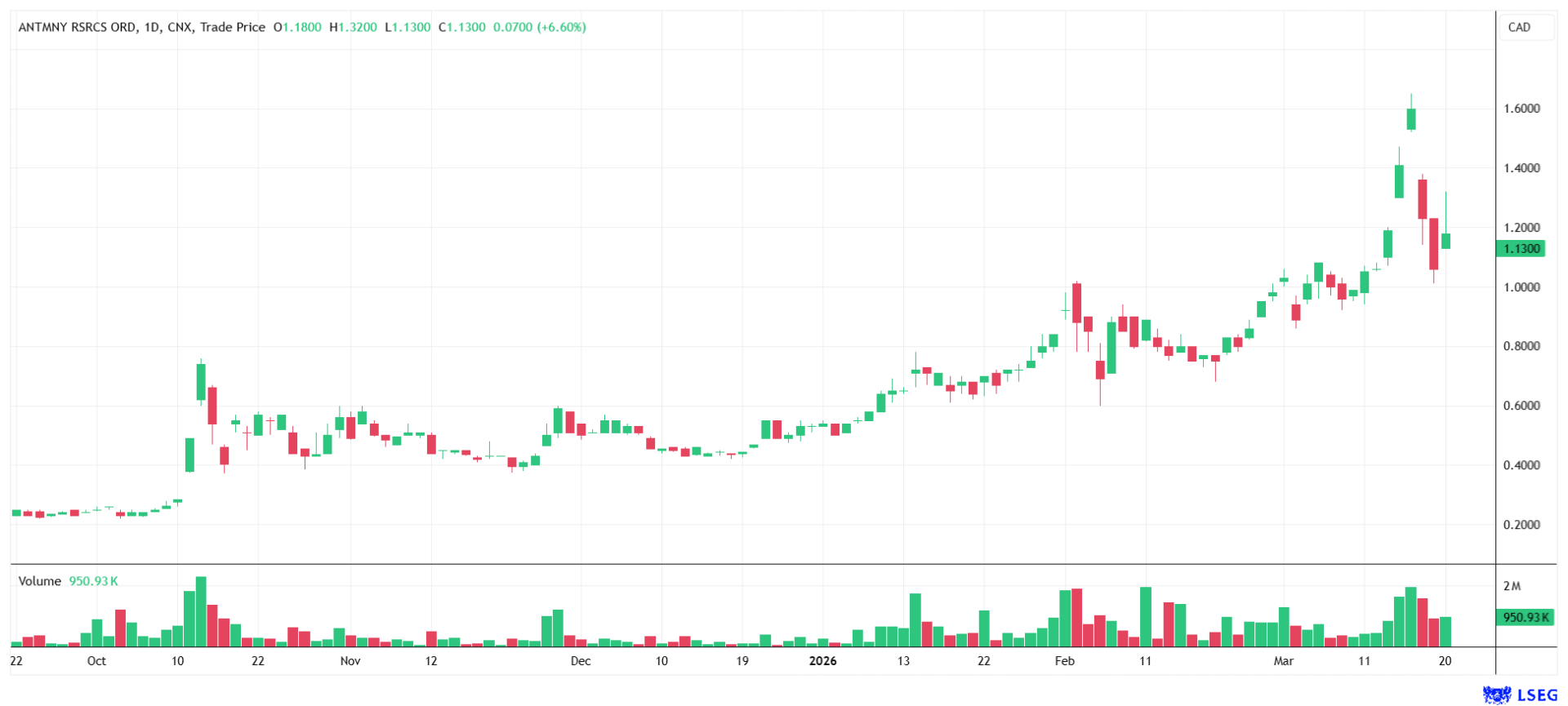
The stock, which hit a high of CAD 1.65 in mid-March, is currently trading at CAD 1.13. Investors now have the opportunity to use this pullback as an attractive entry point.
The gap between rising demand from the defense, solar, and data center sectors and a supply chain increasingly exposed to geopolitical risk continues to widen. In this context, Bald Hill is more than just a promising drilling project; it is a lever for strategic independence. With a fully funded program, three active drilling rigs, and a defined timeline toward an initial resource estimate, the company delivers substance where others present only vague plans. Those who invest today are not betting on speculation, but on a clearly defined roadmap. The coming months will be decisive, as key results are expected this spring.
Conflict of interest
Pursuant to §85 of the German Securities Trading Act (WpHG), we point out that Apaton Finance GmbH as well as partners, authors or employees of Apaton Finance GmbH (hereinafter referred to as "Relevant Persons") currently hold or hold shares or other financial instruments of the aforementioned companies and speculate on their price developments. In this respect, they intend to sell or acquire shares or other financial instruments of the companies (hereinafter each referred to as a "Transaction"). Transactions may thereby influence the respective price of the shares or other financial instruments of the Company.
In this respect, there is a concrete conflict of interest in the reporting on the companies.
In addition, Apaton Finance GmbH is active in the context of the preparation and publication of the reporting in paid contractual relationships.
For this reason, there is also a concrete conflict of interest.
The above information on existing conflicts of interest applies to all types and forms of publication used by Apaton Finance GmbH for publications on companies.
Risk notice
Apaton Finance GmbH offers editors, agencies and companies the opportunity to publish commentaries, interviews, summaries, news and the like on news.financial. These contents are exclusively for the information of the readers and do not represent any call to action or recommendations, neither explicitly nor implicitly they are to be understood as an assurance of possible price developments. The contents do not replace individual expert investment advice and do not constitute an offer to sell the discussed share(s) or other financial instruments, nor an invitation to buy or sell such.
The content is expressly not a financial analysis, but a journalistic or advertising text. Readers or users who make investment decisions or carry out transactions on the basis of the information provided here do so entirely at their own risk. No contractual relationship is established between Apaton Finance GmbH and its readers or the users of its offers, as our information only refers to the company and not to the investment decision of the reader or user.
The acquisition of financial instruments involves high risks, which can lead to the total loss of the invested capital. The information published by Apaton Finance GmbH and its authors is based on careful research. Nevertheless, no liability is assumed for financial losses or a content-related guarantee for the topicality, correctness, appropriateness and completeness of the content provided here. Please also note our Terms of use.