January 30th, 2026 | 07:30 CET
Is antimony the new tungsten? Why Antimony Resources could become a similar story to Almonty Industries
Out of the niche and into the spotlight! Antimony was considered a forgotten metal for decades until geopolitical upheavals shifted the focus to critical metals. Today, it is at the center of a geopolitical and economic realignment because it is indispensable for numerous high-tech and defense applications. China, a long-time dominant supplier, has drastically restricted its exports, leading to noticeable supply bottlenecks in many industries, from battery production to military equipment, and driving prices to historic levels. These restrictions have destabilized strategic supply chains and prompted Western governments, such as the US, to take massive security measures. Analysts and the media emphasize that this shortage is not just a temporary market phenomenon, but an industrial policy issue that affects production, prices, and investment worldwide. Canadian explorer Antimony Resources is just beginning to tell its story, which in its early stages shows many parallels to Almonty Industries. It is worth taking a closer look.
time to read: 4 minutes | Author: André Will-Laudien
ISIN: ANTIMONY RESOURCES CORP | CA0369271014
Table of contents:
Author

André Will-Laudien
Born in Munich, he first studied economics and graduated in business administration at the Ludwig-Maximilians-University in 1995. As he was involved with the stock market at a very early stage, he now has more than 30 years of experience in the capital markets.
Tag cloud
Shares cloud
Antimony – The return of a forgotten metal
For years, antimony was a marginal commodity, mostly mined as a metal by-product and strategically underestimated. This phase now seems to be over. Today, antimony is considered a bottleneck metal for modern defense systems, flame retardant applications, and certain high-performance batteries, without which entire industries would be unable to function. This change is being driven not only by demand, but also by geopolitical supply risks: China controls around 70% of global production and has repeatedly imposed export controls, causing wholesale prices to rise from around USD 15,000/t to over USD 60,000/t at times. In this environment, Antimony Resources aims to develop the first North American, politically stable source of this critical raw material. Somehow, memories of the early Almonty days come to mind. In case anyone asks, this story began in the fall of 2024 and has grown from roughly CAD 60 million to around CAD 3.5 billion today.
Bald Hill – A project that is gaining prestige
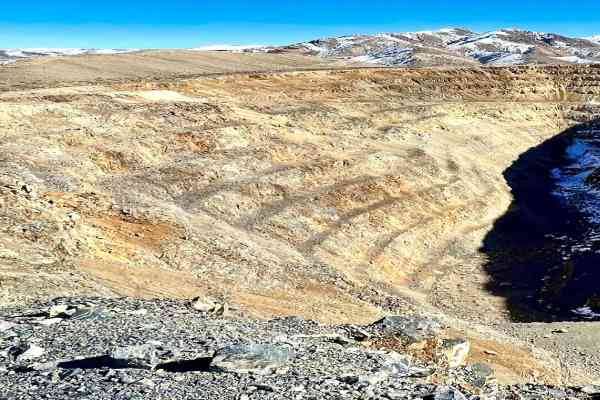
The focus is on the Bald Hill project in New Brunswick, Canada, whose high-grade stibnite mineralization is being confirmed by continuous drilling programs. In 2025, over 13,800 meters were drilled, including numerous significant intervals with average grades of 3% to 4% antimony and local peaks well above that. These results support the assessment from the earlier NI 43-101 report, which indicates an exploration target of approximately 2.7 million tons of rock at 3% to 4% Sb. Of course, a formal resource can only be defined with further drilling. At least 10,000 meters of definition drilling is planned for 2026, which should lay the foundation for an initial resource estimate. The systematic expansion of the Main Zone, South Zone, and new Marcus Zone not only increases the potential volume but also reduces geological uncertainties by validating multiple mineralized structures. This is a classic value driver in the exploration segment, where speculation turns into certainty.
The value drivers: Scarcity, price pressure, and diversification
Strong trends in gold, silver, and copper are currently resulting in significantly broader market dynamics for raw materials that have always been available only in small quantities and are now in demand on a whole new scale. This increases the spotlight on Antimony Resources. Antimony is now considered a critical mineral with a high risk of supply disruption in the US, Canada, and the EU because processing capacities outside China have not yet been institutionalized. Not only consumer industries, but also defense and high-tech sectors are under pressure to find reliable sources for the future. Resolving this predicament will not be easy, as there have been no significant mine openings in the antimony sector in the last 15 years. Today, therefore, those who can demonstrate a good project are in a position of strength. If the framework data is right, the US administration will exert its influence to ensure that development in Canada is approved quickly. However, it is still too early to talk about time frames. Step 1 is the secured resource definition.
CEO James R. Atkinson knows what he is talking about. Here he is in an interview with IIF presenter Lyndsay Malchuk.
The commodities market is currently opening up an exciting chapter. This is because scarcity is meeting a massive wave of money from willing investors who want to participate in the redistribution of resources. Antimony has just been awakened as a critical metal and is still 12 to 24 months ahead of tungsten, uranium, or copper in the cycle. However, there has been a noticeable influx of capital around antimony, especially from the US, where security of supply is increasingly seen as a national interest. Even smaller companies with credible projects in North America are thus coming into the focus of strategic investors.
Conclusion: Those who get their timing wrong will be left behind
The operational plan to establish a reliable resource through large-scale definition drilling is perfectly suited to a market that is urgently seeking diversified sources of antimony-containing raw materials. If Bald Hill is indeed converted into an indicated resource, this will not only open up traditional development paths such as feasibility studies, approvals, and financing, but also strategically position the Company in the critical raw materials network of the West. This is supported not only by the demand for raw materials itself, but also by the current geopolitical situation, in which antimony is considered the "linchpin" of supply chains.
The combination of operational substance and strategic context offers a compelling opportunity profile today. Of course, as with all explorers, long-term value depends largely on the successful implementation of the next drilling and resource milestones. Antimony Resources is still on a dusty road, but the highway to revaluation is not far off. At prices around CAD 0.80 and a market value of just CAD 65 million, risk-aware investors are already taking positions. The clock is ticking – just like it did with Almonty Industries!
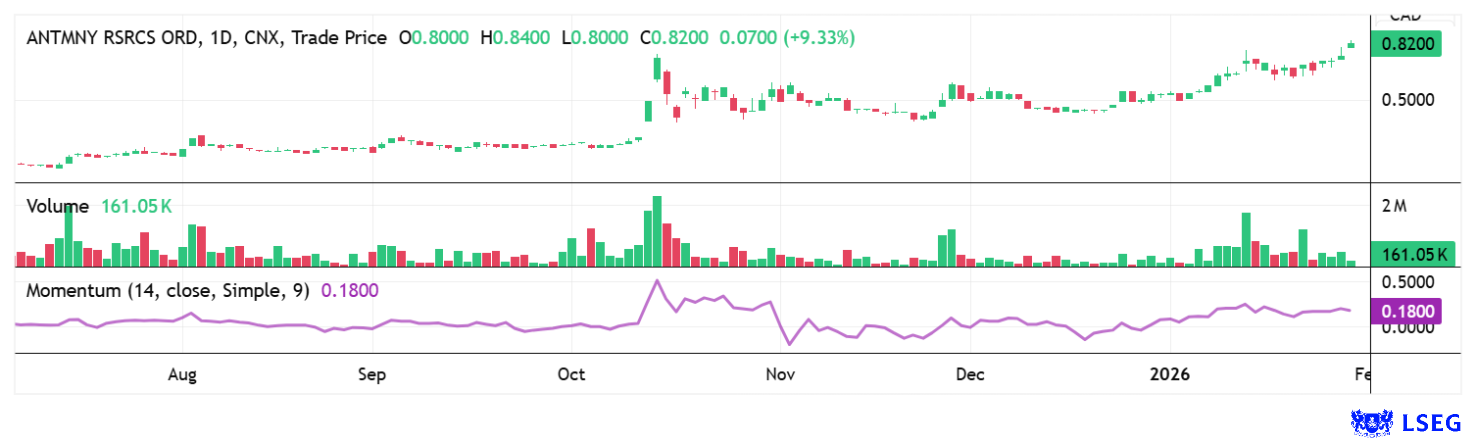
In the current environment, there are striking parallels to be observed in the commodities market. The upstream trends in the defense sector and in major economic waves such as renewable energy and e-mobility, are important. Under the regime of geopolitical upheaval, commodity markets must ensure a supply that is unilaterally restricted by China, the largest producer. Some have noted that tungsten is much rarer than previously thought. Now, attention is also turning to the long-neglected metal antimony. With Antimony Resources, the train is just leaving the station. And this time, it is even on schedule!
Conflict of interest
Pursuant to §85 of the German Securities Trading Act (WpHG), we point out that Apaton Finance GmbH as well as partners, authors or employees of Apaton Finance GmbH (hereinafter referred to as "Relevant Persons") currently hold or hold shares or other financial instruments of the aforementioned companies and speculate on their price developments. In this respect, they intend to sell or acquire shares or other financial instruments of the companies (hereinafter each referred to as a "Transaction"). Transactions may thereby influence the respective price of the shares or other financial instruments of the Company.
In this respect, there is a concrete conflict of interest in the reporting on the companies.
In addition, Apaton Finance GmbH is active in the context of the preparation and publication of the reporting in paid contractual relationships.
For this reason, there is also a concrete conflict of interest.
The above information on existing conflicts of interest applies to all types and forms of publication used by Apaton Finance GmbH for publications on companies.
Risk notice
Apaton Finance GmbH offers editors, agencies and companies the opportunity to publish commentaries, interviews, summaries, news and the like on news.financial. These contents are exclusively for the information of the readers and do not represent any call to action or recommendations, neither explicitly nor implicitly they are to be understood as an assurance of possible price developments. The contents do not replace individual expert investment advice and do not constitute an offer to sell the discussed share(s) or other financial instruments, nor an invitation to buy or sell such.
The content is expressly not a financial analysis, but a journalistic or advertising text. Readers or users who make investment decisions or carry out transactions on the basis of the information provided here do so entirely at their own risk. No contractual relationship is established between Apaton Finance GmbH and its readers or the users of its offers, as our information only refers to the company and not to the investment decision of the reader or user.
The acquisition of financial instruments involves high risks, which can lead to the total loss of the invested capital. The information published by Apaton Finance GmbH and its authors is based on careful research. Nevertheless, no liability is assumed for financial losses or a content-related guarantee for the topicality, correctness, appropriateness and completeness of the content provided here. Please also note our Terms of use.