February 4th, 2026 | 07:30 CET
History repeats itself: Why Antimony Resources now offers the Lynas Rare Earths opportunity of 2010 and could benefit like Cameco
There are moments when geopolitical ruptures disrupt entire industries. Anyone who remembers 2010 knows what we are talking about: at that time, China effectively shut down exports of rare earths amid a dispute over the Senkaku Islands. Western industry was in shock, prices exploded, and a small, hitherto little-noticed Australian explorer named Lynas Rare Earths became the Western world's only hope overnight. Today, 15 years later, we are experiencing déjà vu: this time, however, the focus is not on neodymium, but on antimony – the forgotten metal without which the defense industry would grind to a halt. Once again, China dominates the market, once again export restrictions are being used as a political weapon, and once again the West is desperately searching for a safe alternative. This is where Antimony Resources comes into play. The company is now at exactly the same point where Lynas was before its legendary rise: it controls an antimony project in a secure jurisdiction that can break dependence on the East.
time to read: 3 minutes | Author: Nico Popp
ISIN: ANTIMONY RESOURCES CORP | CA0369271014 , LYNAS CORP. LTD | AU000000LYC6 , CAMECO CORP. | CA13321L1085
Table of contents:
Author

Nico Popp
At home in Southern Germany, the passionate stock exchange expert has been accompanying the capital markets for about twenty years. With a soft spot for smaller companies, he is constantly on the lookout for exciting investment stories.
Tag cloud
Shares cloud
The Lynas paradigm: When security of supply dictates the price
To understand the scale of the opportunity at Antimony Resources, it is worth taking a look back. Before the 2010 crisis, Lynas was a speculative penny stock with a project in Australia. When China blocked exports, profitability became secondary - it was about security of supply and national interests. Japanese trading houses and other investors pumped capital into building Lynas, not because it was the cheapest option, but because it was the only option.
Lynas' share price exploded as the market no longer valued just the ore in the ground, but priced in a geopolitical premium. We are seeing something similar today with Cameco in the uranium sector: Western security of supply is trading at a massive premium to producers from Kazakhstan or Russia. This revaluation is likely still ahead for the antimony sector.
Antimony: The new lubricant of geopolitics
Why is antimony suddenly so important? The silvery-white semi-metal is indispensable for modern warfare. It is used to harden lead in ammunition and is found in armor-piercing projectiles, night vision devices, and infrared sensors. Without antimony, there would be no precision optics and no high-tech weapons.
But this dependence is fatal: China controls over 48% of global production and almost completely dominates processing. As recent reports confirm, Beijing has already introduced export restrictions, which are likely to cause massive unrest in the corridors of the Pentagon in Washington. Stocks are low, and alternative sources in Russia (due to sanctions) or Tajikistan (due to Chinese influence) are not an option for the West. The market is calling for a "NATO-compatible" supply chain for the sought-after semi-metal.
Antimony Resources: The strategic reserve in the West
This is precisely where Antimony Resources positions itself as the logical heir to the Lynas story. The company is not focusing on exotic adventures, but is developing the "Bald Hill Project" in the Canadian province of New Brunswick. For investors, this location is the decisive argument: Canada is one of the safest mining jurisdictions in the world, with an established legal system and direct logistical links to US industry.
The project itself has historical data that indicates high-grade deposits. Antimony Resources has confirmed and even exceeded this data with its work to date. Unlike many explorers who still have to spend years searching for a vein, Antimony Resources is working on a known system that is now being expanded and defined using modern methods. The goal is clear: to establish a domestic antimony source that can deliver independently of Beijing's whims.
Antimony as a hedge for your portfolio
The parallels to 2010 are striking. Back then, there were also doubts as to whether a Western producer could compete with cheap competition from China. But history has shown that when supply chains break down, price plays a secondary role. Antimony Resources thus offers protection against further fragmentation of the global economy. In addition, the high grades at Bald Hill do not exactly suggest that production costs will not be competitive.
While Lynas is now a billion-dollar corporation, Antimony Resources is still at the very beginning of this curve. The company is currently still valued like a classic explorer, but at its core, it offers the opportunity to develop Bald Hill into one of the best Western antimony mines. Since antimony is also needed in flame retardants and increasingly in liquid metal batteries for the energy transition, demand is based on two robust pillars: defense and green energy.
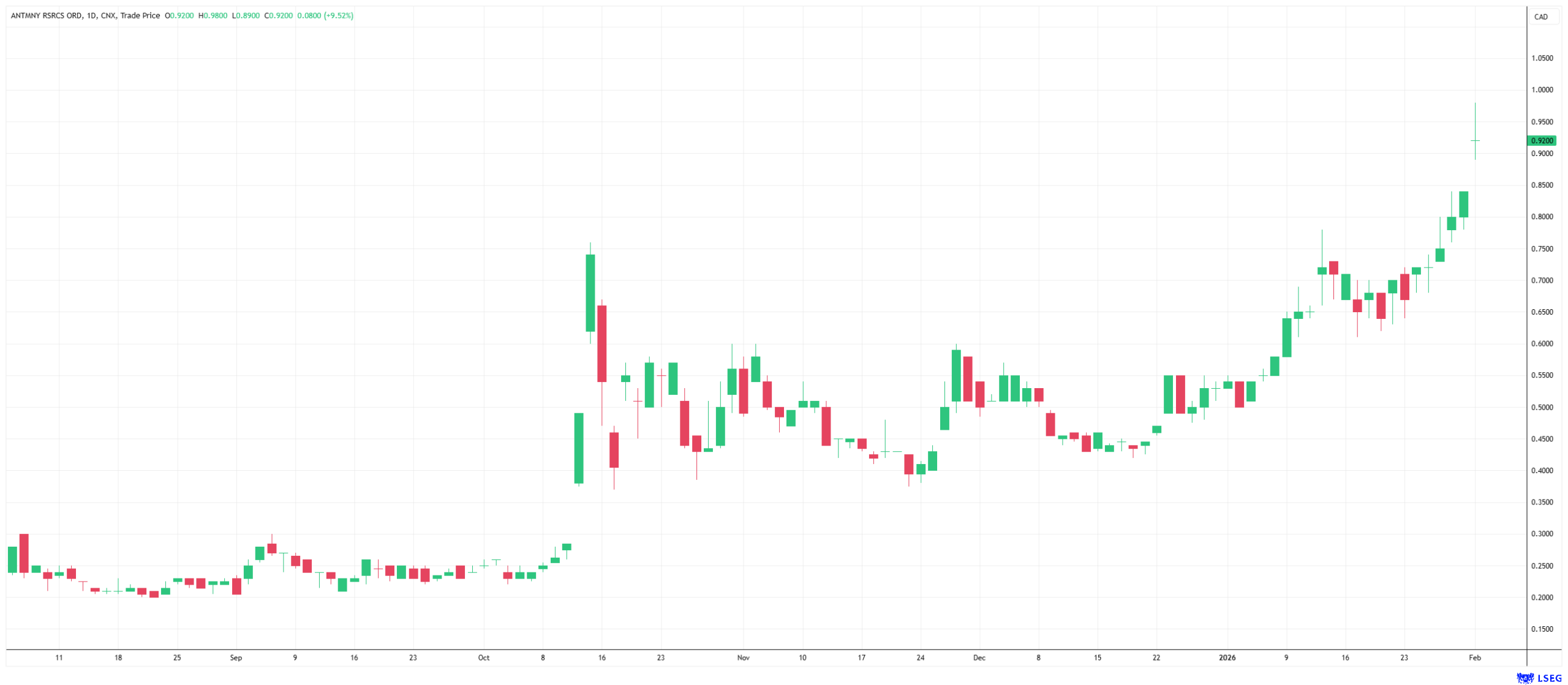
Antimony Resources is on a roll – The stock is skyrocketing
History rarely repeats itself exactly, but it often rhymes. Antimony Resources is in the same starting position as Lynas was in 2009: a small company with the right asset at the right time. The risk of exploration remains, and as with any junior stock, volatility is guaranteed. However, for speculative investors, this offers a rare opportunity to accompany a structural reorganization of the commodities market from the very beginning. Anyone who believes that the West must end its dependence on China for critical metals will find Antimony Resources to be the right stock.
Watch YouTube videoConflict of interest
Pursuant to §85 of the German Securities Trading Act (WpHG), we point out that Apaton Finance GmbH as well as partners, authors or employees of Apaton Finance GmbH (hereinafter referred to as "Relevant Persons") currently hold or hold shares or other financial instruments of the aforementioned companies and speculate on their price developments. In this respect, they intend to sell or acquire shares or other financial instruments of the companies (hereinafter each referred to as a "Transaction"). Transactions may thereby influence the respective price of the shares or other financial instruments of the Company.
In this respect, there is a concrete conflict of interest in the reporting on the companies.
In addition, Apaton Finance GmbH is active in the context of the preparation and publication of the reporting in paid contractual relationships.
For this reason, there is also a concrete conflict of interest.
The above information on existing conflicts of interest applies to all types and forms of publication used by Apaton Finance GmbH for publications on companies.
Risk notice
Apaton Finance GmbH offers editors, agencies and companies the opportunity to publish commentaries, interviews, summaries, news and the like on news.financial. These contents are exclusively for the information of the readers and do not represent any call to action or recommendations, neither explicitly nor implicitly they are to be understood as an assurance of possible price developments. The contents do not replace individual expert investment advice and do not constitute an offer to sell the discussed share(s) or other financial instruments, nor an invitation to buy or sell such.
The content is expressly not a financial analysis, but a journalistic or advertising text. Readers or users who make investment decisions or carry out transactions on the basis of the information provided here do so entirely at their own risk. No contractual relationship is established between Apaton Finance GmbH and its readers or the users of its offers, as our information only refers to the company and not to the investment decision of the reader or user.
The acquisition of financial instruments involves high risks, which can lead to the total loss of the invested capital. The information published by Apaton Finance GmbH and its authors is based on careful research. Nevertheless, no liability is assumed for financial losses or a content-related guarantee for the topicality, correctness, appropriateness and completeness of the content provided here. Please also note our Terms of use.