January 16th, 2026 | 07:20 CET
Green Capital 2.0: How RE Royalties is closing the gap between Hannon Armstrong and Altius
The end of cheap money is forcing wind and solar park developers into a new reality: traditional banks are withdrawing from risk financing, but the investment pressure for the energy transition remains high. Specialized royalty financiers are stepping into this vacuum. While established players such as Hannon Armstrong and Altius Renewable Royalties already dominate this segment, the still largely undiscovered player RE Royalties now offers investors the opportunity to be at the beginning of a similar growth curve. The massive gap between developers' capital requirements and what banks have to offer is the ideal breeding ground for this business model.
time to read: 4 minutes | Author: Nico Popp
ISIN: RE ROYALTIES LTD | CA75527Q1081 , HA SUSTAINABLE INFRASTRUCTURE CAPITAL INC | US41068X1000 , ALTIUS MINERALS CORP | CA0209361009
Table of contents:
Author

Nico Popp
At home in Southern Germany, the passionate stock exchange expert has been accompanying the capital markets for about twenty years. With a soft spot for smaller companies, he is constantly on the lookout for exciting investment stories.
Tag cloud
Shares cloud
Bank withdrawal and capital gap favor the royalty model
To fully grasp the potential of RE Royalties, one must first analyze the macroeconomic environment, which, according to recent reports by the International Energy Agency (IEA) and McKinsey, calls for a dramatic expansion of investment. Experts agree: to achieve global climate targets by 2050, annual investments in clean energy must triple. But it is precisely at this moment of greatest need that the traditional banking sector is falling short, as stricter capital requirements and rising risk aversion are severely limiting lending to projects in the development stage.
This creates an existential dilemma for project developers. Equity has become extremely expensive due to lower valuations in the sector, leading to painful dilution for existing shareholders. Debt capital is often simply unavailable or burdened with covenants that restrict operational flexibility. In this structural bottleneck, flexible royalty financing proves to be the decisive problem solver, as it provides liquidity without diluting shares or dictating rigid repayment plans. This is the ideal breeding ground in which companies like RE Royalties can thrive, as they exchange capital for a percentage share of the gross revenue of projects by relying on the royalty model.
Altius and Apollo: The accolade for the business model
A look at Altius Renewable Royalties proves that this model is no longer just a niche phenomenon, but has arrived at the center of professional investors' attention. The Company has made a mark through its strategic partnership with private equity giant Apollo Global Management. The establishment of the Great Bay Renewables joint venture impressively demonstrates that the royalty model is fully accepted and validated by institutions in the renewable energy sector.
Apollo, one of the world's best-known asset managers, does not invest in experiments, but in calculable returns. The royalty model offers exactly that: direct access to revenue from electricity production before operating costs or debt must be serviced. Large investors are desperately seeking these stable, inflation-protected cash flows, such as those generated by Altius through royalties on clean electricity, as they have a low correlation with volatile stock markets. Altius has shown that this approach can mobilize a lot of capital. For RE Royalties, the success of its "big brother" is the best advertisement, as it validates the business model for the broader market.
Hannon Armstrong: Proof of scalability
While Altius proves the quality of the model, Hannon Armstrong Sustainable Infrastructure in the US shows how enormously scalable specialized "climate financiers" are. Hannon operates more like a mortgage REIT for green energy, but the underlying logic is identical: it finances the gap left by banks. According to current data from Investing.com, the Company reported record earnings per share in the third quarter of 2025. The impressive 15% year-on-year growth in assets under management proves that the market for specialized energy financing is deep enough to allocate billions of dollars efficiently.
Hannon Armstrong is valued at around USD 4.2 billion on the stock market because the Company has proven that it can act as the financier of choice for the largest developers in the US. Recurring revenues enable an attractive dividend policy and steady organic growth. Investors reward this dominance with a premium multiple, making Hannon Armstrong the blueprint for any aspiring financier in this sector. But it is precisely this high valuation that makes entry expensive for new investors – and draws attention to cheaper alternatives.
RE Royalties: The sweet spot for investors
RE Royalties is positioned precisely in the lucrative gap between the billion-dollar players and the capital-hungry project developers. The Canadian company operates in an area that is often too small and granular for Hannon Armstrong, but too complex for traditional banks. With a growing portfolio, the Company offers investors the opportunity to invest early in a business model that combines the proven scalability of Hannon Armstrong with the attractive margins of Altius. Just at the beginning of January, RE Royalties announced further investments in solar energy in California.
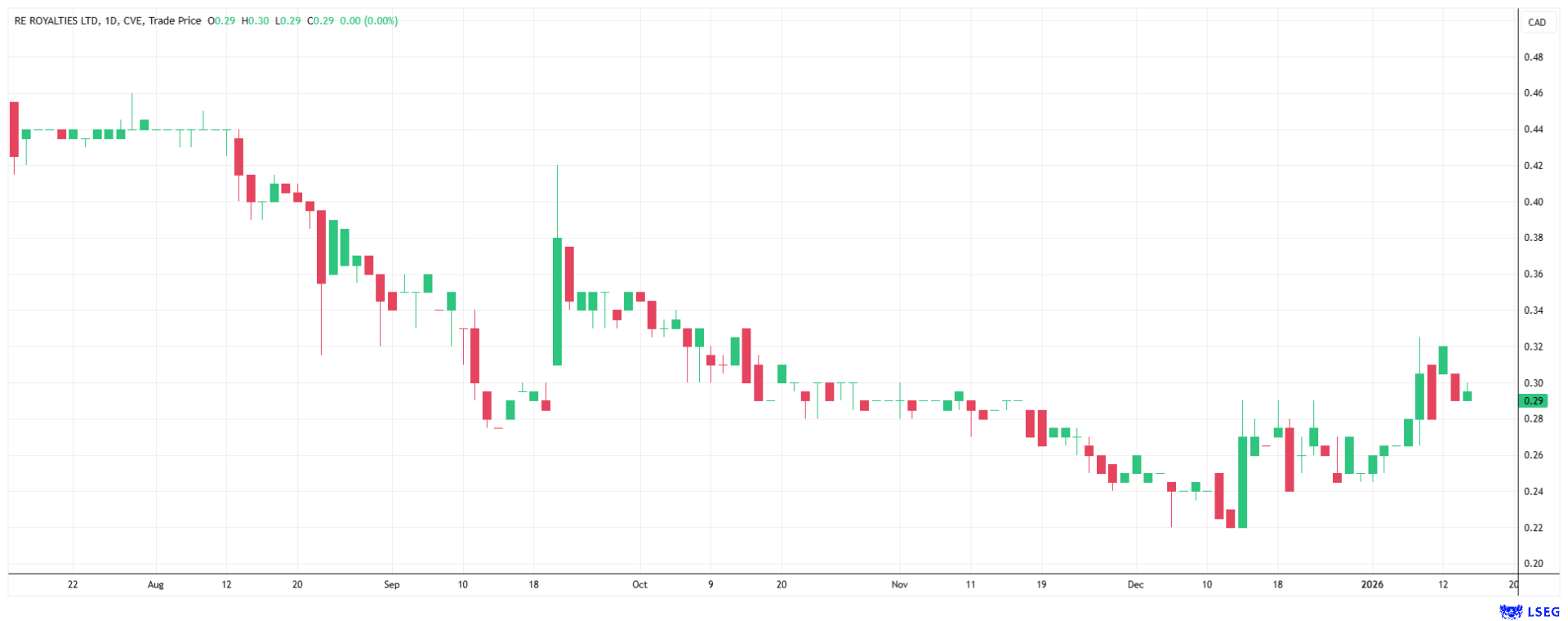
RE Royalties buys royalties from small to medium-sized developers who often have excellent projects but do not have good access to the capital market. This strategy allows RE Royalties to negotiate terms that promise above-average returns. The portfolio is already remarkably diversified, ranging from solar projects in North America to wind farms in Europe, which minimizes cluster risk and ensures a steady stream of income from different jurisdictions and currency areas. Unlike a project developer, RE Royalties does not bear the risk of cost overruns during construction or technical defects during operation – the royalty flows as soon as the electricity flows. These are also good conditions for RE Royalties shareholders – thanks to the quarterly dividend of CAD 0.01, the stock offers attractive distributions in addition to price potential.
Watch YouTube videoConflict of interest
Pursuant to §85 of the German Securities Trading Act (WpHG), we point out that Apaton Finance GmbH as well as partners, authors or employees of Apaton Finance GmbH (hereinafter referred to as "Relevant Persons") may hold shares or other financial instruments of the aforementioned companies in the future or may bet on rising or falling prices and thus a conflict of interest may arise in the future. The Relevant Persons reserve the right to buy or sell shares or other financial instruments of the Company at any time (hereinafter each a "Transaction"). Transactions may, under certain circumstances, influence the respective price of the shares or other financial instruments of the Company.
In addition, Apaton Finance GmbH is active in the context of the preparation and publication of the reporting in paid contractual relationships.
For this reason, there is a concrete conflict of interest.
The above information on existing conflicts of interest applies to all types and forms of publication used by Apaton Finance GmbH for publications on companies.
Risk notice
Apaton Finance GmbH offers editors, agencies and companies the opportunity to publish commentaries, interviews, summaries, news and the like on news.financial. These contents are exclusively for the information of the readers and do not represent any call to action or recommendations, neither explicitly nor implicitly they are to be understood as an assurance of possible price developments. The contents do not replace individual expert investment advice and do not constitute an offer to sell the discussed share(s) or other financial instruments, nor an invitation to buy or sell such.
The content is expressly not a financial analysis, but a journalistic or advertising text. Readers or users who make investment decisions or carry out transactions on the basis of the information provided here do so entirely at their own risk. No contractual relationship is established between Apaton Finance GmbH and its readers or the users of its offers, as our information only refers to the company and not to the investment decision of the reader or user.
The acquisition of financial instruments involves high risks, which can lead to the total loss of the invested capital. The information published by Apaton Finance GmbH and its authors is based on careful research. Nevertheless, no liability is assumed for financial losses or a content-related guarantee for the topicality, correctness, appropriateness and completeness of the content provided here. Please also note our Terms of use.