May 4th, 2026 | 07:05 CEST
Geopolitical Front Lines Redrawn: Why HPQ Silicon, DroneShield, SAP, and Oracle Are Now Indispensable for Investors
After 12 months of extreme volatility and uncertainty, one thing is clear: the modern era is not being decided in an ivory tower, but on the front lines of geopolitical conflicts. Europe's long period of peace is over, and technology is shaping the new wars in ways never seen before. This complex situation is now shaping commodity markets, supply chains, and digital infrastructure simultaneously. Drone technology is emerging as one of the most visible fields where military requirements and industrial innovation converge directly. Battery performance determines not only range and operational capability but also the strategic strength of entire supply chains. At the same time, data specialists like SAP and Oracle are coming into focus because they provide the information and control layer on which modern states and companies operate. Those who invest with an eye on the times, therefore, look not only at weapons and energy but also at the digital infrastructure of SAP and Oracle as part of the new power architecture.
time to read: 5 minutes | Author: André Will-Laudien
ISIN: HPQ SILICON INC | CA40444L1031 | TSXV: HPQ , OTCQB: HPQFF , SAP SE O.N. | DE0007164600 , ORACLE CORP. DL-_01 | US68389X1054 , DRONESHIELD LTD | AU000000DRO2
Table of contents:
Author

André Will-Laudien
Born in Munich, he first studied economics and graduated in business administration at the Ludwig-Maximilians-University in 1995. As he was involved with the stock market at a very early stage, he now has more than 30 years of experience in the capital markets.
Tag cloud
Shares cloud
DroneShield – Heading for NATO in growth mode
The Australian defence company DroneShield is on everyone's lips. Due to widespread demand for drone defence, the company is delivering impressive growth figures and increasingly positioning itself as a specialized beneficiary of the global anti-drone boom. In Q1 2026, revenue jumped to around AUD 74 million, representing growth of over 120% year-over-year and clearly underscoring the momentum in the core business. Overall, the quarterly report signals a significantly accelerated commercialization of the technology. At the same time, the company returned to financial stability with positive operating cash flow of over AUD 24 million and is building a solid liquidity base of more than AUD 220 million. This means the Australian company can now easily fund necessary capacity adjustments from its cash flow.
At the same time, a very ambitious demand environment is emerging, with a pipeline of approximately AUD 2.2 billion spread across over 300 projects worldwide, with Europe standing out as the largest single market. This scale makes it clear that DroneShield has long since evolved from a niche provider into a major player in the global security ecosystem. The product range extends from mobile jamming systems to stationary AI-powered defence platforms, which are already in use by the thousands and are continually expanding. And scaling is also succeeding, as the company's strategy is currently shifting clearly toward recurring revenue models, particularly through software and SaaS components, which are expected to deliver a significantly more stable share of revenue in the future.
This is precisely where analysts have doubts, however, as the disruptions from the early days run deep. In 2025, the stock price had surged by 700% and then plummeted by 80% in an ad hoc announcement due to uncertainties regarding employee stock sales. So while operational momentum is convincing, governance and stability remain under critical scrutiny. The fact remains: with projected revenue of just under AUD 400 million, the valuation currently still exceeds AUD 3.3 billion. A price-to-sales (P/S) ratio of 8 is too high, even in the event of further geopolitical conflicts. However, if a bridge can be built between growth and credibility, DroneShield will likely remain one of the most exciting pure-play beneficiaries of the new security technology landscape.
Soaring with substance: How HPQ is electrifying the drone economy
We now turn to an interesting component supplier in the drone business, because the new industrial value chain starts with the battery! The Canadian company HPQ Silicon epitomizes the shift in the energy sector away from the volume market toward highly specialized performance niches. With energy densities of up to 395 Wh/kg at the pack level and capacities of 15,900 mAh, the company targets precisely those applications where every gram and every minute of flight time counts.
The first commercial order from the European drone sector consequently marks the transition from the lab to a monetizable reality. This development typically triggers a revaluation of a technology's worth. In recent years, HPQ Silicon has quietly but consistently transformed itself from a pure raw materials supplier into a technology-driven multi-asset player whose strategic focus is clearly aimed at high-margin specialty applications. At the heart of this is the consistent further development of silicon-based anode materials, which enable a significant leap in capacity compared to traditional graphite solutions and thus address one of the key bottlenecks in modern energy storage.
The latest performance data from the fourth-generation batteries indicate that HPQ is not only keeping pace technologically but can also claim a leading role in selected parameters. Capacities exceeding 7,000 mAh in cylindrical cells, along with minimal degradation rates in the early-cycle range, point to a robust material architecture that delivers stability even under demanding conditions. A particularly dynamic application area is emerging in the drone sector, which is increasingly becoming a strategic spearhead for HPQ. Here, high energy density meets a low weight of just 1.16 kg—precisely the parameters where GEN4 technology plays to its strengths.
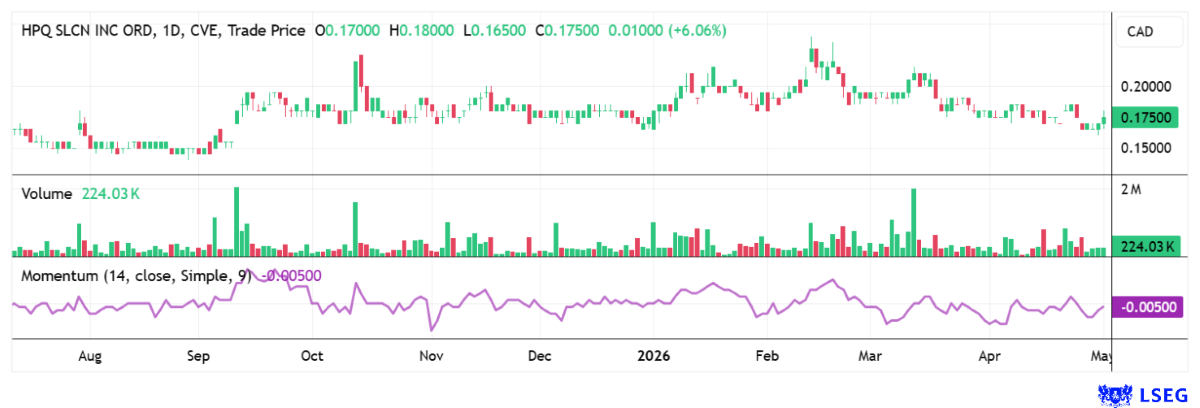
Strategically noteworthy is the decision to deliberately target niche markets with high willingness to pay, rather than getting lost in the price-sensitive mass market for electric mobility. Particularly in the defence and industrial segments, performance parameters can be monetized more effectively, which improves the margin structure in the long term. At the same time, HPQ secures additional control over value creation through exclusive marketing rights in North America. The partnership with French developer Novacium serves as a technological lever that encompasses not only battery materials but also adjacent fields of innovation, such as alternative hydrogen production. With a valuation of approximately CAD 80 million, the capital market has so far reflected this potential only to a very limited extent. An entry between CAD 0.18 and CAD 0.20 appears opportune! The stock is also trading in Frankfurt with good trading volumes.
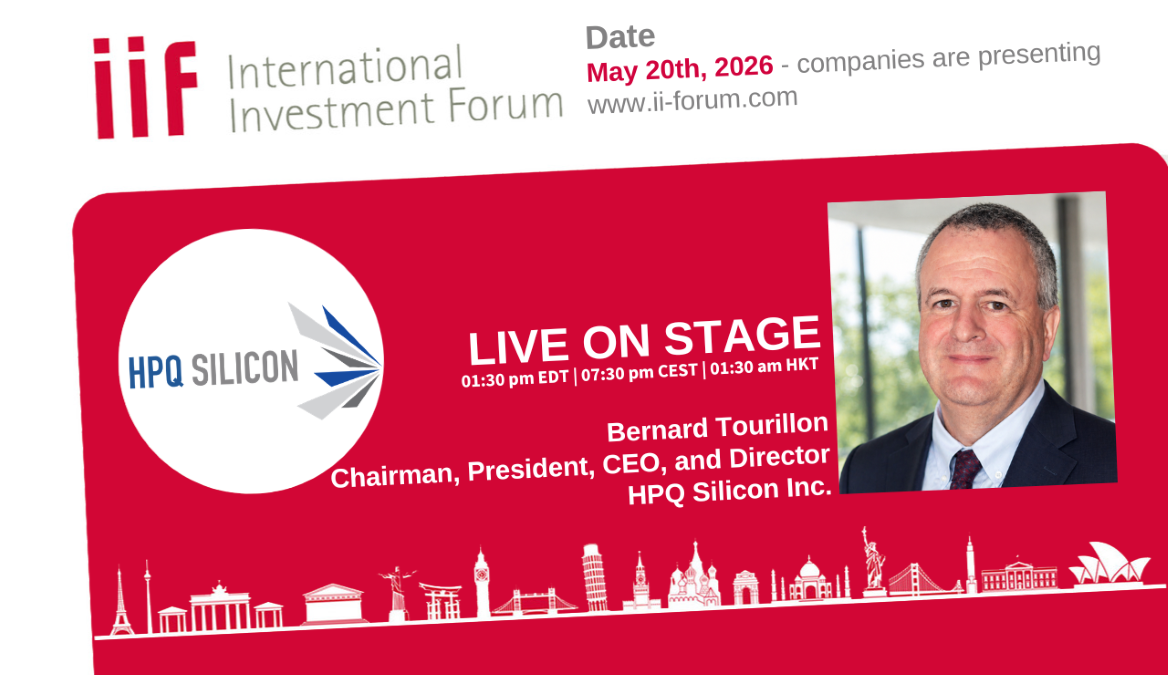
Chairman, President, CEO and Director Bernard Trouillon will present the company in Europe for the first time at the 19th International Investment Forum. Click here to register.
Oracle and SAP - Cloud Giants in Repricing Mode
Data managers and AI experts like Oracle and SAP are also part of the central storm blowing coldly from the cyber corner. Oracle's shares have recently been on a rollercoaster ride. With a sharp price jump of over 10%, a classic short-covering and rebound scenario was even triggered last week, after the stock had previously come under significant pressure amid AI consolidation. The trigger was new AI and cloud updates, including developments related to Aconex, which the market interpreted as a sign that Oracle is driving its platform strategy more dynamically than had recently been priced in. The previous upward exaggeration was followed by a sharp correction, during which over-positioning and unrealistic valuation expectations were largely unwound. The stock price is now likely to stabilize again.
SAP, on the other hand, is in a significantly longer downtrend that has halved the price from around EUR 275 to about EUR 145, reflecting a noticeable revaluation of the European software blue chip. Despite stable fundamentals, market participants are focusing primarily on the slower pace of cloud and AI expansion, leading to valuation discounts relative to US competitors. Nevertheless, the expected earnings growth, with a rise to around EUR 7.19 per share at a 2026 P/E ratio of just under 20, suggests a rather moderate valuation. SAP is holding its Annual General Meeting tomorrow; it will be interesting to see what outlook CEO Christian Klein presents to the market. SAP is historically undervalued; analysts on the LSEG Refinitiv platform expect a 50% rise in just 12 months!
The stock markets currently have a lot on their plate. While HPQ Silicon and DroneShield are advancing the physical foundations of modern drone and defence applications, SAP and Oracle act as digital control centers that generate actionable real-time intelligence from the resulting data streams. All in all, this creates an interesting portfolio mix of hardware performance, security-critical applications, and data-driven control. These are all areas that have proven to be structurally growing in recent times.
Conflict of interest
Pursuant to §85 of the German Securities Trading Act (WpHG), we point out that Apaton Finance GmbH as well as partners, authors or employees of Apaton Finance GmbH (hereinafter referred to as "Relevant Persons") currently hold or hold shares or other financial instruments of the aforementioned companies and speculate on their price developments. In this respect, they intend to sell or acquire shares or other financial instruments of the companies (hereinafter each referred to as a "Transaction"). Transactions may thereby influence the respective price of the shares or other financial instruments of the Company.
In this respect, there is a concrete conflict of interest in the reporting on the companies.
In addition, Apaton Finance GmbH is active in the context of the preparation and publication of the reporting in paid contractual relationships.
For this reason, there is also a concrete conflict of interest.
The above information on existing conflicts of interest applies to all types and forms of publication used by Apaton Finance GmbH for publications on companies.
Risk notice
Apaton Finance GmbH offers editors, agencies and companies the opportunity to publish commentaries, interviews, summaries, news and the like on news.financial. These contents are exclusively for the information of the readers and do not represent any call to action or recommendations, neither explicitly nor implicitly they are to be understood as an assurance of possible price developments. The contents do not replace individual expert investment advice and do not constitute an offer to sell the discussed share(s) or other financial instruments, nor an invitation to buy or sell such.
The content is expressly not a financial analysis, but a journalistic or advertising text. Readers or users who make investment decisions or carry out transactions on the basis of the information provided here do so entirely at their own risk. No contractual relationship is established between Apaton Finance GmbH and its readers or the users of its offers, as our information only refers to the company and not to the investment decision of the reader or user.
The acquisition of financial instruments involves high risks, which can lead to the total loss of the invested capital. The information published by Apaton Finance GmbH and its authors is based on careful research. Nevertheless, no liability is assumed for financial losses or a content-related guarantee for the topicality, correctness, appropriateness and completeness of the content provided here. Please also note our Terms of use.